

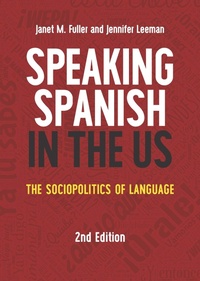
Speaking Spanish in the US
The Sociopolitics of Language
2nd Edition
Published on 2. June 2020
Book
Hardback
344 pages
978-1-78892-828-1 (ISBN)
Description
A sociolinguistics textbook examining how Spanish in the US is embedded in history and politics.
This book introduces readers to basic concepts of sociolinguistics with a focus on Spanish in the US. The coverage goes beyond linguistics to examine the history and politics of Spanish in the US, the relationship of language to Latinx identities, and how language ideologies and policies reflect and shape societal views of Spanish and its speakers. Accessible to those with no linguistic background, this book provides students with a foundation in the study of language and society, and the opportunity to relate theoretical concepts to Spanish in the US in a range of contexts, including everyday speech, contemporary culture, media, education and policy.
The book is a substantially revised and expanded 2nd edition of Spanish Speakers in the USA, including new chapters on the history of Spanish in the US, the demographics of Spanish in the US, and language policy; and expanded chapters on language ideologies, race, identity, media, and education.
A Spanish-language edition of this book is also available: https://www.multilingual-matters.com/page/detail/?K=9781800413931.
This book introduces readers to basic concepts of sociolinguistics with a focus on Spanish in the US. The coverage goes beyond linguistics to examine the history and politics of Spanish in the US, the relationship of language to Latinx identities, and how language ideologies and policies reflect and shape societal views of Spanish and its speakers. Accessible to those with no linguistic background, this book provides students with a foundation in the study of language and society, and the opportunity to relate theoretical concepts to Spanish in the US in a range of contexts, including everyday speech, contemporary culture, media, education and policy.
The book is a substantially revised and expanded 2nd edition of Spanish Speakers in the USA, including new chapters on the history of Spanish in the US, the demographics of Spanish in the US, and language policy; and expanded chapters on language ideologies, race, identity, media, and education.
A Spanish-language edition of this book is also available: https://www.multilingual-matters.com/page/detail/?K=9781800413931.
Reviews / Votes
Adopting a thoroughly interdisciplinary, critical and social constructionist approach, Fuller and Leeman make tremendous strides in teasing out the myriad ethnoracial, geopolitical and sociocultural foundations that affect Spanish speakers in being counted, educated and cared for in US society. This book will undoubtedly become a cornerstone in the formation of the next generation of scholars and activists dedicated to the study of Spanish in the US. * Glenn A. Martinez, The Ohio State University, USA * Speaking Spanish in the US is an insightful, accessible, and wide-ranging book that provides a critical counterforce to contemporary discourse that criminalizes Latinx Spanish-speakers and their linguistic practices, showing definitively that Latinx people are now and have always been a vital part of US sociocultural and political economic life. * Hilary Parsons Dick, Arcadia University, USA * A significant contribution to the study of language in society, this book challenges readers to consider the social and political meanings of speaking Spanish in the United States [...] The inclusion of key terminology, discussion questions, and resources for further reading make this book an ideal text for courses in linguistics, language studies, and a number of other disciplines. -- Carlo Cinaglia, Michigan State University, USA * Language in Society 50 (2021) * Educators, scholars, and students of linguistics, Hispanic linguistics, and Latino studies, as well as academics in other fields and nonacademics interested in the state of Spanish in the US would benefit tremendously from reading this text, as it intertwines many threads quite masterfully and clearly develops how to use an interdisciplinary critical sociopolitical approach to integrate language, identity, and linguistic ideology into teaching and social justice. -- Michelle F. Ramos Pellicia, California State University San Marcos, USA * Latino Studies, 2021 * Speaking Spanish in the US es, desde ya, un hito en los estudios sobre la lengua espanola en los Estados Unidos. Marca el camino, o los caminos, a seguir. -- Silvia Betti, Universita di Bologna, Italia * Hispania, Volume 104, Number 3, September 2021 * Este libro es una publicacio?n sumamente interesante para aprender y reflexionar acerca del contexto social, poli?tico e ideolo?gico del espan?ol en los Estados Unidos en la actualidad y tambie?n acerca de las condiciones histo?ricas y otros antecedentes que han moldeado esa situacio?n [...] es altamente recomendable para estudiantes o para investigadores que precisen de referencias sobre temas particulares concernientes al espan?ol. -- Claudia Crespo del Rio, Pontificia Universidad Catolica del Peru * Infoling 6.24 (2021) * En definitiva, Speaking Spanish in the US muestra las realidades sociolingu?i?sticas del espan?ol en EEUU, visibilizando la diversidad de la comunidad latinx y su relevancia en la historia, sociedad y desarrollo econo?mico de este pai?s. Es un libro accesible para estudiantes e investigadores que no tienen formacio?n especializada en los estudios sobre lenguaje en su contexto sociocultural; sin embargo, tambie?n constituye un estudio de largo alcance que indaga perspicazmente las causas etno- racionales, geopoli?ticas, ideolo?gicas y sociales que subyacen en el discurso que degrada a los hispanohablantes y a sus pra?cticas lingu?i?sticas. -- Gabriela Prego-Vazquez, Universidade de Santiago de Compostela, Spain * Discurso & Sociedad, Vol.15(4), 2021 * This book is a must-read for researchers, teachers and students of sociolinguistics, sociology of language, linguistic and cultural anthropology, and anyone who is interested in multilingual discourse, bilingual education, and in the relationship between language and worldviews, identity performance, public policy or racialization processes, among many other up-to-date issues concerning language use in the US. -- Marcela Altamira, National University of Cordoba, Argentina * Spanish in Context, 2022 * I will plan to use this textbook for my general education-level students, and I would recommend it to instructors teaching courses on the sociopolitics of Spanish in the US; it takes on an ambitious array of potentially sprawling topics in an interesting, focused, and accessible way. This work lives up to its promise, providing a valuable, complex approach to a compelling topic that is of critical importance to higher education in today's political landscape. -- Anna Babel, The Ohio State University, USA * Journal of Spanish Language Teaching, 2021 * The book is clearly organized and would make an engaging text for a course on Spanish in the U.S. or courses that study the intersection of politics and language. Students of many interrelated disciplines could benefit from this book, as well as Spanish instructors who are ready to implement critical pedagogy in their courses and would like inspiration for where to start. -- Mary Hudgens Henderson, Winona State University, USA * Spanish as a Heritage Language Vol. 1 No. 1, 2021 * This volume is an important addition to the growing body of linguistic research on the oldest European language spoken in what is now the United States. Its focus on the social and political realities of Spanish speakers, as opposed to structural aspects of the language itself, sets it somewhat apart from other studies. While some book-length treatises do mention the sociopolitical dimensions in which Spanish exists, none deals with these as a principal theme. -- Daniel Villa, New Mexico State University, USA * Journal of Multilingual and Multicultural Development, 2021 *More details
Series
Edition
2nd edition
Language
English
Place of publication
Bristol
United Kingdom
Target group
College/higher education
Dimensions
Height: 251 mm
Width: 179 mm
Thickness: 23 mm
Weight
788 gr
ISBN-13
978-1-78892-828-1 (9781788928281)
Copyright in bibliographic data and cover images is held by Nielsen Book Services Limited or by the publishers or by their respective licensors: all rights reserved.
Schweitzer Classification
Other editions
Additional editions
Book
06/2020
2nd Edition
Multilingual Matters
€48.50
Shipment within 3-4 weeks
Persons
Janet M. Fuller is Professor of Language and Society in the Department of European Languages and Cultures, University of Groningen, the Netherlands. Her research interests include multilingualism, language ideologies and social identities.
Jennifer Leeman is Professor of Hispanic Linguistics in the Department of Modern and Classical Languages, George Mason University, USA. Her research interests include language ideologies, census questions on language and ethnoracial identity, and critical pedagogical approaches to teaching Spanish for heritage speakers.
Jennifer Leeman is Professor of Hispanic Linguistics in the Department of Modern and Classical Languages, George Mason University, USA. Her research interests include language ideologies, census questions on language and ethnoracial identity, and critical pedagogical approaches to teaching Spanish for heritage speakers.
Content
Chapter 1. An Introduction to Speaking Spanish in the US
Chapter 2. The Demographics of Spanish in the US
Chapter 3. The History of Spanish and Spanish Speakers in the US
Chapter 4. Language Ideologies
Chapter 5. "Race", Racialization, and Latinx Ethnoracial Identity
Chapter 6. Language and Identity
Chapter 7. Media Representations of and for Spanish Speakers in the US
Chapter 8. Language Policy and Spanish in the US
Chapter 9. Spanish in US Schools
Chapter 10. Structural Aspects of Speaking Spanish in the US
Chapter 11. The Future of Spanish in the US
Chapter 2. The Demographics of Spanish in the US
Chapter 3. The History of Spanish and Spanish Speakers in the US
Chapter 4. Language Ideologies
Chapter 5. "Race", Racialization, and Latinx Ethnoracial Identity
Chapter 6. Language and Identity
Chapter 7. Media Representations of and for Spanish Speakers in the US
Chapter 8. Language Policy and Spanish in the US
Chapter 9. Spanish in US Schools
Chapter 10. Structural Aspects of Speaking Spanish in the US
Chapter 11. The Future of Spanish in the US