

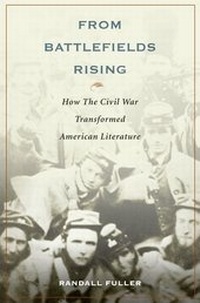
From Battlefields Rising
How The Civil War Transformed American Literature
1st Edition
Published on 3. February 2011
Book
Hardback
272 pages
978-0-19-534230-7 (ISBN)
Description
This book considers the effects of the American civil war on those writers and artists who helped their young nation imagine itself. the writers and artists of the early to mid-nineteenth century. One of the war's many traumas was the pain of witnessing the disintegration of a symbolic order they had helped construct in previous decades. If Emerson, Whitman, Hawthorne and Melville grounded their writing on a coherent national myth, aimed at a familiar audience, the
civil war challenged every prior presumption and called on the writers to confront novel exigencies with a suitable new style and form. Put another way, it forced them to engage anew with the language and symbols that had shaped America's previous conception of itself. As a result, poetry became
more important for Emerson and Melville, while the prose form re-emerged in Whitman's undervalued Memoranda During the War. It energized the poetry of Emily Dickinson and seemed to silence Hawthorne, who could no longer organize romance amid the wartime reports he read and the military camps he visited.
Fuller shows how the war shaped and influenced poetic language and narrative during a time of full scale national crisis. In so doing, his book takes up where very few literary historians have previously ventured. Seeking to change the way scholars and students read the late work of major writers such as Hawthorne, Emerson, and Melville, this study challenges easy conclusions and earlier notions about the differences between ante- and postbellum writing. It uncovers a host of continuities
extending from the 'Romantic' to the 'Realist' periods of American writing while also revealing previously unseen ruptures and tensions within the work of individual writers. It offers a literary history from the era that forever changed America's early idealism into something rawer-and something more
American-that set the stage for a new model of literary social engagement and experimentation.
civil war challenged every prior presumption and called on the writers to confront novel exigencies with a suitable new style and form. Put another way, it forced them to engage anew with the language and symbols that had shaped America's previous conception of itself. As a result, poetry became
more important for Emerson and Melville, while the prose form re-emerged in Whitman's undervalued Memoranda During the War. It energized the poetry of Emily Dickinson and seemed to silence Hawthorne, who could no longer organize romance amid the wartime reports he read and the military camps he visited.
Fuller shows how the war shaped and influenced poetic language and narrative during a time of full scale national crisis. In so doing, his book takes up where very few literary historians have previously ventured. Seeking to change the way scholars and students read the late work of major writers such as Hawthorne, Emerson, and Melville, this study challenges easy conclusions and earlier notions about the differences between ante- and postbellum writing. It uncovers a host of continuities
extending from the 'Romantic' to the 'Realist' periods of American writing while also revealing previously unseen ruptures and tensions within the work of individual writers. It offers a literary history from the era that forever changed America's early idealism into something rawer-and something more
American-that set the stage for a new model of literary social engagement and experimentation.
Reviews / Votes
"When the volcano of Civil War erupted in 1861, American literature had already achieved maturity in the writings of Emerson, Melville, Whitman, Hawthorne, and others. All of them, plus new voices like Emily Dickinson, tried to understand and express the profound meaning of the war in their writings, which Randall Fuller skillfully dissects in this original and incisive volume."--James M. McPherson, author of Battle Cry of Freedom"In this lucid and insightful work, Randall Fuller probes the creative and intellectual responses of some of the nation's greatest writers to the Civil War. The result is a luminous and revealing portrait of American literary culture in a period of volcanic eruption."--Louis P. Masur, author of The Civil War: A Concise History
"This is a beautiful, powerful book, uniting the pivotal event of American history with the defining literature of the nation. Fuller's account is filled with humanity, eloquence, and surprise. Anyone who reads this book will see both the Civil War and America's iconic authors with new eyes."--Edward Ayers, author of In The Presence of Mine Enemies
"Fuller's book is a moving excursion through the writers who found their language altered by the convulsions of the American Civil War. From Alcott to Emerson, Dickinson to Douglass, Melville to Hawthorne, Fuller traces connections both familiar and strange, granting careful attention to new literary configurations in the wake of war."--Shirley Samuels, author of Facing America: Iconography and the Civil War
"Highly recommended."--Library Journal
"A fresh and fascinating look not only at Melville, Emerson, Whitman, and Hawthorne but at lesser lights and the loyalties that drove them...It should stand high on any must-read list of books, old or new, as we move into the Civil War anniversary years."--The Weekly Standard
"When it comes to the Civil War, there's no poem or novel or even author who leaves us saying: This is the one who got it right, who captured what the war meant and what it felt like. Now one scholar has come up with a new angle on this very old problem. In 'From Battlefields Rising: How the Civil War Transformed American Literature,' Randall Fuller reminds us that the 1860s featured as talented a cohort of American writers as any decade could ask
for."--The Boston Globe
"An engaging story...Fuller is a gifted storyteller...Well-researched, well-written, and well worth the read."--Civil War Book Review
More details
Language
English
Place of publication
New York
United States
Target group
College/higher education
History buffs and general readers with an interest in American history and literature; readers of periodicals like The New Republic, The New York Review of Books, BookForum, and the Nation; scholars of the American Renaissance, nineteenth-century American literature; readers of scholarly journals like The Journal of American History, American Literature, ESQ, American Literary History, the Walt Whitman Quarterly Review, and Leviathan; students in courses on the Civil War and literature.
Illustrations
47 black and white halftones
Dimensions
Height: 235 mm
Width: 156 mm
Thickness: 23.6 mm
Weight
484 gr
ISBN-13
978-0-19-534230-7 (9780195342307)
Copyright in bibliographic data and cover images is held by Nielsen Book Services Limited or by the publishers or by their respective licensors: all rights reserved.
Schweitzer Classification
Other editions
Additional editions
FULLER RANDALL
From Battlefields Rising How The Civil War Transformed American Literature
How the Civil War Transformed American Literature
E-Book
02/2011
1st Edition
Oxford University Press
€8.39
Available for download
E-Book
01/2011
1st Edition
OUP eBook
€9.49
Available for download
Person
Randell Fuller is Associate Professor of English at Drury University. He is the author of Emerson's Ghosts: Literature, Politics, and the Making of Americanists (OUP 2007).
Content
INTRODUCTION: EMERSON'S DREAM; EPILOGUE. HEAVEN; END NOTES