

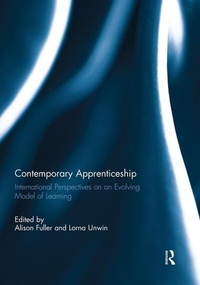
Contemporary Apprenticeship
International Perspectives on an Evolving Model of Learning
1st Edition
Published on 18. July 2015
Book
Paperback/Softback
278 pages
978-1-138-94407-7 (ISBN)
Description
Throughout the world, people understand the meaning of 'apprenticeship'. As a model of learning and skill formation, apprenticeship has adapted over the years to reflect changes in work, in technology, and in the types of knowledge that underpin occupational expertise. Apprenticeship serves the needs of government, as well as employers, individuals and society more generally. These needs have always co-existed in dynamic tension.
This book explores the contemporary state of apprenticeship in Europe, the United States, Canada, and Ghana. The chapters present perspectives from leading researchers in the field, showing how apprenticeship is evolving and changing in every country (crossing boundaries of age, sector and levels of skill and knowledge) and examining the ability of apprenticeship to facilitate both vertical progression - particularly to higher education - and horizontal progression between jobs and sectors. As such, apprenticeship remains at the core of debates about vocational learning and the nature of expertise.
This book was originally published as a special issue of the Journal of Vocational Education and Training.
This book explores the contemporary state of apprenticeship in Europe, the United States, Canada, and Ghana. The chapters present perspectives from leading researchers in the field, showing how apprenticeship is evolving and changing in every country (crossing boundaries of age, sector and levels of skill and knowledge) and examining the ability of apprenticeship to facilitate both vertical progression - particularly to higher education - and horizontal progression between jobs and sectors. As such, apprenticeship remains at the core of debates about vocational learning and the nature of expertise.
This book was originally published as a special issue of the Journal of Vocational Education and Training.
More details
Language
English
Place of publication
London
United Kingdom
Publishing group
Taylor & Francis Ltd
Target group
College/higher education
Professional and scholarly
Postgraduate and Professional
Dimensions
Height: 246 mm
Width: 174 mm
Weight
544 gr
ISBN-13
978-1-138-94407-7 (9781138944077)
Copyright in bibliographic data and cover images is held by Nielsen Book Services Limited or by the publishers or by their respective licensors: all rights reserved.
Schweitzer Classification
Other editions
Additional editions

Alison Fuller | Lorna Unwin
Contemporary Apprenticeship
International Perspectives on an Evolving Model of Learning
E-Book
06/2014
1st Edition
Routledge
€69.99
Available for download

Alison Fuller | Lorna Unwin
Contemporary Apprenticeship
International Perspectives on an Evolving Model of Learning
E-Book
06/2014
1st Edition
Routledge
€69.99
Available for download
Alison Fuller | Lorna Unwin
Contemporary Apprenticeship
International Perspectives on an Evolving Model of Learning
Book
12/2012
1st Edition
Routledge
€207.98
Shipment within 15-20 days
Persons
Alison Fuller is Professor of Education and Work and Head of the Lifelong and Work-Related Learning Research Centre at the University of Southampton, UK. Her research interests focus on education-to-work transitions, vocational education, training and apprenticeship, patterns of adult participation in education, and workplace learning.
Lorna Unwin is Professor of Vocational Education and Deputy Director of the ESRC-funded LLAKES Research Centre at the Institute of Education, University of London, UK. Her research interests focus on the shifting meaning of occupational expertise, vocational education and training policy and practice, apprenticeship, and workplaces as sites for learning. She is Editor of the Journal of Vocational Education and Training.
Lorna Unwin is Professor of Vocational Education and Deputy Director of the ESRC-funded LLAKES Research Centre at the Institute of Education, University of London, UK. Her research interests focus on the shifting meaning of occupational expertise, vocational education and training policy and practice, apprenticeship, and workplaces as sites for learning. She is Editor of the Journal of Vocational Education and Training.
Content
1. Introduction: International Perspectives on Apprenticeship Alison Fuller and Lorna Unwin Part I: Is apprenticeship still a viable model for skill formation in industrialised countries? 2. Apprenticeship: from learning theory to practice Cindy Louise Poortman, Knud Illeris and Loek Nieuwenhuis 3. Challenges for the dual system and occupational self-governance in Denmark Ida Juul and Christian Helms Jorgensen 4. Apprenticeship training in Germany - still a future-oriented model for recruiting skilled workers? Guenter Walden and Klaus Troltsch 5. Apprenticeship in Canada: where's the crisis? John Meredith 6. 'Made in the trade': youth attitudes toward apprenticeship certification Alison Taylor and Sheryl Freeman 7. Expanding Apprenticeship in the United States: Barriers and Opportunities Robert I. Lerman Part II: Can the concept of apprenticeship be stretched too far? 8. Australian employers' adoption of traineeships Erica Smith, Paul Comyn, Ros Brennan Kemmis and Andy Smith 9. Two-year apprenticeships - a successful model of training? Marlise Kammermann, Barbara E. Stalder and Achim Haettich 10. The dominance of apprenticeships in the German VET system and its implications for Europeanisation: a comparative view in the context of the EQF and the European LLL strategy Thomas Deissinger, Robin Heine and Mariska Ott 11. The 'duality' of VET in Austria: institutional competition between school and apprenticeship Lorenz Lassnigg Part III: How is apprenticeship as a model of learning being refreshed? 12. The role of materiality in apprenticeships: the case of the Suame Magazine, Kumasi, Ghana Thomas Jaarsma, Harro Maat, Paul Richards and Arjen Wals 13. Apprenticeship as a model of vocational 'formation' and 'reformation': the use of Foundation Degrees in the aircraft engineering industry David Guile 14. The views of employers on internships as a means of learning from work experience in higher education Maarit Hannele Virolainen, Marja-Leena Stenstroem and Mauri Kantola 15. Collective guidance at work: a resource for apprentices? Laurent Filliettaz