

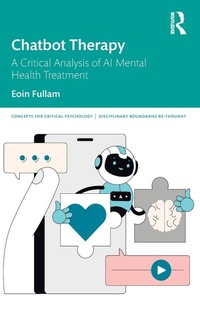
Chatbot Therapy
A Critical Analysis of AI Mental Health Treatment
1st Edition
Published on 30. June 2025
Book
Paperback/Softback
162 pages
978-1-032-95762-3 (ISBN)
Description
Chatbot Therapy: A Critical Analysis of AI Mental Health Treatment examines automated mental health therapy in the form of therapy chatbots, taking a critical analysis of this new technology.
Drawing on historical and emerging scholarship on critical theory, science and technology studies, and critical psychology, this project investigates the social life of mental health therapy applications. The book unearths the assumptions about subjectivity, consciousness, and mental health that underpin these applications, looking predominantly at Wysa and Woebot, but also at other chatbot and non-chatbot mental health applications. It explores the historical emergence of this technology, the technical and design aspects of chatbot therapy apps, the therapeutic methods employed, and the economic context within which therapy chatbots have developed. It centres around the questions of what it means to automate mental health treatment and of how automated interventions alter our understanding of mental suffering and well-being.
This highly topical and interdisciplinary study will be of great interest to postgraduate students and researchers in the fields of critical psychology, mental health, cognitive science, artificial intelligence, science and technology studies, and critical theory. It will also be relevant reading for mental health professionals.
Drawing on historical and emerging scholarship on critical theory, science and technology studies, and critical psychology, this project investigates the social life of mental health therapy applications. The book unearths the assumptions about subjectivity, consciousness, and mental health that underpin these applications, looking predominantly at Wysa and Woebot, but also at other chatbot and non-chatbot mental health applications. It explores the historical emergence of this technology, the technical and design aspects of chatbot therapy apps, the therapeutic methods employed, and the economic context within which therapy chatbots have developed. It centres around the questions of what it means to automate mental health treatment and of how automated interventions alter our understanding of mental suffering and well-being.
This highly topical and interdisciplinary study will be of great interest to postgraduate students and researchers in the fields of critical psychology, mental health, cognitive science, artificial intelligence, science and technology studies, and critical theory. It will also be relevant reading for mental health professionals.
More details
Series
Language
English
Place of publication
London
United Kingdom
Publishing group
Taylor & Francis Ltd
Target group
College/higher education
Professional and scholarly
Postgraduate, Professional Reference, and Undergraduate Advanced
Illustrations
5 s/w Abbildungen, 3 s/w Photographien bzw. Rasterbilder, 2 s/w Zeichnungen
2 Line drawings, black and white; 3 Halftones, black and white; 5 Illustrations, black and white
Dimensions
Height: 216 mm
Width: 140 mm
Thickness: 10 mm
Weight
228 gr
ISBN-13
978-1-032-95762-3 (9781032957623)
Copyright in bibliographic data and cover images is held by Nielsen Book Services Limited or by the publishers or by their respective licensors: all rights reserved.
Schweitzer Classification
Other editions
Additional editions
E-Book
06/2025
Routledge
€55.49
Available for download
E-Book
06/2025
Routledge
€55.49
Available for download

Book
06/2025
1st Edition
Routledge
€206.90
Shipment within 10-20 days
Person
Eoin Fullam is a lecturer in the School of Social Sciences at Birkbeck, University of London, UK. His research is interdisciplinary, drawing on critical theory, science and technology studies, and psychoanalytic theory to analyse contemporary technical society and mental health. Eoin's primary research concern is to explore the ways in which human subjectivity is constructed, produced, or influenced by technological interventions.
Content
Series Editor Preface. Introduction. 1. Computational Conditions. 2. Automated Conversations. 3. Treatment Methods. 4. Economic Imperatives. 5. Conclusion: Invention Is the Mother of Necessity.