

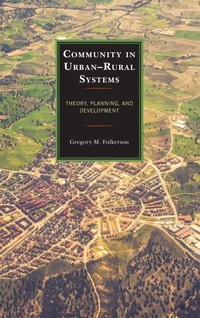
Community in Urban-Rural Systems
Theory, Planning, and Development
Published on 14. September 2022
Book
Hardback
194 pages
978-1-6669-1753-6 (ISBN)
Description
Gregory M. Fulkerson offers a complete portrait of what communities are, how they work, and how they are embedded in urban-rural systems at regional, national, and global scales. After explaining the concept of urban-rural systems, Fulkerson walks through the central dynamics of environmental demography, political economy, culture, social interaction, the built environment, and community connections. His focus on urban-rural systems ensures that communities are understood as nodes within a network, overcoming the tendency to view them as self-contained. Each chapter in Community in Urban-Rural Systems: Theory, Planning, and Development offers a blend of classical and contemporary theories and concludes with relevant planning considerations. An additional chapter on community development provides strategies for translating planning considerations into action. The conclusion offers insights into long-term principles of community sustainability and justice.
Reviews / Votes
Fulkerson, a sociologist whose work focuses on globalization, rurality, community, agriculture, and the environment, aims to promote systemic understanding of the relationships that tie together urban and rural areas. In this volume he explicates the issues surrounding the seeming powerlessness and dependence of rural areas in relation to urban areas in an urban-oriented global world. It brings together a wide range of literature relevant to how humans organize themselves economically, politically, and socially. An important dimension of this discussion is the concept of environmental sustainability. Including an extensive bibliography and a very good concluding chapter summarizing the arguments, this is an excellent work for both students of community and community development practitioners. Highly recommended. Advanced undergraduates through faculty; professionals * Choice Reviews * "Fulkerson's work is always theoretically sound, and this book is no exception, but this entry into urban-rural scholarship makes practical sense as well. He advances an approach to strengthening communities-a task few social scientists have taken on-and he does so in a way that acknowledges the geographic, economic, cultural and political realities of people who live in these places. These applied contributions make the book invaluable for social scientists, regional planners, and anyone who seeks to be engaged in building stronger, sustainable communities." -- Karen E. Hayden, Merrimack College Gregory M. Fulkerson's new book does an admirable job in drawing from a range of classical and contemporary sources and multiple scholarly disciplines to provide a useful set of frameworks for thinking about rural people and places in an urbanizing world. -- Kai A. Schafft, Pennsylvania State UniversityMore details
Series
Language
English
Place of publication
United States
Publishing group
Bloomsbury Publishing Plc
Target group
Professional and scholarly
Illustrations
13 b/w illustrations; 1 tables;
Dimensions
Height: 235 mm
Width: 157 mm
Thickness: 15 mm
Weight
440 gr
ISBN-13
978-1-6669-1753-6 (9781666917536)
Copyright in bibliographic data and cover images is held by Nielsen Book Services Limited or by the publishers or by their respective licensors: all rights reserved.
Schweitzer Classification
Other editions
Additional editions
E-Book
09/2022
1st Edition
Lexington Books
€33.49
Available for download
Person
Gregory Fulkerson is professor and chair of sociology at the State University of New York at Oneonta.
Content
Introduction: Defining and Studying Community
Chapter 1: Urban-Rural Systems
Chapter 2: Environmental Demography
Chapter 3: Political Economy
Chapter 4: Culture
Chapter 5: Social Interaction
Chapter 6: Built Environment and Spatial Organization
Chapter 7: Community Connections
Chapter 8: Community Planning and Development
Conclusion: Toward Sustainability and Justice
Chapter 1: Urban-Rural Systems
Chapter 2: Environmental Demography
Chapter 3: Political Economy
Chapter 4: Culture
Chapter 5: Social Interaction
Chapter 6: Built Environment and Spatial Organization
Chapter 7: Community Connections
Chapter 8: Community Planning and Development
Conclusion: Toward Sustainability and Justice