

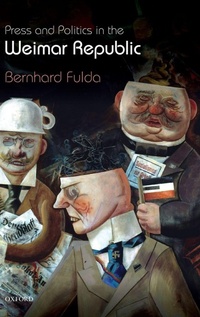
Press and Politics in the Weimar Republic
Published on 8. January 2009
Book
Hardback
342 pages
978-0-19-954778-4 (ISBN)
Description
Press and Politics offers a new interpretation of the fate of Germany's first democracy and the advent of Hitler's Third Reich. It is the first study to explore the role of the press in the politics of the Weimar Republic, and to ask how influential it really was in undermining democratic values.
Anyone who seeks to understand the relationship between the press and politics in Germany at this time has to confront a central problem. Newspapers certainly told their readers how to vote, especially at election time. It was widely accepted that the press wielded immense political power. And yet power ultimately fell to Adolf Hitler, a radical politician whose party press had been strikingly unsuccessful.
Press and Politics unravels this apparent paradox by focusing on Berlin, the political centre of the Weimar Republic and the capital of the German press. The book examines the complex relationship between media presentation, popular reception, and political attitudes in this period. What was the relationship between newspaper circulation and electoral behaviour? Which papers did well, and why? What was the nature of political coverage in the press? Who was most influenced by it? Bernhard Fulda addresses all these questions and more, looking at the nature and impact of newspaper reporting on German politics, politicians, and voters. He shows how the press personalized politics, how politicians were turned into celebrities or hate figures, and how - through deliberate distortions - individual newspapers succeeded in building up a plausible, partisan counter-reality.
Anyone who seeks to understand the relationship between the press and politics in Germany at this time has to confront a central problem. Newspapers certainly told their readers how to vote, especially at election time. It was widely accepted that the press wielded immense political power. And yet power ultimately fell to Adolf Hitler, a radical politician whose party press had been strikingly unsuccessful.
Press and Politics unravels this apparent paradox by focusing on Berlin, the political centre of the Weimar Republic and the capital of the German press. The book examines the complex relationship between media presentation, popular reception, and political attitudes in this period. What was the relationship between newspaper circulation and electoral behaviour? Which papers did well, and why? What was the nature of political coverage in the press? Who was most influenced by it? Bernhard Fulda addresses all these questions and more, looking at the nature and impact of newspaper reporting on German politics, politicians, and voters. He shows how the press personalized politics, how politicians were turned into celebrities or hate figures, and how - through deliberate distortions - individual newspapers succeeded in building up a plausible, partisan counter-reality.
Reviews / Votes
it deserves praise for throwing the differentiated structure of the press and its complex relationship with politics into sharp relief ... Fulda's study will serve as an inspiring contribution to Weimar scholarship. * Dirk Schumann, English Historical Review * This is a highly original study that fills a gaping hole in the literature on Weimar Germany. Focusing on Berlin, but always with an eye to the 'national' picture, Fulda's work offers not so much a history of the press in the Weimar years as a history of the Republic through the lens of the press. The links he forges between political coverage, entertainment and the increasing consumer orientation of publishers and readers alike show how much we can gain by approaching politics as an integral part of popular culture, and vice-versa. * Corey Ross, University of Birmingham *More details
Language
English
Place of publication
Oxford
United Kingdom
Target group
College/higher education
Professional and scholarly
Illustrations
15 integrated halftones and five tables
Dimensions
Height: 240 mm
Width: 161 mm
Thickness: 23 mm
Weight
681 gr
ISBN-13
978-0-19-954778-4 (9780199547784)
Copyright in bibliographic data and cover images is held by Nielsen Book Services Limited or by the publishers or by their respective licensors: all rights reserved.
Schweitzer Classification
Person
Bernhard Fulda is a Lecturer and Fellow in History at Sidney Sussex College, Cambridge.
Content
Introduction ; 1. The Berlin Press, 1918 to 1932 ; 2. Media Personalities, 1918 to 1924 ; 3. Competing Stories, 1924-1925 ; 4. The 'Unpolitical' Press: Provincial Newspapers Around Berlin, 1925 to 1928 ; 5. Conquering Headlines: Violence, Sensations, and the Rise of the Nazis, 1928 to 1930 ; 6. War of Words: the Spectre of Civil War, 1931 to 1932 ; 7. Conclusion ; Notes ; Bibliography ; Index