

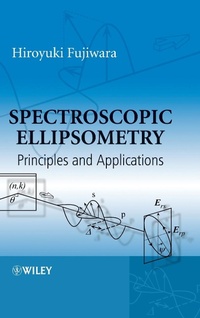
Spectroscopic Ellipsometry
Principles and Applications
1st Edition
Published on 26. January 2007
Book
Hardback
392 pages
978-0-470-01608-4 (ISBN)
Description
Ellipsometry is a powerful tool used for the characterization of thin films and multi-layer semiconductor structures. This book deals with fundamental principles and applications of spectroscopic ellipsometry (SE). Beginning with an overview of SE technologies the text moves on to focus on the data analysis of results obtained from SE, Fundamental data analyses, principles and physical backgrounds and the various materials used in different fields from LSI industry to biotechnology are described. The final chapter describes the latest developments of real-time monitoring and process control which have attracted significant attention in various scientific and industrial fields.
More details
Language
English
Place of publication
New York
United States
Target group
Professional and scholarly
Product notice
sewn/stitched
Paper over boards
Dimensions
Height: 235 mm
Width: 157 mm
Thickness: 28 mm
Weight
787 gr
ISBN-13
978-0-470-01608-4 (9780470016084)
Copyright in bibliographic data and cover images is held by Nielsen Book Services Limited or by the publishers or by their respective licensors: all rights reserved.
Schweitzer Classification
Other editions
Additional editions
E-Book
09/2007
1st Edition
Wiley
€168.99
Available for download
Person
Dr Hiroyuki Fujiwara is based at the National Institute of Advanced Industrial Science and Technology, Ibaraki, Japan. He received his PhD at the Tokyo Institute of Technology in 1996 and carried out post-doctoral research with Professor R.W. Collins at Penn State University. From 1998 to present he has been working as a senior research scientist at the Research Center for Photovoltaics at NIAIST. He received the 'Most Promising Young Scientist Award' from the Japan Society of Applied Physics and the 'Young Researcher Award' at the World Conference on Photovoltaic Energy Conversion in 2003.
Content
Foreword. Preface.
Acknowledgments.
1 Introduction to Spectroscopic Ellipsometry.
1.1 Features of Spectroscopic Ellipsometry.
1.2 Applications of Spectroscopic Ellipsometry.
1.3 Data Analysis.
1.4 History of Development.
1.5 Future Prospects.
References.
2 Principles of Optics.
2.1 Propagation of Light.
2.2 Dielectrics.
2.3 Reflection and Transmission of Light.
2.4 Optical Interference.
References.
3 Polarization of Light.
3.1 Representation of Polarized Light.
3.2 Optical Elements.
3.3 Jones Matrix.
3.4 Stokes Parameters.
References.
4 Principles of Spectroscopic Ellipsometry.
4.1 Principles of Ellipsometry Measurement.
4.2 Ellipsometry Measurement.
4.3 Instrumentation for Ellipsometry.
4.4 Precision and Error of Measurement.
References.
5 Data Analysis.
5.1 Interpretation of (?, ?).
5.2 Dielectric Function Models.
5.3 Effective Medium Approximation.
5.4 Optical Models.
5.5 Data Analysis Procedure.
References.
6 Ellipsometry of Anisotropic Materials.
6.1 Reflection and Transmission of Light by Anisotropic Materials.
6.2 Fresnel Equations for Anisotropic Materials.
6.3 4x4 Matrix Method.
6.4 Interpretation of (?, ?) for Anisotropic Materials.
6.5 Measurement and Data Analysis of Anisotropic Materials.
References.
7 Data Analysis Examples.
7.1 Insulators.
7.2 Semiconductors.
7.3 Metals/Semiconductors.
7.4 Organic Materials/Biomaterials.
7.5 Anisotropic Materials.
References.
8 Real-Time Monitoring by Spectroscopic Ellipsometry.
8.1 Data Analysis in Real-Time Monitoring.
8.2 Observation of Thin-Film Growth by Real-Time Monitoring.
8.3 Process Control by Real-Time Monitoring.
References.
Appendices.
1 Trigonometric Functions.
2 Definitions of Optical Constants.
3 Maxwell's Equations for Conductors.
4 Jones-Mueller Matrix Conversion.
5 Kramers-Kronig Relations.
Index.
Acknowledgments.
1 Introduction to Spectroscopic Ellipsometry.
1.1 Features of Spectroscopic Ellipsometry.
1.2 Applications of Spectroscopic Ellipsometry.
1.3 Data Analysis.
1.4 History of Development.
1.5 Future Prospects.
References.
2 Principles of Optics.
2.1 Propagation of Light.
2.2 Dielectrics.
2.3 Reflection and Transmission of Light.
2.4 Optical Interference.
References.
3 Polarization of Light.
3.1 Representation of Polarized Light.
3.2 Optical Elements.
3.3 Jones Matrix.
3.4 Stokes Parameters.
References.
4 Principles of Spectroscopic Ellipsometry.
4.1 Principles of Ellipsometry Measurement.
4.2 Ellipsometry Measurement.
4.3 Instrumentation for Ellipsometry.
4.4 Precision and Error of Measurement.
References.
5 Data Analysis.
5.1 Interpretation of (?, ?).
5.2 Dielectric Function Models.
5.3 Effective Medium Approximation.
5.4 Optical Models.
5.5 Data Analysis Procedure.
References.
6 Ellipsometry of Anisotropic Materials.
6.1 Reflection and Transmission of Light by Anisotropic Materials.
6.2 Fresnel Equations for Anisotropic Materials.
6.3 4x4 Matrix Method.
6.4 Interpretation of (?, ?) for Anisotropic Materials.
6.5 Measurement and Data Analysis of Anisotropic Materials.
References.
7 Data Analysis Examples.
7.1 Insulators.
7.2 Semiconductors.
7.3 Metals/Semiconductors.
7.4 Organic Materials/Biomaterials.
7.5 Anisotropic Materials.
References.
8 Real-Time Monitoring by Spectroscopic Ellipsometry.
8.1 Data Analysis in Real-Time Monitoring.
8.2 Observation of Thin-Film Growth by Real-Time Monitoring.
8.3 Process Control by Real-Time Monitoring.
References.
Appendices.
1 Trigonometric Functions.
2 Definitions of Optical Constants.
3 Maxwell's Equations for Conductors.
4 Jones-Mueller Matrix Conversion.
5 Kramers-Kronig Relations.
Index.