

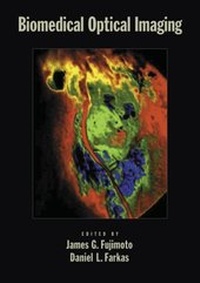
Biomedical Optical Imaging
Published on 23. April 2009
Book
Hardback
440 pages
978-0-19-515044-5 (ISBN)
Description
Biomedical optical imaging is a rapidly emerging research area with widespread fundamental research and clinical applications. This book gives an overview of biomedical optical imaging with contributions from leading international research groups who have pioneered many of these techniques and applications.
A unique research field spanning the microscopic to the macroscopic, biomedical optical imaging allows both structural and functional imaging. Techniques such as confocal and multiphoton microscopy provide cellular level resolution imaging in biological systems. The integration of this technology with exogenous chromophores can selectively enhance contrast for molecular targets as well as supply functional information on processes such as nerve transduction.
Novel techniques integrate microscopy with state-of-the-art optics technology, and these include spectral imaging, two photon fluorescence correlation, nonlinear nanoscopy; optical coherence tomography techniques allow functional, dynamic, nanoscale, and cross-sectional visualization. Moving to the macroscopic scale, spectroscopic assessment and imaging methods such as fluorescence and light scattering can provide diagnostics of tissue pathology including neoplastic changes. Techniques using
light diffusion and photon migration are a means to explore processes which occur deep inside biological tissues and organs. The integration of these techniques with exogenous probes enables molecular specific sensitivity.
A unique research field spanning the microscopic to the macroscopic, biomedical optical imaging allows both structural and functional imaging. Techniques such as confocal and multiphoton microscopy provide cellular level resolution imaging in biological systems. The integration of this technology with exogenous chromophores can selectively enhance contrast for molecular targets as well as supply functional information on processes such as nerve transduction.
Novel techniques integrate microscopy with state-of-the-art optics technology, and these include spectral imaging, two photon fluorescence correlation, nonlinear nanoscopy; optical coherence tomography techniques allow functional, dynamic, nanoscale, and cross-sectional visualization. Moving to the macroscopic scale, spectroscopic assessment and imaging methods such as fluorescence and light scattering can provide diagnostics of tissue pathology including neoplastic changes. Techniques using
light diffusion and photon migration are a means to explore processes which occur deep inside biological tissues and organs. The integration of these techniques with exogenous probes enables molecular specific sensitivity.
More details
Language
English
Place of publication
New York
United States
Target group
College/higher education
Professional and scholarly
Illustrations
107 colour illustrations, 27 halftones, and 79 line illustrations
Dimensions
Height: 261 mm
Width: 188 mm
Thickness: 33 mm
Weight
1470 gr
ISBN-13
978-0-19-515044-5 (9780195150445)
Copyright in bibliographic data and cover images is held by Nielsen Book Services Limited or by the publishers or by their respective licensors: all rights reserved.
Schweitzer Classification
Other editions
Additional editions
James G. Fujimoto | Daniel Farkas
Biomedical Optical Imaging
E-Book
04/2009
1st Edition
OUP eBook
€56.49
Available for download
James G. Fujimoto | Daniel Farkas
Biomedical Optical Imaging
E-Book
04/2009
1st Edition
OUP eBook
€56.49
Available for download
Persons
James G. Fujimoto is Professor of Electrical Engineering and Computer Science at the Massachusetts Institute of Technology, where he works on the development and application of femtosecond laser technology and studies ultrafast phenomena and biomedical optics. He received his bachelors, masters, and doctorate degrees from M.I.T.
Daniel Farkas is Vice Chairman for Research in the Department of Surgery and Director of the Minimally Invasive Surgical Technologies Institute at the Cedars-Sinai Medical Center in Los Angeles. He is also a Research Professor in Biomedical Engineering at the University of Southern California, and Adjunct Professor at the Robotics Institute at Carnegie Mellon University. Farkas was trained in theoretical physics in Romania, and holds a Ph.D. in Biophysics and Biochemistry from the Weizmann
Institute in Israel.
Daniel Farkas is Vice Chairman for Research in the Department of Surgery and Director of the Minimally Invasive Surgical Technologies Institute at the Cedars-Sinai Medical Center in Los Angeles. He is also a Research Professor in Biomedical Engineering at the University of Southern California, and Adjunct Professor at the Robotics Institute at Carnegie Mellon University. Farkas was trained in theoretical physics in Romania, and holds a Ph.D. in Biophysics and Biochemistry from the Weizmann
Institute in Israel.
Content
Preface ; 1. Confocal Microscopy ; 2. Spectral Optical Imaging in Biology and Medicine ; 3. Multi-photon Microscopy in Neuroscience ; 4. mRNA Imaging in Living Cells for Biomedical Research ; 5. Building New Fluorescent Probes ; 6. Imaging Membrane Potential with Voltage-Sensitive Dyes ; 7. Biomedical Imaging using Optical Coherence Tomography ; 8. Two-Photon Fluorescence Correlation Spectroscopy ; 9. Nanoscopy: The Future of Optical Microscopy ; 10. Fluorescence Imaging in Medical Diagnostics ; 11. Light Scattering Spectroscopic Techniques for Examining Cellular Structure, Organization and Dynamics ; 12. Fluorescence and Spectroscopic Markers of Cervical Neoplasia ; 13. Quantitative Absorption and Scattering Spectra in Thick Tissues using Broadband Diffuse Optical Spectroscopy ; 14. Detection of Brain Activity by Near-Infrared Light ; 15. In-Vivo Optical Imaging of Molecular Function using NIR Fluorescent Probes