

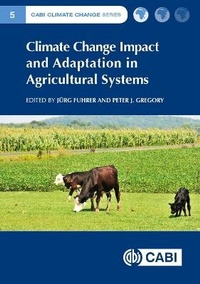
Climate Change Impact and Adaptation in Agricultural Systems
Published on 18. June 2014
Book
Hardback
298 pages
978-1-78064-289-5 (ISBN)
Description
The focus of this book is future global climate change and its implications for agricultural systems which are the main sources of agricultural goods and services provided to society. These systems are either based on crop or livestock production, or on combinations of the two, with characteristics that differ between regions and between levels of management intensity. In turn, they also differ in their sensitivity to projected future changes in climate, and improvements to increase climate-resilience need to be tailored to the specific needs of each system. The book will bring together a series of chapters that provide scientific insights to possible implications of projected climate changes for different important types of crop and livestock systems, and a discussion of options for adaptive and mitigative management.
More details
Series
Language
English
Place of publication
Wallingford
United Kingdom
Target group
College/higher education
Product notice
sewn/stitched
Cloth over boards
Dimensions
Height: 251 mm
Width: 177 mm
Thickness: 25 mm
Weight
845 gr
ISBN-13
978-1-78064-289-5 (9781780642895)
Copyright in bibliographic data and cover images is held by Nielsen Book Services Limited or by the publishers or by their respective licensors: all rights reserved.
Schweitzer Classification
Other editions
Additional editions
Jurg Fuhrer | P. Gregory
Climate Change Impact and Adaptation in Agricultural Systems
E-Book
06/2014
CABI Publishing
€69.49
Available for download
Persons
works at the International Maize and Wheat Improvement Centre (CIMMYT) where his main focus has been to improve the adaptation of wheat to drought and heat stressed environments in collaboration with national wheat programs worldwide. His laboratory develops methodologies that have enhanced the efficiency of breeding and research and led to identification of genetic bases of adaptive traits. These approaches have resulted in a new generation of wheat cultivars based on the combination of stress-adaptive traits from highly diverse genetic sources. Reynolds is also coordinating the establishment of a global consortium to raise the yield potential of wheat to help bolster productivity in the developing world where the dual impact of climate change and population growth threaten food security.
Editor
formerly Agroscope, Switzerland
University of Reading, UK
Contributions
International Maize and Wheat Improvement Center (CIMMYT), Mexico
James Hutton Institute, UK
World Agroforestry Centre (ICRAF), Indonesia
International Maize and Wheat Improvement Center (CIMMYT), Zimbabwe
International Maize and Wheat Improvement Center (CIMMYT), Mexico
University of Arizona, USA
Warwick Crop Centre, University of Warwick, UK
International Maize and Wheat Improvement Center (CIMMYT), Mexico
Content
a: Introduction 1: Climate projections for 2050 2: Rainfed Intensive Crop Systems 3: Climate Sensitivity of Intensive Rice-Wheat Systems in Tropical Asia: Focus on the Indo-Gangetic Plains 4: Climate Change Challenges for Low Input Cropping and Grazing Systems - Australia 5: Diversity in Organic and Agroecological Farming Systems for Mitigation of Climate Change Impact, with Examples from Latin America 6: UK Fruit and Vegetable Production - Impacts of Climate Change and Opportunities for Adaptation 7: Intensive Livestock Systems for Dairy Cows 8: Climate Change and Integrated Crop-Livestock Systems in Temperate-Humid Regions of North and South America: Mitigation and Adaptation 9: Land Managed for Multiple Services 10: Adaptation of Mixed Crop-Livestock Systems in Asia 11: Enhancing Climate Resilience of Cropping Systems 12: Shaping Sustainable Intensive Production Systems: Improved Crops and Cropping Systems in the Developing World 13: The Role of Modelling in Adapting and Building the Climate Resilience of Cropping Systems 14: Agroforestry Solutions for Buffering Climate Variability and Adapting to Change 15: Channelling the Future? The Use of Seasonal Climate Forecasts in Climate Adaptation 16: Agricultural Adaptation to Climate Change: New Approaches to Knowledge and Learning 17: What are the Factors that Dictate the Choice of Coping Strategies for Extreme Climate Events? The Case of Farmers in the Nile Basin of Ethiopia