

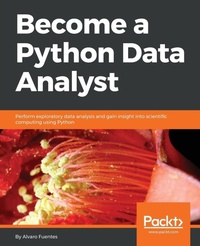
Become a Python Data Analyst
Perform exploratory data analysis and gain insight into scientific computing using Python
Published on 31. August 2018
Book
Paperback/Softback
178 pages
978-1-78953-170-1 (ISBN)
Description
Enhance your data analysis and predictive modeling skills using popular Python tools
Key Features
Cover all fundamental libraries for operation and manipulation of Python for data analysis
Implement real-world datasets to perform predictive analytics with Python
Access modern data analysis techniques and detailed code with scikit-learn and SciPy
Book DescriptionPython is one of the most common and popular languages preferred by leading data analysts and statisticians for working with massive datasets and complex data visualizations.
Become a Python Data Analyst introduces Python's most essential tools and libraries necessary to work with the data analysis process, right from preparing data to performing simple statistical analyses and creating meaningful data visualizations.
In this book, we will cover Python libraries such as NumPy, pandas, matplotlib, seaborn, SciPy, and scikit-learn, and apply them in practical data analysis and statistics examples. As you make your way through the chapters, you will learn to efficiently use the Jupyter Notebook to operate and manipulate data using NumPy and the pandas library. In the concluding chapters, you will gain experience in building simple predictive models and carrying out statistical computation and analysis using rich Python tools and proven data analysis techniques.
By the end of this book, you will have hands-on experience performing data analysis with Python.
What you will learn
Explore important Python libraries and learn to install Anaconda distribution
Understand the basics of NumPy
Produce informative and useful visualizations for analyzing data
Perform common statistical calculations
Build predictive models and understand the principles of predictive analytics
Who this book is forBecome a Python Data Analyst is for entry-level data analysts, data engineers, and BI professionals who want to make complete use of Python tools for performing efficient data analysis. Prior knowledge of Python programming is necessary to understand the concepts covered in this book
Key Features
Cover all fundamental libraries for operation and manipulation of Python for data analysis
Implement real-world datasets to perform predictive analytics with Python
Access modern data analysis techniques and detailed code with scikit-learn and SciPy
Book DescriptionPython is one of the most common and popular languages preferred by leading data analysts and statisticians for working with massive datasets and complex data visualizations.
Become a Python Data Analyst introduces Python's most essential tools and libraries necessary to work with the data analysis process, right from preparing data to performing simple statistical analyses and creating meaningful data visualizations.
In this book, we will cover Python libraries such as NumPy, pandas, matplotlib, seaborn, SciPy, and scikit-learn, and apply them in practical data analysis and statistics examples. As you make your way through the chapters, you will learn to efficiently use the Jupyter Notebook to operate and manipulate data using NumPy and the pandas library. In the concluding chapters, you will gain experience in building simple predictive models and carrying out statistical computation and analysis using rich Python tools and proven data analysis techniques.
By the end of this book, you will have hands-on experience performing data analysis with Python.
What you will learn
Explore important Python libraries and learn to install Anaconda distribution
Understand the basics of NumPy
Produce informative and useful visualizations for analyzing data
Perform common statistical calculations
Build predictive models and understand the principles of predictive analytics
Who this book is forBecome a Python Data Analyst is for entry-level data analysts, data engineers, and BI professionals who want to make complete use of Python tools for performing efficient data analysis. Prior knowledge of Python programming is necessary to understand the concepts covered in this book
More details
Language
English
Place of publication
Birmingham
United Kingdom
Dimensions
Height: 235 mm
Width: 191 mm
Thickness: 10 mm
Weight
345 gr
ISBN-13
978-1-78953-170-1 (9781789531701)
Copyright in bibliographic data and cover images is held by Nielsen Book Services Limited or by the publishers or by their respective licensors: all rights reserved.
Schweitzer Classification
Other editions
Additional editions
Alvaro Fuentes
Become a Python Data Analyst
Perform exploratory data analysis and gain insight into scientific computing using Python
E-Book
08/2018
1st Edition
De Gruyter
€18.49
Available for download
Person
Alvaro Fuentes is a data scientist with an M.S. in quantitative economics and applied mathematics with more than 10 years of experience in analytical roles. He worked in the central bank of Guatemala as an economic analyst, building models for economic and financial data. He founded Quant to provide consulting and training services in data science topics and has been a consultant for many projects in fields such as business, education, psychology, and mass media. He has taught courses to students in topics such as data science, mathematics, statistics, R programming, and Python. He also has technical skills in R programming, Spark, PostgreSQL, Microsoft Excel, machine learning, statistical analysis, econometrics, and mathematical modeling.
Content
Table of Contents
The Anaconda Distribution and Jupyter Notebook
Vectorizing Operations with Numpy
Pandas: Everyone's Favorite Data Analysis Library
Visualization and Exploratory Data Analysis
Statistical Computing with Python
Introduction to Predictive Analytics Models
The Anaconda Distribution and Jupyter Notebook
Vectorizing Operations with Numpy
Pandas: Everyone's Favorite Data Analysis Library
Visualization and Exploratory Data Analysis
Statistical Computing with Python
Introduction to Predictive Analytics Models