

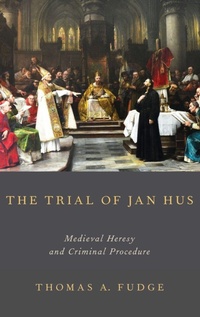
The Trial of Jan Hus
Medieval Heresy and Criminal Procedure
Published on 30. May 2013
Book
Hardback
432 pages
978-0-19-998808-2 (ISBN)
Description
Six hundred years ago, the Czech priest Jan Hus (1371-1415) traveled out of Bohemia, never to return. After a five-year legal ordeal that took place in Prague, in the papal curia, and finally in southern Germany, the case of Jan Hus was heard by one of the largest and most magnificent church gatherings in medieval history: the Council of Constance. Hus was burned alive as a stubborn and disobedient heretic before a huge audience. His trial sparked intense reactions and opinions ranging from satisfaction to condemnations of judicial murder.
Thomas A. Fudge offers the first English-language examination of the indictment, relevant canon law, and questions of procedural legality concerning Jan Hus and the Holy See. In the modern world, there is instinctive sympathy for a man burned alive for his convictions, and it is presumed that any court sanctioning such action must have been irregular. Was Hus guilty of heresy? Were his doctrinal convictions contrary to established ideas espoused by the Latin Church? Was his trial legal? Despite its historical significance and the strong reactions it provoked, the trial of Jan Hus has never before been the subject of a thorough legal analysis or assessed against prevailing canonical legislation and procedural law in the later Middle Ages.
The Trial of Jan Hus shows how this popular and successful priest became a criminal suspect and a convicted felon, and why he was publicly executed, providing critical insight into what may be characterized as the most significant heresy trial of the Middle Ages.
Thomas A. Fudge offers the first English-language examination of the indictment, relevant canon law, and questions of procedural legality concerning Jan Hus and the Holy See. In the modern world, there is instinctive sympathy for a man burned alive for his convictions, and it is presumed that any court sanctioning such action must have been irregular. Was Hus guilty of heresy? Were his doctrinal convictions contrary to established ideas espoused by the Latin Church? Was his trial legal? Despite its historical significance and the strong reactions it provoked, the trial of Jan Hus has never before been the subject of a thorough legal analysis or assessed against prevailing canonical legislation and procedural law in the later Middle Ages.
The Trial of Jan Hus shows how this popular and successful priest became a criminal suspect and a convicted felon, and why he was publicly executed, providing critical insight into what may be characterized as the most significant heresy trial of the Middle Ages.
Reviews / Votes
a careful and thorough analysis of the legal and theological minutiae of the Hus trial. As such, scholars with interests in medieval Bohemia, heresy, canon law and, no doubt, other areas will find this a valuable and thought-provoking work. * Christopher Nicholson, Slavonic and East European Review * Essential. * L.W. Marvin, CHOICE *More details
Language
English
Place of publication
New York
United States
Target group
College/higher education
Dimensions
Height: 240 mm
Width: 161 mm
Thickness: 27 mm
Weight
793 gr
ISBN-13
978-0-19-998808-2 (9780199988082)
Copyright in bibliographic data and cover images is held by Nielsen Book Services Limited or by the publishers or by their respective licensors: all rights reserved.
Schweitzer Classification
Other editions
Additional editions
E-Book
04/2013
1st Edition
OUP eBook
€56.49
Available for download
Person
Professor of Medieval History, University of New England, Australia
Content
List of Maps and Illustrations ; Abbreviations ; Canon Law References and Citations ; Introduction ; 1 Jan Hus in History, Heresy and Court ; 2 Inventing Medieval Heresy ; 3 Law, Procedure and Practice in Medieval Heresy Trials ; 4 Beginnings of the Hus Trial from Prague to the Papal Curia ; 5 An Extraordinary Motion to an Appellate Court ; 6 The Ordo procedendi as a Political Document ; 7 Legal Process at the Council of Constance ; 8 Assessing the Accusations and Criminal Charges ; Closing Arguments ; Appendix Dramatis personae in the Trial of Jan Hus ; Glossary of Legal Terms ; References to Canon Law ; Selected Bibliography ; Index