

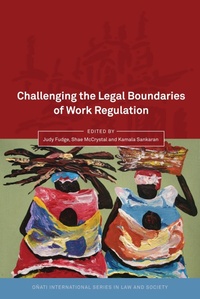
Challenging the Legal Boundaries of Work Regulation
1st Edition
Published on 11. July 2012
Book
Hardback
350 pages
978-1-84946-279-2 (ISBN)
Description
Focusing on paid work that blurs traditional legal boundaries and the challenge this poses to traditional forms of labour regulation, this collection of original case studies illustrates the wide range of different forms of regulation designed to provide decent work. The original case studies cover a diversity of workers from across developed and developing countries, the formal and informal economies and public and private work spaces. Each deals with the failings of traditional labour law, and several explore the capacity of different forms of regulatory techniques, such as commercial law, corporate codes of conduct, or supply chain regulation, to protect workers.
Reviews / Votes
All the essays are well written and coherently focused. Overall, this is an excellent collection of information and analysis -- Beth Gaze * Griffith Law Review, Volume 22, Number 1 *More details
Series
Language
English
Place of publication
Oxford
United Kingdom
Publishing group
Bloomsbury Publishing PLC
Target group
Professional and scholarly
Dimensions
Height: 240 mm
Width: 161 mm
Thickness: 23 mm
Weight
693 gr
ISBN-13
978-1-84946-279-2 (9781849462792)
Copyright in bibliographic data and cover images is held by Nielsen Book Services Limited or by the publishers or by their respective licensors: all rights reserved.
Schweitzer Classification
Other editions
Additional editions
Judy Fudge | Shae McCrystal | Kamala Sankaran
Challenging the Legal Boundaries of Work Regulation
E-Book
07/2012
1st Edition
Hart Publishing
€111.99
Available for download
Judy Fudge | Shae McCrystal | Kamala Sankaran
Challenging the Legal Boundaries of Work Regulation
E-Book
07/2012
1st Edition
Hart Publishing
€111.99
Available for download
Persons
Judy Fudge is Professor and Lansdowne Chair at the Faculty of Law at the University of Victoria, British Columbia, Canada.
Shae McCrystal is Senior Lecturer in the School of Law at the University of Sydney, Australia.
Kamala Sankaran is Associate Professor at the Faculty of Law, University of Delhi, India.
Shae McCrystal is Senior Lecturer in the School of Law at the University of Sydney, Australia.
Kamala Sankaran is Associate Professor at the Faculty of Law, University of Delhi, India.
Content
1. Blurring Legal Boundaries: Regulating for Decent Work
Judy Fudge
PART I: INFORMALITY AT WORK
2. Flexibility and Informalisation of Employment Relationships
Kamala Sankaran
3. Transform or Perish: Changing Conceptions of Work in Recycling
Poornima Chikarmane and Lakshmi Narayanan
4. Informal Sectors and New Industries: The Complexities of Regulating Occupational Health and Safety in
Developing Countries
Richard Johnstone
PART II: BETWEEN THE BORDERS OF EMPLOYMENT AND COMMERCIAL LAW
5. Legal Responsibility for Labour Conditions Down the Production Chain
Alan Hyde
6. A Blurred Boundary between Entrepreneurship and Servitude: Regulating Business Format Franchising in Australia
Joellen Riley
7. Developing Legislative Protection for Owner Drivers in Australia: The Long Road to Regulatory Best Practice
Brendan Johnson
8. Organising Independent Contractors: The Impact of Competition Law
Shae McCrystal
9. Regulation of Dependent Self-employed Workers in Spain: A Regulatory Framework for Informal Work?
Juan-Pablo Landa Zapirain
10. Freelancers: An Intermediate Group in Labour Law?
Guy Davidov
PART III: PAID CARE WORKERS-THE SIGNIFICANCE OF INSTITUTIONS FOR DECENT WORK
11. The Wages of Care-workers: From Structure to Agency
Guy Mundlak
12. Sector-based Collective Bargaining Regimes and Gender Segregation: A Case Study of Self-employed Home
Childcare Workers in Quebec
Stephanie Bernstein
13. From 'Domestic Servant' to 'Domestic Worker'
Einat Albin
14. Employment Agencies and Domestic Work in Ghana
Dzodzi Tsikata
PART IV: REGULATING FOR DECENT WORK
15. Corporate Codes of Conduct in the Garment Sector in Bangalore
Roopa Madhav
16. How Britain's Low-paid Non-unionised Employees Deal with Workplace Problems
Anna Pollert
17. Learning from Case Law Accounts of Marginalised Working
Lizzie Barmes
Judy Fudge
PART I: INFORMALITY AT WORK
2. Flexibility and Informalisation of Employment Relationships
Kamala Sankaran
3. Transform or Perish: Changing Conceptions of Work in Recycling
Poornima Chikarmane and Lakshmi Narayanan
4. Informal Sectors and New Industries: The Complexities of Regulating Occupational Health and Safety in
Developing Countries
Richard Johnstone
PART II: BETWEEN THE BORDERS OF EMPLOYMENT AND COMMERCIAL LAW
5. Legal Responsibility for Labour Conditions Down the Production Chain
Alan Hyde
6. A Blurred Boundary between Entrepreneurship and Servitude: Regulating Business Format Franchising in Australia
Joellen Riley
7. Developing Legislative Protection for Owner Drivers in Australia: The Long Road to Regulatory Best Practice
Brendan Johnson
8. Organising Independent Contractors: The Impact of Competition Law
Shae McCrystal
9. Regulation of Dependent Self-employed Workers in Spain: A Regulatory Framework for Informal Work?
Juan-Pablo Landa Zapirain
10. Freelancers: An Intermediate Group in Labour Law?
Guy Davidov
PART III: PAID CARE WORKERS-THE SIGNIFICANCE OF INSTITUTIONS FOR DECENT WORK
11. The Wages of Care-workers: From Structure to Agency
Guy Mundlak
12. Sector-based Collective Bargaining Regimes and Gender Segregation: A Case Study of Self-employed Home
Childcare Workers in Quebec
Stephanie Bernstein
13. From 'Domestic Servant' to 'Domestic Worker'
Einat Albin
14. Employment Agencies and Domestic Work in Ghana
Dzodzi Tsikata
PART IV: REGULATING FOR DECENT WORK
15. Corporate Codes of Conduct in the Garment Sector in Bangalore
Roopa Madhav
16. How Britain's Low-paid Non-unionised Employees Deal with Workplace Problems
Anna Pollert
17. Learning from Case Law Accounts of Marginalised Working
Lizzie Barmes