

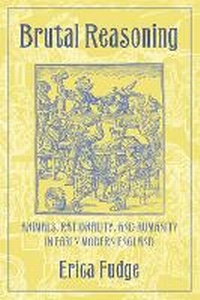
Brutal Reasoning
Animals, Rationality, and Humanity in Early Modern England
Published on 15. February 2019
Book
Paperback/Softback
240 pages
978-1-5017-3087-0 (ISBN)
Description
Early modern English thinkers were fascinated by the subject of animal rationality, even before the appearance of Descartes's Discourse on the Method (1637) and its famous declaration of the automatism of animals. But as Erica Fudge relates in Brutal Reasoning, the discussions were not as straightforward-or as reflexively anthropocentric-as has been assumed.
Surveying a wide range of texts-religious, philosophical, literary, even comic-Fudge explains the crucial role that reason played in conceptualizations of the human and the animal, as well as the distinctions between the two. Brutal Reasoning looks at the ways in which humans were conceptualized, at what being "human" meant, and at how humans could lose their humanity. It also takes up the questions of what made an animal an animal, why animals were studied in the early modern period, and at how people understood, and misunderstood, what they saw when they did look.
From the influence of classical thinking on the human-animal divide and debates surrounding the rationality of women, children, and Native Americans to the frequent references in popular and pedagogical texts to Morocco the Intelligent Horse, Fudge gives a new and vital context to the human perception of animals in this period. At the same time, she challenges overly simplistic notions about early modern attitudes to animals and about the impact of those attitudes on modern culture.
Surveying a wide range of texts-religious, philosophical, literary, even comic-Fudge explains the crucial role that reason played in conceptualizations of the human and the animal, as well as the distinctions between the two. Brutal Reasoning looks at the ways in which humans were conceptualized, at what being "human" meant, and at how humans could lose their humanity. It also takes up the questions of what made an animal an animal, why animals were studied in the early modern period, and at how people understood, and misunderstood, what they saw when they did look.
From the influence of classical thinking on the human-animal divide and debates surrounding the rationality of women, children, and Native Americans to the frequent references in popular and pedagogical texts to Morocco the Intelligent Horse, Fudge gives a new and vital context to the human perception of animals in this period. At the same time, she challenges overly simplistic notions about early modern attitudes to animals and about the impact of those attitudes on modern culture.
Reviews / Votes
At the heart of Brutal Reasoning is a contention that modern historiography has ignored how instrumental animals have been in forming humanity's ideas of itself. Fudge argues that scholars have imposed on the Early modern world an anachronistic concept of humanity separated from animals by an unbridgeable chasm.(Times Literary Supplement) Brutal Reasoning presents a powerful alternative to a critique of speciesism elaborated on the ground of a posthumanist theory of the subject, which typically pays little attention to particular animals and forms a bloodless abstraction out of the 'nonhuman.' Fudge's commitment to historical specificity serves as a corrective to the recent tendency to treat animals as a way station en route to an analysis of sexism and racism. As a historical argument it presents a view of modernity far more nuanced than studies that locate the decisive break between humans and animals in the alienation of nineteenth-century capitalism, or that reduce the polyphonic voices of early modern Europe to simple monody. A fundamental reassessment of the human-animal relation in early modern history, the book succeeds in adjusting our sense of the period's philosophy and literature by restoring animals to a central place in the project of constructing the human self.
(H-Animal)
More details
Language
English
Place of publication
Ithaca
United States
Target group
College/higher education
Professional and scholarly
Product notice
Paperback (trade)
Illustrations
4 b&w halftones - 4 Halftones, black and white
Dimensions
Height: 229 mm
Width: 152 mm
Thickness: 18 mm
Weight
454 gr
ISBN-13
978-1-5017-3087-0 (9781501730870)
Copyright in bibliographic data and cover images is held by Nielsen Book Services Limited or by the publishers or by their respective licensors: all rights reserved.
Schweitzer Classification
Other editions
Additional editions
E-Book
02/2019
Cornell University Press
€27.49
Available for download
E-Book
02/2019
1st Edition
Cornell University Press
€162.99
Available for download
Person
Erica Fudge is Professor of English Studies at the University of Strathclyde and Director of the British Animal Studies Network. She is the author of Brutal Reasoning and Perceiving Animals and editor of Renaissance Beasts.