

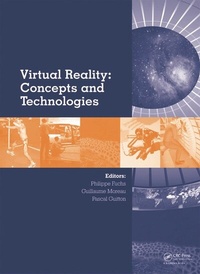
Virtual Reality: Concepts and Technologies
1st Edition
Published on 27. July 2011
Book
Hardback
432 pages
978-0-415-68471-2 (ISBN)
Description
A manual for both designers and users, comprehensively presenting the current state of experts' knowledge on virtual reality (VR) in computer science, mechanics, optics, acoustics, physiology, psychology, ergonomics, ethics, and related area. Designed as a reference book and design guide to help the reader develop a VR project, it presents the reader with the importance of the user's needs and various aspects of the human computer interface (HCI). It further treats technical aspects of VR, hardware and software implementations, and details on the sensory and psycho-sensory interfaces. Providing various concepts and technologies, including mathematics and modelling techniques, it allows the reader to formalize, conceptualize and construct a virtual reality project from original thought to application. This book is intended for engineers, computer scientists and computer game developers working on various VR applications. It can further serve as an educational tool in Virtual Reality courses for senior graduate and postgraduate students.
More details
Language
English
Place of publication
London
United Kingdom
Publishing group
Taylor & Francis Ltd
Target group
College/higher education
Professional and scholarly
General, Postgraduate, Professional, Professional Practice & Development, and Undergraduate
Dimensions
Height: 246 mm
Width: 174 mm
Weight
929 gr
ISBN-13
978-0-415-68471-2 (9780415684712)
Copyright in bibliographic data and cover images is held by Nielsen Book Services Limited or by the publishers or by their respective licensors: all rights reserved.
Schweitzer Classification
Other editions
Additional editions
Philippe Fuchs | Guillaume Moreau | Pascal Guitton
Virtual Reality: Concepts and Technologies
E-Book
07/2011
1st Edition
CRC Press
€224.99
Available for download
Philippe Fuchs | Guillaume Moreau | Pascal Guitton
Virtual Reality: Concepts and Technologies
E-Book
07/2011
1st Edition
CRC Press
€225.99
Available for download
Persons
Philippe Fuchs, Professor in Mines ParisTech, School of Engineering
(Paris), is the leader of the << Virtual Reality & Augmented Reality >> team.
His field of research is the theoretical approach of VR and its applications
in industry.
Guillaume Moreau is Associate Professor at Ecole Centrale Nantes School
of Engineering and his research topics are GIS, Virtual and Augmented Reality
and Computer vision.
Pascal Guitton is full Professor at the University of Bordeaux. He is
President of the French national association of Virtual Reality (AFRV) and
the Director of Research at INRIA.
(Paris), is the leader of the << Virtual Reality & Augmented Reality >> team.
His field of research is the theoretical approach of VR and its applications
in industry.
Guillaume Moreau is Associate Professor at Ecole Centrale Nantes School
of Engineering and his research topics are GIS, Virtual and Augmented Reality
and Computer vision.
Pascal Guitton is full Professor at the University of Bordeaux. He is
President of the French national association of Virtual Reality (AFRV) and
the Director of Research at INRIA.
Content
1. Introduction to virtual reality 2. Theoretical and pragmatic approach to virtual reality 3. Human senses 4. Interaction between virtual reality and behavioural sciences
5. Immersion and presence 6. Location sensors 7. Manual motor interfaces 8. Hardware devices of force feedback interfaces 9. Control of a force feedback interface 10. Tactile feedback interfaces 11. Visual interfaces 12. Interaction techniques for virtual behavioural primitives 13. Stereoscopic restitution of vision 14. Geometric models of virtual environments 15. Models for visual rendering 16. Models for haptic rendering 17. Collision detection
5. Immersion and presence 6. Location sensors 7. Manual motor interfaces 8. Hardware devices of force feedback interfaces 9. Control of a force feedback interface 10. Tactile feedback interfaces 11. Visual interfaces 12. Interaction techniques for virtual behavioural primitives 13. Stereoscopic restitution of vision 14. Geometric models of virtual environments 15. Models for visual rendering 16. Models for haptic rendering 17. Collision detection