

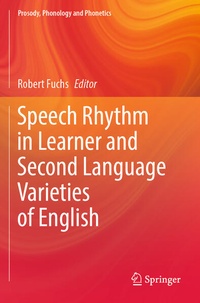
Speech Rhythm in Learner and Second Language Varieties of English
Published on 20. August 2024
Book
Paperback/Softback
VI, 229 pages
978-981-19-8942-1 (ISBN)
Description
This book presents cutting-edge research on the production and perception of speech rhythm by speakers of English in countries where it is used as a foreign language or an institutionalised second language (also sometimes known as the Expanding and Outer Circles). It contributes to a better understanding of speech rhythm, which has long been recognised as an important supra-segmental category of speech, focusing on its relevance in World Englishes, Second Language Acquisition and learner varieties of English, as well as the sociolinguistic and perceptual significance of this phonological variable.
More details
Series
Edition
2023 ed.
Language
English
Place of publication
Singapore
Singapore
Target group
Professional and scholarly
Illustrations
54 s/w Abbildungen, 23 farbige Abbildungen
VI, 229 p. 77 illus., 23 illus. in color.
Dimensions
Height: 235 mm
Width: 155 mm
Thickness: 13 mm
Weight
365 gr
ISBN-13
978-981-19-8942-1 (9789811989421)
DOI
10.1007/978-981-19-8940-7
Schweitzer Classification
Other editions
Additional editions
Book
08/2023
Springer
€149.79
Shipment within 3-4 weeks
Person
Dr. Robert Fuchs is an Associate Professor of English Linguistics at the University of Hamburg, Germany. He has previously held positions in Hong Kong and at the Universities of Münster and Augsburg, Germany. His research focuses on acoustic phonetics and laboratory phonology, corpus linguistics, corpus-assisted discourse analysis, varieties of English and learner English. In 2016, he was awarded the Richard M. Hogg Prize by the International Society for the Linguistics of English.
Content
(Re-)viewing the Acquisition of Rhythm in the Light of L2 Phonological Theories.- Individual Patterns in Production and Perception of Periodic Speech Among L1 and L2 English Speakers.- Analysing Rhythmic Variability in Indian English: the Case of Marathi English and Telugu English.- The Introduction of English Rhythm in the EFL Classroom to Improve Intelligibility, Comprehensibility and Fluency.- Bilingual and Monolingual Speech Rhythm in Additional Language Learning.- Rhythmic Patterns of Malaysian English Speakers.- L2 Speech Rhythm Development in a Study-Abroad Setting.- Investigating (Rhythm) Variation in Indian English: an Integrated Approach.- Novel Methods for Characterising L2 Speech Rhythm.- Speech Rhythm, Intonation and Segmental Differences as Cues to Dialect Discrimination.