

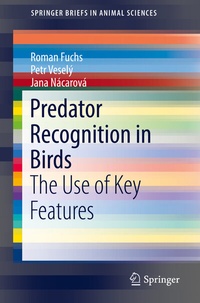
Predator Recognition in Birds
The Use of Key Features
Published on 4. April 2019
Book
Paperback/Softback
X, 117 pages
978-3-030-12402-1 (ISBN)
Description
This SpringerBrief answers the question on how birds recognize their predators using multidisciplinary approaches and outlines paths of the future research of predator recognition. A special focus is put on the role of key features to discriminate against predators and non-predators. The first part of the book provides a comprehensive review of the mechanisms of predator recognition based on classical ethological studies in untrained birds. The second part introduces a new view on the topic treating theories of cognitive ethology. This approach involves examination of conditioned domestic pigeons and highlights the actual abilities of birds to recognize and categorize.
More details
Series
Edition
2019 ed.
Language
English
Place of publication
Cham
Switzerland
Publishing group
Springer International Publishing
Target group
Professional and scholarly
Illustrations
8 s/w Abbildungen
X, 117 p. 8 illus.
Dimensions
Height: 235 mm
Width: 155 mm
Thickness: 8 mm
Weight
207 gr
ISBN-13
978-3-030-12402-1 (9783030124021)
DOI
10.1007/978-3-030-12404-5
Schweitzer Classification
Other editions
Additional editions
E-Book
03/2019
1st Edition
Springer
€53.49
Available for download
Persons
Dr. Roman Fuchs Department of Zoology Faculty of Science University of South Bohemia Branisovská 1760 37005 Ceské Budejovice Czech Republic Dr. Petr Veselý Department of ZoologyFaculty of Science University of South BohemiaBranisovská 1760 37005 Ceské Budejovice Czech Republic Dr. Jana NácarováDepartment of ZoologyFaculty of Science University of South BohemiaBranisovská 1760 37005 Ceské Budejovice Czech Republic
Content
1 What do we know about predator recognition by untrained birds?.- 1.1 The study of predator recognition (How to make birds respond in etho-ecological experiments - to show that they recognized the predator - nest defense, feeder experiments, laboratory experiments.).- 1.2 Evidence for predator recognition ability (What predator categories birds recognize - predator vs. non-predator, aerial vs. terrestrial predators, individual predator species.).- 1.3 Tools used for predator recognition (What cues bird use for predator recognition - sign stimuli, coloration, size.).- 2 What can the recognition experiments with trained pigeons tell?.- 2.1 Category discrimination and concepts formation (How do birds form categories of predators - memorizing vs. generalization vs. conceptualization.).- 2.2 Object recognition (What cues birds use for predator recognition - particulate feature theory vs. recognition by components, local vs. global features.).- 2.3 Other cognitive processes (Are we able toreveal other cognitive processes in predator recognition by birds - amodal completion, priming.).