

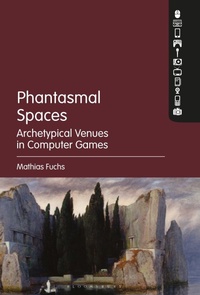
Phantasmal Spaces
Archetypical Venues in Computer Games
Published on 24. December 2020
Book
Paperback/Softback
176 pages
978-1-5013-7626-9 (ISBN)
Description
Recognizable, recurring spatial settings in video games serve not only as points of reference and signposts for orientation, but also as implicit sources of content. These spatial archetypes denote more than real-world objects or settings: they suggest and bring forward emotional states, historical context, atmospheric "attunement," in the words of Massumi, and aesthetic programs that go beyond plain semiotic reference.
In each chapter, Mathias Fuchs brings to the fore an archetype commonly found in old and new digital games: The Ruin, The Cave, The Cloud, The Portal, The Road, The Forest, and The Island are each analysed at length, through the perspectives of aesthetics, games technology, psychoanalysis, and intertextuality. Gridding these seven tropes together with these four analytical lenses provides the reader with a systematic framework to understand the various complex considerations at play in evocative game design.
In each chapter, Mathias Fuchs brings to the fore an archetype commonly found in old and new digital games: The Ruin, The Cave, The Cloud, The Portal, The Road, The Forest, and The Island are each analysed at length, through the perspectives of aesthetics, games technology, psychoanalysis, and intertextuality. Gridding these seven tropes together with these four analytical lenses provides the reader with a systematic framework to understand the various complex considerations at play in evocative game design.
Reviews / Votes
Mathias Fuchs ventures into a fascinating range of art-historical, literary, film and philosophical references to analyse the function of archetypal experiences of various spatial environments commonly found in computer games. * Burlington Contemporary * A major new work in game aesthetics: Fuchs neatly sidesteps the stale isolationist dogma of game studies by treating videogames as entwined within the same cultural and psychological forces as other artworks. And about time too! * Chris Bateman, game designer and author of Imaginary Games (2011) * Mathias Fuchs's new approach to the analysis of computer games makes us aware of how much of the spaces occupied by players are in fact dreamscapes, places of phantasmal qualities. The book aims way beyond the 'spatial turn' in game studies and approaches spaces as lived-in phantasms. Full of insights and surprising observations, Phantasmal Spaces is a complex yet widely accessible contribution to the study of our own imagination in times of digital media. * Markus Rautzenberg, Professor of Philosophy, Folkwang University of the Arts, Germany *More details
Language
English
Place of publication
New York
United States
Publishing group
Bloomsbury Publishing Plc
Target group
College/higher education
Professional and scholarly
Illustrations
17 bw illus, 2 tables
Dimensions
Height: 229 mm
Width: 152 mm
Thickness: 10 mm
Weight
268 gr
ISBN-13
978-1-5013-7626-9 (9781501376269)
Copyright in bibliographic data and cover images is held by Nielsen Book Services Limited or by the publishers or by their respective licensors: all rights reserved.
Schweitzer Classification
Other editions
Additional editions
E-Book
06/2019
1st Edition
Bloomsbury Academic USA
€36.99
Available for download
E-Book
06/2019
1st Edition
Bloomsbury Academic USA
€36.99
Available for download
Person
Mathias Fuchs is Professor at the Institute of Culture and Aesthetics of Digital Media at Leuphana University of Lueneburg, Germany. An artist as well as media scholar, Fuchs pioneered the artistic use of computer games and has exhibited work at ISEA, SIGGRAPH and the Millennium Dome. He is the editor of Diversity of Play (2015) and co-editor of Rethinking Gamification (2014).
Content
Phantasmal Spaces: Introduction
1. The Road
Road Movies, Photography, Edward Hopper's Roads
Driving Games and Driving Game Interfaces
Psychology of Driving
Transmedia Road Phantasms
2. The Ruin
Painting Decay
Digital Dust
Sigmund Freud's Death Drive and the Opponents Thereof
S.T.A.L.K.E.R. and Tarkovsky's Wastelands
3. The Cave
Cave Men
Unreal Tournament Design Philosophy, Boolean Subtractions
Frightened to Death
C-movies
4. The Cloud
The Beauty of Clouds and Industrial Steam
Cloud Rendering
Head in the Clouds: Daydreaming
Transmedia Cloud Formations
5. The Cliff
Running and Falling
Physics Engines
Psychology of Risk Taking
Leaping from One Medium to Another
6. The Forest
Nibelungen Forests
Tree-Generators
The Uncanny
Tale of Tale of Tales
7. The Portal
Doors, Gateways, Passages
Warp Zones
Rites of Passage
Doors in Transmedia Spacetelling
8. The Island
You are Alone!
Chiselling Mountains - Fetching Pretty Sunrises
Really Alone!!!
Robinson Crusoe
Atmospheric Places: Conclusion
References
Ludography
Index
1. The Road
Road Movies, Photography, Edward Hopper's Roads
Driving Games and Driving Game Interfaces
Psychology of Driving
Transmedia Road Phantasms
2. The Ruin
Painting Decay
Digital Dust
Sigmund Freud's Death Drive and the Opponents Thereof
S.T.A.L.K.E.R. and Tarkovsky's Wastelands
3. The Cave
Cave Men
Unreal Tournament Design Philosophy, Boolean Subtractions
Frightened to Death
C-movies
4. The Cloud
The Beauty of Clouds and Industrial Steam
Cloud Rendering
Head in the Clouds: Daydreaming
Transmedia Cloud Formations
5. The Cliff
Running and Falling
Physics Engines
Psychology of Risk Taking
Leaping from One Medium to Another
6. The Forest
Nibelungen Forests
Tree-Generators
The Uncanny
Tale of Tale of Tales
7. The Portal
Doors, Gateways, Passages
Warp Zones
Rites of Passage
Doors in Transmedia Spacetelling
8. The Island
You are Alone!
Chiselling Mountains - Fetching Pretty Sunrises
Really Alone!!!
Robinson Crusoe
Atmospheric Places: Conclusion
References
Ludography
Index