

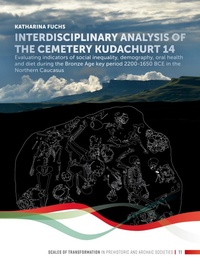
Interdisciplinary analysis of the cemetery 'Kudachurt 14'
Evaluating indicators of social inequality, demography, oral health and diet during the Bronze Age key period 2200-1650 BCE in the Northern Caucasus
1st Edition
Published on 28. November 2020
Book
Paperback/Softback
440 pages
978-90-8890-903-0 (ISBN)
Description
This book provides detailed disciplinary and interdisciplinary insights into social inequality, oral health and dietary strategies of a Bronze Age population buried in the North Caucasian foothills, 2200-1650 BCE.
More details
Series
Thesis
Doctoral thesis
Edition
1. Auflage
Language
English
Place of publication
Leiden
Netherlands
Target group
Professional and scholarly
Illustrations
137fc/25bw
Dimensions
Height: 280 mm
Width: 210 mm
Thickness: 27 mm
Weight
1467 gr
ISBN-13
978-90-8890-903-0 (9789088909030)
DOI
https://doi.org/10.59641/l4568ox
Copyright in bibliographic data and cover images is held by Nielsen Book Services Limited or by the publishers or by their respective licensors: all rights reserved.
Schweitzer Classification
Person
Katharina Fuchs obtained her doctoral degree as a scholar of the Graduate School 'Human Development in Landscapes' in 2018 at Kiel University. Being an archaeologist and physical anthropologist by training, she has a strong interest in interdisciplinary research with a special focus on health and disease in past populations.
Besides working with human remains from different archaeological contexts and geographic regions, she gained experience as the scientific coordinator of the Collaborative Research Centre 1266 'Scales of Transformation: Socio-environmental interactions in Prehistoric and Archaic Societies' . Recently, she joined the team of the Ancient DNA Laboratory at the Institute of Clinical Molecular Biology at Kiel University, and is research associate for Human Osteology and aDNA in the scope of the Johanna-Mestorf Academy.
Besides working with human remains from different archaeological contexts and geographic regions, she gained experience as the scientific coordinator of the Collaborative Research Centre 1266 'Scales of Transformation: Socio-environmental interactions in Prehistoric and Archaic Societies' . Recently, she joined the team of the Ancient DNA Laboratory at the Institute of Clinical Molecular Biology at Kiel University, and is research associate for Human Osteology and aDNA in the scope of the Johanna-Mestorf Academy.
Content
PART I: BACKGROUND AND OBJECTIVES OF RESEARCH
1. Introduction
1.1. Environmental and archaeological background
1.1.1. Topography and environment
1.1.2. The North Caucasian Bronze Age: Cultures and chronology
1.1.3. Climatic conditions
1.2. State of the art
1.2.1. Burial practices: Socio-ritual indicators
1.2.2. Human Remains: Osteology and palaeopathology
1.2.3. Stable isotope analyses: Palaeodietary reconstructions
2. Questions of research and methodological approach
2.1. The cemetery 'Kudachurt 14' (chapter 3)
2.2. Burial practice: Social indicators (chapter 4)
2.3. Human Remains: Demography and oral health (chapter 5)
2.4. Carbon and nitrogen stable isotopes: Palaeodietary reconstruction (chapter 6)
2.5. Interdisciplinary synthesis: Burial practice, human osteology and stable isotopes (chapter 7)
2.6. Basic approach and terminology
3. The cemetery of Kudachurt 14
3.1. Location and environmental aspect
3.2. Excavation and subsequent work
3.2.1. Excavation techniques and on-site documentation
3.2.2. Findings: Inventory, preparation and current state
3.3. Cemetery plan
3.4. Findings and chronology
3.4.1. Relative chronology and typological classification
3.4.1.1. Kudachurt 14 and typological significance
3.4.1.2. Comparison of sites and finds
3.4.2. Radiocarbon dating and stratigraphy
3.4.2.1. Radiocarbon dating
3.4.2.2. Stratigraphic structures
3.4.2.3. Radiocarbon dating and stratigraphic structures
3.4.3. Summary: Chronology and typological classification
3.5. Kudachurt 14 and the MBA-LBA transition in the Northern Caucasus
PART II: DISCIPLINARY ANALYSES: BURIAL PRACTICE, HUMAN REMAINS AND ISOTOPES
4. Burial practice: Social indicators
4.1. Characteristics of burial practice
4.1.1. Spatial distribution
4.1.2. Elements of grave construction
4.1.3. Inhumations and burial types
4.1.4. Goods for the dead: Burial items
4.1.5. Data quality groups
4.2. Results 1: Basis of data and single characteristics
4.2.1. Elements of grave construction
4.2.1.1. Construction elements
4.2.1.2. Construction elements and dimensions
4.2.1.3. Dromos structures
4.2.1.4. Spatial distribution
4.2.1.5. Summary elements of grave construction
4.2.2. Inhumation and burial types
4.2.2.1. Skeletal in situ-preservation
4.2.2.2. MNIC, MNIG and burial type
4.2.2.3. Signs of re-access
4.2.2.4. Body treatment
4.2.2.5. Presence of ochre
4.2.3. Burial items
4.2.3.1. Cemetery and data quality
4.2.3.2. Cemetery and burial item criteria
4.2.3.3. Graves and burial item criteria
4.2.3.4. Grave assemblages and burial item criteria
4.2.3.5. Functional classes and spatial distribution
4.2.3.6. Assemblage variation: CPI and CRI
4.2.3.7. Evaluation: significance of CPI and CRI
4.2.3.8. Assemblage compositions: Correspondence analyses
4.2.3.9. Summary burial item analyses
4.3. Results 2: Social proxies of burial practice
4.3.1. Construction elements, burial types and MNIG
4.3.2. Construction elements and burial item characteristics
4.3.3. Burial item criteria: burial types and individuals
4.3.3.1. Data basis and clearing
4.3.3.2. Frequencies per burial type and individual
4.3.4. Burial item criteria: Assemblage functional character and burial type
4.3.5. Burial item criteria: Assemblage compositions and burial type
4.3.6. Burial item criteria: Assemblage functional character and individuals
4.3.6.1. Single burials
4.3.6.2. Double burials
4.3.6.3. Collective burials
4.3.6.4. Bodily treatment
4.3.6.5. Interim result: Individual equipment
4.4. Chronological aspects
4.5. Discussion and evaluation: Burial practice and social indicators
4.5.1. Grave constructions: Proxies for effort or practicability?
4.5.2. Regularities of bodily treatment?
4.5.3. Burial item criteria: Cemetery
4.5.4. Funeral equipment groups: Commonalities or inequalities?
4.5.5. Social implications of burial practice
4.6. Conclusions
5. Human remains: Demography and oral health
5.1. Functional data from human remains
5.2. Significance of biological sex and age-at-death
5.3. Dental pathology and oral health
5.4. Investigative parameters and methods
5.4.1. Anatomical terminology
5.4.2. Preparatory work and recording approach
5.4.3. Age-at-death
5.4.4. Biological sex
5.4.5. Categories of oral health
5.4.5.1. Dental calculus
5.4.5.2. Periodontal disease
5.4.5.3. Periapical lesions
5.4.5.4. Antemortem tooth loss
5.4.5.5. Dental wear: Masticatory and extramasticatory traits
5.4.5.6. Carious lesions
5.4.5.7. Enamel hypoplasia
5.5. Material: Graves, individuals and dentitions
5.6. Results 1: Data basis, demography and categories of oral health
5.6.1. Data basis: skeletal and dental preservation
5.6.2. Demography: Age-at-death and biological sex
5.6.2.1. Cemetery (IOC)
5.6.2.2. Graves and spatial distribution (IOG)
5.6.3. Categories of oral health
5.6.3.1. Dental calculus
5.6.3.2. Periodontal disease
5.6.3.3. Periapical lesions
5.6.3.4. Antemortem and perimortem tooth loss
5.6.3.5. Dental wear: Masticatory and extramasticatory traits
5.6.3.6. Interrelations of dental wear: Individual dentitions
5.6.3.7. Carious lesions
5.6.3.8. AMTL calibration: Caries and dental wear
5.6.3.9. Extramasticatory traits: Occupational habits or hygienic measures?
5.6.3.10. Enamel hypoplasia
5.6.4. Summary oral health: Results 1
5.7. Results 2: Statuses of oral health and burial contexts
5.7.1. Correlation of oral health categories: Inter-individual comparison
5.7.2. Statuses of oral health, burial contexts and spatial distribution
5.8. Chronological aspects
5.9. Discussion and evaluation: Demography and oral health
5.9.1. Demographic and palaeopathological implications
5.9.2. Dietary implications
5.9.3. Occupational habits
5.9.4. Social implications
6. Carbon and nitrogen stable isotopes: Palaeodietary reconstruction
6.1. Principles of stable isotope analyses
6.1.1. Basic concept and terminology
6.1.2. Stable C and N isotopes from bone collagen
6.1.3. Stable C and N isotopes in palaeodietary reconstructions
6.1.3.1. Food webs
6.1.3.2. ?13C
6.1.3.3. ?15N
6.2. Recent research on subsistence and diet in the North Caucasian Bronze Age
6.3. The significance of Kudachurt 14
6.4. Working hypotheses
6.5. Material and methods
6.5.1. Sample selection
6.5.2. Methods
6.6. Results
6.6.1. Collagen quality
6.6.2. Animal values
6.6.3. Human values
6.6.4. Animal and human values
6.7. Discussion and evaluation
6.8. Chronological aspects
6.9. Context of current C and N isotope research in the North Caucasian Bronze Age
6.10. Conclusion: Trends and limits of dietary reconstructions at Kudachurt 14
PART III: INTERDISCIPLINAR SYNTHESIS AND CONCLUSION
7. Interdisciplinary synthesis: Burial practice, human remains, and stable isotopes
7.1. Cemetery: Age, sex and funeral equipment
7.2. Individual contexts: Burial practice, social inequality and demography
7.3. Grave contexts: Social inequality, demography, oral health and diet
8. Conclusions
8.1. Research questions and answers
8.1.1. The cemetery Kudachurt 14 (chapter 3)
8.1.2. Burial practice: Social indicators (chapter 4)
8.1.3. Human Remains: Demography and oral health (chapter 5)
8.1.4. Carbon and nitrogen stable isotopes: Palaeodietary reconstruction (chapter 6)
8.1.5. Interdisciplinary synthesis: Burial practice, human osteology and stable isotopes (chapter 7)
8.2. Evaluation and research prospects
9. Short summary
10. Kurzzusammenfassung
11. ??????? ??????????
12. References
13. Tables, figures and abbreviations
13.1. List of tables
13.2. List of figures and copyrights
13.3. Abbreviations
PART IV: ONLINE DATA: CATALOGUE AND APPENDIX
14. Appendix
14.1. Isotope tables
14.1. Recording schemes
15. Grave catalogue
16. Item plate catalogue
17. Database
1. Introduction
1.1. Environmental and archaeological background
1.1.1. Topography and environment
1.1.2. The North Caucasian Bronze Age: Cultures and chronology
1.1.3. Climatic conditions
1.2. State of the art
1.2.1. Burial practices: Socio-ritual indicators
1.2.2. Human Remains: Osteology and palaeopathology
1.2.3. Stable isotope analyses: Palaeodietary reconstructions
2. Questions of research and methodological approach
2.1. The cemetery 'Kudachurt 14' (chapter 3)
2.2. Burial practice: Social indicators (chapter 4)
2.3. Human Remains: Demography and oral health (chapter 5)
2.4. Carbon and nitrogen stable isotopes: Palaeodietary reconstruction (chapter 6)
2.5. Interdisciplinary synthesis: Burial practice, human osteology and stable isotopes (chapter 7)
2.6. Basic approach and terminology
3. The cemetery of Kudachurt 14
3.1. Location and environmental aspect
3.2. Excavation and subsequent work
3.2.1. Excavation techniques and on-site documentation
3.2.2. Findings: Inventory, preparation and current state
3.3. Cemetery plan
3.4. Findings and chronology
3.4.1. Relative chronology and typological classification
3.4.1.1. Kudachurt 14 and typological significance
3.4.1.2. Comparison of sites and finds
3.4.2. Radiocarbon dating and stratigraphy
3.4.2.1. Radiocarbon dating
3.4.2.2. Stratigraphic structures
3.4.2.3. Radiocarbon dating and stratigraphic structures
3.4.3. Summary: Chronology and typological classification
3.5. Kudachurt 14 and the MBA-LBA transition in the Northern Caucasus
PART II: DISCIPLINARY ANALYSES: BURIAL PRACTICE, HUMAN REMAINS AND ISOTOPES
4. Burial practice: Social indicators
4.1. Characteristics of burial practice
4.1.1. Spatial distribution
4.1.2. Elements of grave construction
4.1.3. Inhumations and burial types
4.1.4. Goods for the dead: Burial items
4.1.5. Data quality groups
4.2. Results 1: Basis of data and single characteristics
4.2.1. Elements of grave construction
4.2.1.1. Construction elements
4.2.1.2. Construction elements and dimensions
4.2.1.3. Dromos structures
4.2.1.4. Spatial distribution
4.2.1.5. Summary elements of grave construction
4.2.2. Inhumation and burial types
4.2.2.1. Skeletal in situ-preservation
4.2.2.2. MNIC, MNIG and burial type
4.2.2.3. Signs of re-access
4.2.2.4. Body treatment
4.2.2.5. Presence of ochre
4.2.3. Burial items
4.2.3.1. Cemetery and data quality
4.2.3.2. Cemetery and burial item criteria
4.2.3.3. Graves and burial item criteria
4.2.3.4. Grave assemblages and burial item criteria
4.2.3.5. Functional classes and spatial distribution
4.2.3.6. Assemblage variation: CPI and CRI
4.2.3.7. Evaluation: significance of CPI and CRI
4.2.3.8. Assemblage compositions: Correspondence analyses
4.2.3.9. Summary burial item analyses
4.3. Results 2: Social proxies of burial practice
4.3.1. Construction elements, burial types and MNIG
4.3.2. Construction elements and burial item characteristics
4.3.3. Burial item criteria: burial types and individuals
4.3.3.1. Data basis and clearing
4.3.3.2. Frequencies per burial type and individual
4.3.4. Burial item criteria: Assemblage functional character and burial type
4.3.5. Burial item criteria: Assemblage compositions and burial type
4.3.6. Burial item criteria: Assemblage functional character and individuals
4.3.6.1. Single burials
4.3.6.2. Double burials
4.3.6.3. Collective burials
4.3.6.4. Bodily treatment
4.3.6.5. Interim result: Individual equipment
4.4. Chronological aspects
4.5. Discussion and evaluation: Burial practice and social indicators
4.5.1. Grave constructions: Proxies for effort or practicability?
4.5.2. Regularities of bodily treatment?
4.5.3. Burial item criteria: Cemetery
4.5.4. Funeral equipment groups: Commonalities or inequalities?
4.5.5. Social implications of burial practice
4.6. Conclusions
5. Human remains: Demography and oral health
5.1. Functional data from human remains
5.2. Significance of biological sex and age-at-death
5.3. Dental pathology and oral health
5.4. Investigative parameters and methods
5.4.1. Anatomical terminology
5.4.2. Preparatory work and recording approach
5.4.3. Age-at-death
5.4.4. Biological sex
5.4.5. Categories of oral health
5.4.5.1. Dental calculus
5.4.5.2. Periodontal disease
5.4.5.3. Periapical lesions
5.4.5.4. Antemortem tooth loss
5.4.5.5. Dental wear: Masticatory and extramasticatory traits
5.4.5.6. Carious lesions
5.4.5.7. Enamel hypoplasia
5.5. Material: Graves, individuals and dentitions
5.6. Results 1: Data basis, demography and categories of oral health
5.6.1. Data basis: skeletal and dental preservation
5.6.2. Demography: Age-at-death and biological sex
5.6.2.1. Cemetery (IOC)
5.6.2.2. Graves and spatial distribution (IOG)
5.6.3. Categories of oral health
5.6.3.1. Dental calculus
5.6.3.2. Periodontal disease
5.6.3.3. Periapical lesions
5.6.3.4. Antemortem and perimortem tooth loss
5.6.3.5. Dental wear: Masticatory and extramasticatory traits
5.6.3.6. Interrelations of dental wear: Individual dentitions
5.6.3.7. Carious lesions
5.6.3.8. AMTL calibration: Caries and dental wear
5.6.3.9. Extramasticatory traits: Occupational habits or hygienic measures?
5.6.3.10. Enamel hypoplasia
5.6.4. Summary oral health: Results 1
5.7. Results 2: Statuses of oral health and burial contexts
5.7.1. Correlation of oral health categories: Inter-individual comparison
5.7.2. Statuses of oral health, burial contexts and spatial distribution
5.8. Chronological aspects
5.9. Discussion and evaluation: Demography and oral health
5.9.1. Demographic and palaeopathological implications
5.9.2. Dietary implications
5.9.3. Occupational habits
5.9.4. Social implications
6. Carbon and nitrogen stable isotopes: Palaeodietary reconstruction
6.1. Principles of stable isotope analyses
6.1.1. Basic concept and terminology
6.1.2. Stable C and N isotopes from bone collagen
6.1.3. Stable C and N isotopes in palaeodietary reconstructions
6.1.3.1. Food webs
6.1.3.2. ?13C
6.1.3.3. ?15N
6.2. Recent research on subsistence and diet in the North Caucasian Bronze Age
6.3. The significance of Kudachurt 14
6.4. Working hypotheses
6.5. Material and methods
6.5.1. Sample selection
6.5.2. Methods
6.6. Results
6.6.1. Collagen quality
6.6.2. Animal values
6.6.3. Human values
6.6.4. Animal and human values
6.7. Discussion and evaluation
6.8. Chronological aspects
6.9. Context of current C and N isotope research in the North Caucasian Bronze Age
6.10. Conclusion: Trends and limits of dietary reconstructions at Kudachurt 14
PART III: INTERDISCIPLINAR SYNTHESIS AND CONCLUSION
7. Interdisciplinary synthesis: Burial practice, human remains, and stable isotopes
7.1. Cemetery: Age, sex and funeral equipment
7.2. Individual contexts: Burial practice, social inequality and demography
7.3. Grave contexts: Social inequality, demography, oral health and diet
8. Conclusions
8.1. Research questions and answers
8.1.1. The cemetery Kudachurt 14 (chapter 3)
8.1.2. Burial practice: Social indicators (chapter 4)
8.1.3. Human Remains: Demography and oral health (chapter 5)
8.1.4. Carbon and nitrogen stable isotopes: Palaeodietary reconstruction (chapter 6)
8.1.5. Interdisciplinary synthesis: Burial practice, human osteology and stable isotopes (chapter 7)
8.2. Evaluation and research prospects
9. Short summary
10. Kurzzusammenfassung
11. ??????? ??????????
12. References
13. Tables, figures and abbreviations
13.1. List of tables
13.2. List of figures and copyrights
13.3. Abbreviations
PART IV: ONLINE DATA: CATALOGUE AND APPENDIX
14. Appendix
14.1. Isotope tables
14.1. Recording schemes
15. Grave catalogue
16. Item plate catalogue
17. Database