

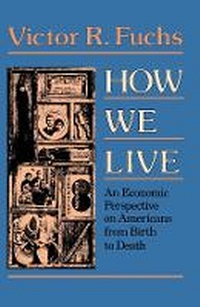
How We Live
An Economic Perspective on Americans from Birth to Death
Published on 1. January 1984
Book
Paperback/Softback
320 pages
978-0-674-41226-2 (ISBN)
Description
Victor Fuchs, author of Who Shall Live?, cuts through the hand wringing and the "pop" panaceas for America's current social crises in a brilliant analysis of the way we live. The facts are familiar. A doubled rate of divorce. A birth rate cut nearly in half while the percentage of illegitimate births nearly tripled. The young face dismal job prospects, and many of the old are totally dependent on the federal government.
Fuchs's economic approach shows us that the societal upheaval of American life is not created by fiat but rather emerges as millions of men and women make seemingly small choices that are constrained by their circumstances: "Should I go back to school?" "How many children should we have?" "When should I retire?" In a masterly synthesis, he shows the interrelatedness of our choices regarding family, work, health, and education throughout the life cycle. He uses the latest facts of American life to explore three major themes-the fading family, the impact of simple demographics on individual destiny, and the effect of weighing present and future costs and benefits on individual choice.
Fuchs concludes by offering innovative solutions to many contemporary problems: social security, health insurance, child care, youth unemployment, and illegitimate births. Moving beyond the outworn orthodoxies of liberalism and conservatism, he offers a clearer view of our circumstances so that readers from all walks of life can make better private choices, and contribute to more effective public policies.
Fuchs's economic approach shows us that the societal upheaval of American life is not created by fiat but rather emerges as millions of men and women make seemingly small choices that are constrained by their circumstances: "Should I go back to school?" "How many children should we have?" "When should I retire?" In a masterly synthesis, he shows the interrelatedness of our choices regarding family, work, health, and education throughout the life cycle. He uses the latest facts of American life to explore three major themes-the fading family, the impact of simple demographics on individual destiny, and the effect of weighing present and future costs and benefits on individual choice.
Fuchs concludes by offering innovative solutions to many contemporary problems: social security, health insurance, child care, youth unemployment, and illegitimate births. Moving beyond the outworn orthodoxies of liberalism and conservatism, he offers a clearer view of our circumstances so that readers from all walks of life can make better private choices, and contribute to more effective public policies.
Reviews / Votes
Mr. Fuchs writes clearly and with remarkable common sense... One wishes that How We Live could be made compulsory reading for senators, representatives, and the people at the White House. -- Alfred L. Malabre, Jr. * Wall Street Journal * Fuchs genuinely uses economic data and reasoning to illuminate the choices people make and yet remains quite free of the intellectually imperial view that economic analysis alone suffices to explain the choices... How We Live is a veritable handbook for reformers. Those concerned with policies affecting the family and the labor market especially cannot afford to ignore the information Fuchs assembles. -- Dennis Wrong * The New Republic * Chock-full of fascinating facts and educated conjectures...there is much insightful research. And Mr. Fuchs's compact style makes the book a pleasure to read. -- Peter Passell * New York Times * The book is addressed to a wide audience, and...will be extremely effective in teaching laymen that basic economic principles can go a long way in explaining the changing structure of our lives. -- Walter Y. Oi * Journal of Economic Literature * Can be recommended for scholars, students, policy makers, and even friends or relatives who ask, 'What do economists do?' -- Lee Benham * Journal of Political Economy * Victor Fuchs has performed an astonishing job of synthesis and exposition of the vast literature on the progress of Americans through their life cycle. The economic point of view is maintained but with a breadth not always characteristic of economists working in this area. -- Kenneth J. ArrowMore details
Language
English
Place of publication
Cambridge, Mass
United States
Target group
College/higher education
Professional and scholarly
Illustrations
13 line illustrations, 26 tables
Dimensions
Height: 235 mm
Width: 156 mm
Weight
499 gr
ISBN-13
978-0-674-41226-2 (9780674412262)
Copyright in bibliographic data and cover images is held by Nielsen Book Services Limited or by the publishers or by their respective licensors: all rights reserved.
Schweitzer Classification