

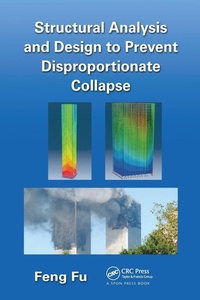
Structural Analysis and Design to Prevent Disproportionate Collapse
1st Edition
Published on 24. January 2018
Book
Paperback/Softback
202 pages
978-1-138-49041-3 (ISBN)
Description
Hard Guidance on Preventing Disproportionate Collapse
Disproportionate collapse is a pressing issue in current design practice. Numerous causes are possible - especially forms of extreme loading, such as blast, fire, earthquake, or vehicle collisions. But it is the mechanism and its prevention which are of especial interest and concern.
After the World Trade Center collapse in 2001, interest was sparked, and it is now imperative for a design engineer to have sufficient knowledge on both the analysis and design against disproportionate collapse. Detailed structural design guidance for preventing this has been developed in Europe and the US - such as BS5950 in the UK, and guidance from the Department of Defense and the General Services Administration in the US. However, Structural Analysis and Design to Prevent Disproportionate Collapse is the first systematic text in the market to help design engineers or structural engineering students to properly understand this guidance.
Covers the design and analysis of a structure to prevent disproportionate collapse
Provides an understanding of disproportionate collapse problems for different structures under different loads
Contains detailed knowledge on the design and progressive collapse analysis of complex structures
Incorporates ABAQUS (R), ETABS, SAP2000, and Highlights 3D Modeling Techniques
As progressive collapse analysis is a distinctive and complicated procedure, it normally requires an ability to use a modern commercial finite element package, and Structural Analysis and Design to Prevent Disproportionate Collapse features a detailed introduction to the use of FE programs such as ABAQUS (R) in progressive collapse analysis. In addition, case studies are performed using 3D FE models based on various types of structures such as multi-storey buildings, long-span space structures, and bridges. These models replicate real collapse incidents and prestigious construction projects, such as progressive collapse analysis of the Twin Towers, structural fire analysis of World Trade Center 7, blast analysis of the Murrah Federal Building and progressive collapse analysis of the Millau Viaduct, which help designers to fully understand the failure mechanisms and effective mitigation methods in practice.
Disproportionate collapse is a pressing issue in current design practice. Numerous causes are possible - especially forms of extreme loading, such as blast, fire, earthquake, or vehicle collisions. But it is the mechanism and its prevention which are of especial interest and concern.
After the World Trade Center collapse in 2001, interest was sparked, and it is now imperative for a design engineer to have sufficient knowledge on both the analysis and design against disproportionate collapse. Detailed structural design guidance for preventing this has been developed in Europe and the US - such as BS5950 in the UK, and guidance from the Department of Defense and the General Services Administration in the US. However, Structural Analysis and Design to Prevent Disproportionate Collapse is the first systematic text in the market to help design engineers or structural engineering students to properly understand this guidance.
Covers the design and analysis of a structure to prevent disproportionate collapse
Provides an understanding of disproportionate collapse problems for different structures under different loads
Contains detailed knowledge on the design and progressive collapse analysis of complex structures
Incorporates ABAQUS (R), ETABS, SAP2000, and Highlights 3D Modeling Techniques
As progressive collapse analysis is a distinctive and complicated procedure, it normally requires an ability to use a modern commercial finite element package, and Structural Analysis and Design to Prevent Disproportionate Collapse features a detailed introduction to the use of FE programs such as ABAQUS (R) in progressive collapse analysis. In addition, case studies are performed using 3D FE models based on various types of structures such as multi-storey buildings, long-span space structures, and bridges. These models replicate real collapse incidents and prestigious construction projects, such as progressive collapse analysis of the Twin Towers, structural fire analysis of World Trade Center 7, blast analysis of the Murrah Federal Building and progressive collapse analysis of the Millau Viaduct, which help designers to fully understand the failure mechanisms and effective mitigation methods in practice.
Reviews / Votes
"This book can be used by students, engineers and researchers as a unique source, as it contains necessary theories, numerical procedures, design strategies and use of commercial software. The real scenario case studies offer insight and understanding of this most disastrous form of structural failure."-Jianqiao Ye, Lancaster University, UK
"It is of major practical interest and I would definitely recommend it for design engineering offices and lecturers in structural mechanics."
-Philippe Bouillard, Universite Libre de Bruxelles, Belgium
"This book attempts to advance the state of the art by showing how to create computer models of large structures that are then subject to an "event" to see if the subsequent collapse is progressive."
- Roger Davies in TheStructuralEngineer
"An excellent introduction to the progressive collapse of structures that will allow the understanding of the basic aspects of this phenomenon and help improve structural designs. ... This is a compact and clearly written book that the reader will find easy to read."
-- Jose M. Adam, in Journal of Performance of Constructed Facilities, ASCE "This book can be used by students, engineers and researchers as a unique source, as it contains necessary theories, numerical procedures, design strategies and use of commercial software. The real scenario case studies offer insight and understanding of this most disastrous form of structural failure."
-Jianqiao Ye, Lancaster University, UK
"It is of major practical interest and I would definitely recommend it for design engineering offices and lecturers in structural mechanics."
-Philippe Bouillard, Universite Libre de Bruxelles, Belgium
"This book attempts to advance the state of the art by showing how to create computer models of large structures that are then subject to an "event" to see if the subsequent collapse is progressive."
- Roger Davies in TheStructuralEngineer
"An excellent introduction to the progressive collapse of structures that will allow the understanding of the basic aspects of this phenomenon and help improve structural designs. ... This is a compact and clearly written book that the reader will find easy to read."
-- Jose M. Adam, in Journal of Performance of Constructed Facilities
More details
Language
English
Place of publication
London
United Kingdom
Publishing group
Taylor & Francis Ltd
Target group
College/higher education
Professional and scholarly
Illustrations
120 s/w Abbildungen, 9 s/w Tabellen
9 Tables, black and white; 120 Illustrations, black and white
Dimensions
Height: 234 mm
Width: 156 mm
Thickness: 11 mm
Weight
319 gr
ISBN-13
978-1-138-49041-3 (9781138490413)
Copyright in bibliographic data and cover images is held by Nielsen Book Services Limited or by the publishers or by their respective licensors: all rights reserved.
Schweitzer Classification
Other editions
Additional editions
E-Book
04/2016
CRC Press
€88.49
Available for download
E-Book
04/2016
CRC Press
€88.49
Available for download
Book
03/2016
1st Edition
CRC Press
€215.41
Shipment within 15-20 days
Person
Dr. Feng Fu received his PhD from the University of Leeds and his MBA from the University of Manchester. He is a chartered structural engineer, a member of the Institution of Structural Engineers, a member of the Institution of Civil Engineers and a Member of the American Society of Civil Engineering. He is currently a lecturer in structural engineering at City University, following his work as a lecturer at the University of Bradford. Prior to that, he worked for several consultancy companies, such as the WSP Group, the Waterman Group, and the Beijing Institute of Architectural Design and Research. During his industrial practice, he was involved in the design of extensive prestigious construction projects worldwide. He also gained experience in designing buildings under extreme loadings, and knowledge in designing buildings to prevent progressive collapse.
Content
Introduction. Progressive Collapse Design and Analysis of Multistorey Buildings. Progressive Collapse Design and Analysis of Space Structures. Progressive Collapse Design and Analysis of Bridge Structures. Fire-Induced Building Collapse. Design and Analysis of Buildings under Blast Loading. Conclusion.