

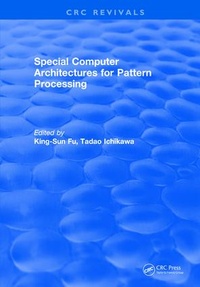
Special Computer Architectures for Pattern Processing
1st Edition
Published on 12. December 2017
Book
Hardback
270 pages
978-1-315-89768-4 (ISBN)
Description
It has been recognized for a long time that a conventional sequential processor is inefficient for operations on pictorial data where relatively simple operations need to be performed on a large number of data elements (pixels). Though many parallel processing architectures for picture processing have been proposed in the past, very few have actually been implemented due to the costs involved. With LSI technology, it is becoming possible to realize parallel architectures at a modest cost. In the following the authors review some of the proposed architectures for pattern recognition and image processing.
More details
Language
English
Place of publication
London
United Kingdom
Publishing group
Taylor & Francis Ltd
Target group
College/higher education
Dimensions
Height: 254 mm
Width: 178 mm
Weight
660 gr
ISBN-13
978-1-315-89768-4 (9781315897684)
Copyright in bibliographic data and cover images is held by Nielsen Book Services Limited or by the publishers or by their respective licensors: all rights reserved.
Schweitzer Classification
Other editions
Additional editions
E-Book
05/2018
1st Edition
CRC Press
€264.99
Available for download
E-Book
05/2018
1st Edition
CRC Press
€264.99
Available for download
Person
King-Sun Fu
Content
1. Computer Architecture-an Introduction 2. Introduction to Pattern Processing 3. CLIP4 4. Pattern Processing on STARAN 5. The ILLIAC IV Architecture and its Suitability for Image Processing 6. From PIACAP 1 to PICAP 2 7. A Reconfigurable Architecture for Arrays of Micro Programable Processors 8. Design of a Local Parallel Pattern Processor for Image Processing 10. A Multimicroprocessor ARES for Associative Search on Semantic Data Bases 10. A Shared-Resource Multiple Microprocessor System for Pattern Recognition and Image Processing 11. A Parallel Processor Specialised in Three-Dimensional Display and Real Time Synthesis of New Tomograms Based on Serial Tomograms