

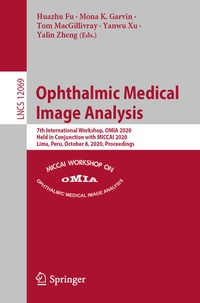
Ophthalmic Medical Image Analysis
7th International Workshop, OMIA 2020, Held in Conjunction with MICCAI 2020, Lima, Peru, October 8, 2020, Proceedings
Published on 20. November 2020
Book
Paperback/Softback
IX, 218 pages
978-3-030-63418-6 (ISBN)
Description
This book constitutes the refereed proceedings of the 6th International Workshop on Ophthalmic Medical Image Analysis, OMIA 2020, held in conjunction with the 23rd International Conference on Medical Imaging and Computer-Assisted Intervention, MICCAI 2020, in Lima, Peru, in October 2020. The workshop was held virtually due to the COVID-19 crisis.
The 21 papers presented at OMIA 2020 were carefully reviewed and selected from 34 submissions. The papers cover various topics in the field of ophthalmic medical image analysis and challenges in terms of reliability and validation, number and type of conditions considered, multi-modal analysis (e.g., fundus, optical coherence tomography, scanning laser ophthalmoscopy), novel imaging technologies, and the effective transfer of advanced computer vision and machine learning technologies.
More details
Series
Edition
1st ed. 2020
Language
English
Place of publication
Cham
Switzerland
Publishing group
Springer International Publishing
Target group
Professional and scholarly
Illustrations
19 s/w Abbildungen
IX, 218 p. 19 illus.
Dimensions
Height: 235 mm
Width: 155 mm
Thickness: 13 mm
Weight
353 gr
ISBN-13
978-3-030-63418-6 (9783030634186)
DOI
10.1007/978-3-030-63419-3
Schweitzer Classification
Other editions
Additional editions
Huazhu Fu | Mona K. Garvin | Tom MacGillivray
Ophthalmic Medical Image Analysis
7th International Workshop, OMIA 2020, Held in Conjunction with MICCAI 2020, Lima, Peru, October 8, 2020, Proceedings
E-Book
11/2020
Springer
€53.49
Available for download
Content
Bio-Inspired Attentive Segmentation of Retinal OCT imaging.- DR detection using Optical Coherence Tomography Angiography (OCTA): a transfer learning approach with robustness analysis.- What is the optimal attribution method for explainable ophthalmic disease classification?.- DeSupGAN: Multi-scale Feature Averaging Generative Adversarial Network for Simultaneous De-blurring and Super-resolution of Retinal Fundus Images.- Encoder-Decoder Networks for Retinal Vessel Segmentation using Large Multi-Scale Patches.- Retinal Image Quality Assessment via Specific Structures Segmentation.- Cascaded Attention Guided Network for Retinal Vessel Segmentation.- Self-supervised Denoising via Diffeomorphic Template Estimation: Application to Optical Coherence Tomography.- Automated Detection of Diabetic Retinopathy From Smartphone Fundus Videos.- Optic Disc, Cup and Fovea Detection from Retinal Images using U-Net++ with EfficientNet Encoder.- Multi-level Light U-Net and Atrous Spatial Pyramid Poolingfor Optic Disc Segmentation on Fundus Image.- An Interactive Approach to Region of Interest Selection in Cytologic Analysis of Uveal Melanoma Based on Unsupervised Clustering.- Retinal OCT Denoising with Pseudo-Multimodal Fusion Network.- Deep-Learning-Based Estimation of 3D Optic-Nerve-Head Shape from 2D Color Fundus Photographs in Cases of Optic Disc Swelling.- Weakly supervised retinal detachment segmentation using deep feature propagation learning in SD-OCT images.- A framework for the discovery of retinal biomarkers in Optical Coherence Tomography Angiography (OCTA).- An Automated Aggressive Posterior Retinopathy of Prematurity Diagnosis System by Squeeze and Excitation Hierarchical Bilinear Pooling Network.- Weakly-Supervised Lesion-aware and Consistency Regularization for Retinitis Pigmentosa Detection from Ultra-widefield Images.- A Conditional Generative Adversarial Network-based Method for Eye Fundus Image Quality Enhancement.- Construction of quantitative indexes for cataract surgery evaluation based on deep learning.- Hybrid Deep Learning Gaussian Process for Diabetic Retinopathy Diagnosis and Uncertainty Quantification.