

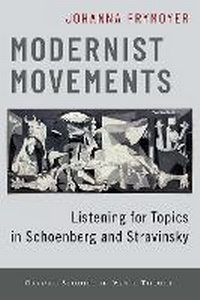
Modernist Movements
Listening for Topics in Schoenberg and Stravinsky
Will be published approx. on 19. August 2028
Book
Hardback
408 pages
978-0-19-764134-7 (ISBN)
Description
Topic theory examines the lexicon of conventions that emerged in the late eighteenth century through which composers evoked dances, marches, hunting, the pastoral, and the supernatural. While scholars have explored ad hoc applications of the theory in later repertories, author Johanna Frymoyer begins with fundamental methodological questions of if, why, and how analysts ought to apply topic theory--a method tailored to eighteenth-century historical and aesthetic contingencies--to modernist repertory.
Advancing topic theory beyond its foundations in semiotics to incorporate insights from cognition, Frymoyer argues that topical identification and interpretation are governed by mental categories and prototypicality effects, and that topics function as mnemonics of bodily movement (such as dance). Her approach explains how listeners past and present, though they may not be able to dance a minuet or march in synchronized military procession, nonetheless preserve these historically--embedded patterns of movement in memory. Topic theory therefore provides important insight into how listeners engage imaginatively--choreographically, one could say--with musical meaning in ways that are experienced as transhistorical, embodied, and intersubjective.
Illuminated by innovative analyses of Schoenberg and Stravinsky and placing topics in dialogue with considerations of twelve-tone style, metrical irregularity, accessibility, and agency, Modernist Movements is an important contribution to topic theory, modernist studies, and embodied cognition.
Advancing topic theory beyond its foundations in semiotics to incorporate insights from cognition, Frymoyer argues that topical identification and interpretation are governed by mental categories and prototypicality effects, and that topics function as mnemonics of bodily movement (such as dance). Her approach explains how listeners past and present, though they may not be able to dance a minuet or march in synchronized military procession, nonetheless preserve these historically--embedded patterns of movement in memory. Topic theory therefore provides important insight into how listeners engage imaginatively--choreographically, one could say--with musical meaning in ways that are experienced as transhistorical, embodied, and intersubjective.
Illuminated by innovative analyses of Schoenberg and Stravinsky and placing topics in dialogue with considerations of twelve-tone style, metrical irregularity, accessibility, and agency, Modernist Movements is an important contribution to topic theory, modernist studies, and embodied cognition.
More details
Series
Language
English
Place of publication
New York
United States
Target group
College/higher education
Product notice
sewn/stitched
Cloth over boards
Illustrations
71 figures
Dimensions
Height: 237 mm
Width: 167 mm
Thickness: 31 mm
Weight
739 gr
ISBN-13
978-0-19-764134-7 (9780197641347)
Copyright in bibliographic data and cover images is held by Nielsen Book Services Limited or by the publishers or by their respective licensors: all rights reserved.
Schweitzer Classification
Other editions
Additional editions
E-Book
06/2025
OUP eBook
€77.99
Available for download
E-Book
06/2025
OUP eBook
€77.99
Available for download
Person
Johanna Frymoyer is an Assistant Professor of Music Theory at the University of Notre Dame. Her research interests explore musical meaning through the lenses of semiotics, cognitive linguistics, and embodiment.
Content
Part I: Defining
Chapter 1. Topic Theory and Modernism
Chapter 2. Categories, Prototypicality Effects, and Memory
Part II: Hearing
Chapter 3. Harmony: Topics in Schoenberg's Twelve-Tone Style
Chapter 4. Meter: Stravinsky's Dance Topics
Part III: Moving
Chapter 5. History, Memory, Usage: A Case Study of the Russian Supernatural
Chapter 6. Body, Agency, and Intersubjectivity in Topical Listening
Bibliography
Index
Chapter 1. Topic Theory and Modernism
Chapter 2. Categories, Prototypicality Effects, and Memory
Part II: Hearing
Chapter 3. Harmony: Topics in Schoenberg's Twelve-Tone Style
Chapter 4. Meter: Stravinsky's Dance Topics
Part III: Moving
Chapter 5. History, Memory, Usage: A Case Study of the Russian Supernatural
Chapter 6. Body, Agency, and Intersubjectivity in Topical Listening
Bibliography
Index