

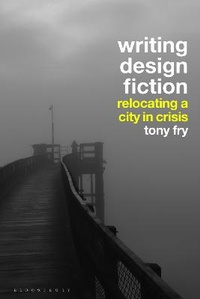
Writing Design Fiction
Relocating a City in Crisis
Published on 1. June 2023
Book
Paperback/Softback
208 pages
978-1-350-21734-8 (ISBN)
Description
Written by leading design philosopher Tony Fry, Writing Design Fiction: Relocating a City in Crisis is both an introduction to the power of "design fiction" in the design process, and a novella-length work of fiction in itself-telling the dramatic story of the relocation of the City of Harshon.
Set in the near future, Harshon, a delta city, is facing environmental catastrophe due to rising sea levels-consequently, a decision is made to relocate the entire city inland. A diverse cast of voices-including an architect, a journalist, an economist, a construction worker, and residents-narrate the extraordinary challenges and complexities which follow. This work presents a real-world scenario which, in coming decades, will face many of the world's cities. The fictional format provides a novel way of exploring the very serious inherent technical, social, political, economic and cultural challenges. The story provides a rehearsal of the design challenges which are likely to face architects, planners, and designers in an uncertain global future.
"Design fiction" is a fast-growing area within design and architecture, increasingly deployed as a serious methodology by designers as a tool in scenario planning. Writing Design Fiction takes the practice to a higher level conceptually and theoretically, but also practically. The book is divided into four parts, with the fictional narrative bookended by further critical analysis. Part One shows how a critique of existing modes of design fiction can lead to more grounded and critical thinking and practice. Part Three critically reflects on the narrative, while Part Four presents the practical application of the second order design fiction approach. This book demonstrates the value of a more developed mode of design fiction to students, professional designers and architects across the breadth of design practices, as well as to other disciplines interested in the future of cities.
Set in the near future, Harshon, a delta city, is facing environmental catastrophe due to rising sea levels-consequently, a decision is made to relocate the entire city inland. A diverse cast of voices-including an architect, a journalist, an economist, a construction worker, and residents-narrate the extraordinary challenges and complexities which follow. This work presents a real-world scenario which, in coming decades, will face many of the world's cities. The fictional format provides a novel way of exploring the very serious inherent technical, social, political, economic and cultural challenges. The story provides a rehearsal of the design challenges which are likely to face architects, planners, and designers in an uncertain global future.
"Design fiction" is a fast-growing area within design and architecture, increasingly deployed as a serious methodology by designers as a tool in scenario planning. Writing Design Fiction takes the practice to a higher level conceptually and theoretically, but also practically. The book is divided into four parts, with the fictional narrative bookended by further critical analysis. Part One shows how a critique of existing modes of design fiction can lead to more grounded and critical thinking and practice. Part Three critically reflects on the narrative, while Part Four presents the practical application of the second order design fiction approach. This book demonstrates the value of a more developed mode of design fiction to students, professional designers and architects across the breadth of design practices, as well as to other disciplines interested in the future of cities.
Reviews / Votes
Twisting time's arrow into a knot, Tony Fry loops together a fictional city's future collapse with our own crises of the present. Urgent and unsettling, his penetrating reflections reveal unexpected opportunities for turning design fiction into design action. * Jamer Hunt, Parsons School of Design, The New School, USA * Tony Fry's second order design fiction approach pulverizes the entanglements of the past and current design intelligentsia. Comprehending the essence of design through the fictional story of Harshon, powerfully "moves" us to a threshold of awareness of the existential significance of design, from which one is disclosed as "engaged design". * Philippe d'Anjou, Florida Atlantic University, USA *More details
Language
English
Place of publication
London
United Kingdom
Publishing group
Bloomsbury Publishing PLC
Target group
College/higher education
Illustrations
16 bw illus
Dimensions
Height: 234 mm
Width: 158 mm
Thickness: 14 mm
Weight
500 gr
ISBN-13
978-1-350-21734-8 (9781350217348)
Copyright in bibliographic data and cover images is held by Nielsen Book Services Limited or by the publishers or by their respective licensors: all rights reserved.
Schweitzer Classification
Other editions
Additional editions
E-Book
10/2021
1st Edition
Bloomsbury Visual Arts
€28.49
Available for download
E-Book
10/2021
1st Edition
Bloomsbury Visual Arts
€28.49
Available for download
Person
Tony Fry is Principal of The Studio at the Edge of the World, Adjunct Professor at the University of Tasmania, Australia and Visiting Professor at Universidad de Ibague, Colombia. Tony has held academic positions in Australia and internationally and is the author of fourteen books, including Design Futuring (Bloomsbury, 2009); Design as Politics (Bloomsbury, 2011), Becoming Human By Design (Bloomsbury, 2012), Remaking Cities (Bloomsbury, 2017), and Unstaging War (2019).
Content
THE CURTAIN RISES. The Opening of the Metanarrative
PART ONE: An Extended Prologue
PART TWO:The Story of Moving Urbana
1. The story of Port Urbana - Grace Ebu
2. The displaced and the move: Lena Arikan
3. Stasis and unsettlement - Kendrick Jensen
4. Age and life in the end times - Angela Leung
5. The world of health - Gerda Krauss
6. Localising the economic at the end of global capitalism: Gordon Chow
7. New thinking, new action - Carla Boas
8. Construction from the future to the present- Chris Glover
PART THREE: Reflection and Direction
PART FOUR: Design Fiction Applied
THE CURTAIN FALLS. The Closing of the Metanarrative
References
Index
PART ONE: An Extended Prologue
PART TWO:The Story of Moving Urbana
1. The story of Port Urbana - Grace Ebu
2. The displaced and the move: Lena Arikan
3. Stasis and unsettlement - Kendrick Jensen
4. Age and life in the end times - Angela Leung
5. The world of health - Gerda Krauss
6. Localising the economic at the end of global capitalism: Gordon Chow
7. New thinking, new action - Carla Boas
8. Construction from the future to the present- Chris Glover
PART THREE: Reflection and Direction
PART FOUR: Design Fiction Applied
THE CURTAIN FALLS. The Closing of the Metanarrative
References
Index