

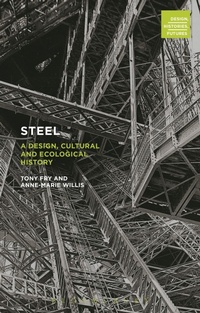
Steel
A Design, Cultural and Ecological History
Published on 29. January 2015
Book
Hardback
272 pages
978-0-85785-479-7 (ISBN)
Description
Steel has, over centuries, played a crucial role in shaping our material, and in particular, urban landscapes. This books undertakes a cultural and ecological history of the material, examining the relationship between steel and design at a micro and macro level - in terms of both what it has been used to design and how it has functioned as a 'world-making force'.
The research for the book is informed by diverse sources including industry journals, contemporary accounts and technical literature - all framed by rich, early accounts of iron and steel making from the middle ages to the opening of the industrial age, and most notably, the crucial works of Vannoccio Biringuccio, Georgius Agricola, Andrew Ure and Harry Scrivenor.
In contrast, trans-cultural accounts of the history of metallurgy from eminent sinologists and cultural historians like Joseph Needham and G.E.R. Lloyd are used. Readings on the pre-history and history of science, as well as histories and philosophies technology from scholars such as Siegfried Giedion, Merritt Roe Smith, L.T.C Rolt, Robert B. Gordon inform the analysis. Social and economic history from historians such as Eric Hobsbawn, William T. Hogan and David Brody are consulted; labour process theory is also examined, particularly the influential writings of F.W. Taylor in the late 19th and early 20th centuries and his contemporary critics, like David Nobel and Harry Braverman. Many other disciples also inform the account: histories of urban design and architecture, transport and military history, environmental history and geography.
The research for the book is informed by diverse sources including industry journals, contemporary accounts and technical literature - all framed by rich, early accounts of iron and steel making from the middle ages to the opening of the industrial age, and most notably, the crucial works of Vannoccio Biringuccio, Georgius Agricola, Andrew Ure and Harry Scrivenor.
In contrast, trans-cultural accounts of the history of metallurgy from eminent sinologists and cultural historians like Joseph Needham and G.E.R. Lloyd are used. Readings on the pre-history and history of science, as well as histories and philosophies technology from scholars such as Siegfried Giedion, Merritt Roe Smith, L.T.C Rolt, Robert B. Gordon inform the analysis. Social and economic history from historians such as Eric Hobsbawn, William T. Hogan and David Brody are consulted; labour process theory is also examined, particularly the influential writings of F.W. Taylor in the late 19th and early 20th centuries and his contemporary critics, like David Nobel and Harry Braverman. Many other disciples also inform the account: histories of urban design and architecture, transport and military history, environmental history and geography.
Reviews / Votes
Tony Fry (Queensland College of Art, Australia), one of the world's leading experts on the theory of design and its impact on culture, and Anne-Marie Willis (design theory, German Univ., Egypt) have produced an exceptional piece of scholarship with Steel: A Design, Cultural, and Ecological History. The book is part of a series called "Design, Histories, Futures," which 'aims to advance knowledge on the wider historical significance of design.' This work defies easy categorization: it is part history, part historiography, part ecological philosophy, and part design theory. All parts, however, are tied seamlessly together under one conceptual umbrella-the history of steel (and iron) production and the past, present, and future effects these materials have had (and will continue to have) on the world. Fry and Willis also pay close attention to the question of sustainability as they trace the social and economic histories of steel in various cultures, both Western and non-Western. This carefully documented study will be an excellent source for all historians of technology and for specialists in ecological and design studies. Summing Up: Highly recommended. Graduate students, researchers/faculty, and professionals/practitioners. * CHOICE * The work offers insight into the embedded complexities of the sustainability agenda, via historical consideration of one material - steel. This provides a vehicle for addressing the ways in which humans have historically conceived of and produced their world. It goes beyond conventional commodity histories, in addressing the philosophical conditions in which the production and consumption of steel originates. -- Paul Micklethwaite, Kingston University, UKMore details
Series
Language
English
Place of publication
London
United Kingdom
Publishing group
Bloomsbury Publishing PLC
Target group
Professional and scholarly
Illustrations
31 bw illus
Dimensions
Height: 222 mm
Width: 145 mm
Thickness: 18 mm
Weight
477 gr
ISBN-13
978-0-85785-479-7 (9780857854797)
Copyright in bibliographic data and cover images is held by Nielsen Book Services Limited or by the publishers or by their respective licensors: all rights reserved.
Schweitzer Classification
Other editions
Additional editions
E-Book
02/2015
1st Edition
Bloomsbury Academic
€35.49
Available for download
Persons
Tony Fry is Principal of The Studio at the Edge of the World, Tasmania, Adjunct Professor at the University of Tasmania, Australia and Visiting Professor at University of Ibague, Colombia. He is an award-winning designer, cultural theorist, educator and author. He has held academic positions in Australia and internationally and is the author of sixteen books, including Design Futuring (Bloomsbury, 2009), Design as Politics (Bloomsbury, 2011), Becoming Human By Design (Bloomsbury, 2012), Remaking Cities (Bloomsbury, 2017), Defuturing (Bloomsbury, 2020) and Writing Design Fiction (Bloomsbury, 2021). Anne-Marie Willis is a design writer, editor and educator who has taught at universities in Australia, Hong Kong and Egypt, including as Professor of Design Theory at the German University in Cairo. She was Editor of Design Philosophy Papers, and former Assistant Director of the EcoDesign Foundation, an organization that pioneered sustainable design in Australia. Her published books include The Design Philosophy Reader (Bloomsbury, 2019) and Steel (Bloomsbury, 2015). She collaborates with Tony Fry at the Studio at the Edge of the World, Tasmania, and is also a member of the editorial advisory board for the Bloomsbury Design Library.
Content
Introduction
Part 1- The Ages of Iron
Chapter 1. Traffic in Ideas
Chapter 2. Ecologies of Carbon
Chapter 3. Magic, Alchemy and Science
Part 2 - The Ages of Industry
Chapter 4. The Proto-Modern
Chapter 5. Fully Mechanised Modernity
Chapter 6. Technology After the Modern
Part 3 - Towards the Ages of Sustainment
Chapter 7. Environments of Iron and Steel-making
Chapter 8. Regulating Industrial Environments
Chapter 9. Futuring: Sustainment by Design
Bibliography
Index
Part 1- The Ages of Iron
Chapter 1. Traffic in Ideas
Chapter 2. Ecologies of Carbon
Chapter 3. Magic, Alchemy and Science
Part 2 - The Ages of Industry
Chapter 4. The Proto-Modern
Chapter 5. Fully Mechanised Modernity
Chapter 6. Technology After the Modern
Part 3 - Towards the Ages of Sustainment
Chapter 7. Environments of Iron and Steel-making
Chapter 8. Regulating Industrial Environments
Chapter 9. Futuring: Sustainment by Design
Bibliography
Index