

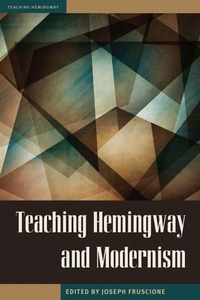
Teaching Hemingway and Modernism
Will be published approx. on 30. November 2015
Book
Paperback/Softback
224 pages
978-1-60635-246-5 (ISBN)
Description
Teaching Hemingway and Modernism presents concrete, intertextual models for using Hemingway's work effectively in various classroom settings, so students can understand the pertinent works, definitions, and types of avant-gardism that inflected his art. The fifteen teacher-scholars whose essays are included in the volume offer approaches that combine a focused individual treatment of Hemingway's writing with clear links to the modernist era and offer meaningful assignments, prompts, and teaching tools.
The essays and related appendices balance text, context, and classroom practice while considering a broad and student-based audience. The contributors address a variety of critically significant questions-among them:
How can we view and teach Hemingway's work along a spectrum of modernist avant-gardism?
How can we teach his stylistic minimalism both on its own and in conjunction with the more expansive styles of Joyce, Faulkner, Woolf, and other modernists?
What is post modernist about an author so often discussed exclusively as a modernist, and how might we teach Hemingway's work vis-a-vis that of contemporary authors?
How can teachers bridge twentieth- and twenty first- century pedagogies for Hemingway studies and American literary studies in high school, undergraduate, and graduate settings? What role, if any, should new media play in the classroom?
Teaching Hemingway and Modernism is an indispensable tool for anyone teaching Hemingway, and it offers exciting and innovative approaches to understanding one of the most iconic authors of the modernist era.
The essays and related appendices balance text, context, and classroom practice while considering a broad and student-based audience. The contributors address a variety of critically significant questions-among them:
How can we view and teach Hemingway's work along a spectrum of modernist avant-gardism?
How can we teach his stylistic minimalism both on its own and in conjunction with the more expansive styles of Joyce, Faulkner, Woolf, and other modernists?
What is post modernist about an author so often discussed exclusively as a modernist, and how might we teach Hemingway's work vis-a-vis that of contemporary authors?
How can teachers bridge twentieth- and twenty first- century pedagogies for Hemingway studies and American literary studies in high school, undergraduate, and graduate settings? What role, if any, should new media play in the classroom?
Teaching Hemingway and Modernism is an indispensable tool for anyone teaching Hemingway, and it offers exciting and innovative approaches to understanding one of the most iconic authors of the modernist era.
More details
Series
Language
English
Place of publication
Kent, OH
United States
Target group
College/higher education
Professional and scholarly
Product notice
Paperback (trade)
Unsewn / adhesive bound
Dimensions
Height: 226 mm
Width: 152 mm
Thickness: 15 mm
Weight
340 gr
ISBN-13
978-1-60635-246-5 (9781606352465)
Copyright in bibliographic data and cover images is held by Nielsen Book Services Limited or by the publishers or by their respective licensors: all rights reserved.
Schweitzer Classification
Other editions
Additional editions
Joseph Fruscione
Teaching Hemingway and Modernism
E-Book
11/2015
Kent State University Press
€42.99
Available for download
Joseph Fruscione
Teaching Hemingway and Modernism
E-Book
11/2015
Kent State University Press
€35.49
Available for download
Person
Joseph Fruscione taught American literature and first-year writing for fifteen years at George Washington University, USA, Georgetown University, USA, and the University of Maryland, Baltimore County, USA. He is the author of Faulkner and Hemingway: Biography of a Literary Rivalry, "Knowing and Recombining: Ellison's Ways of Understanding Hemingway" in Hemingway and the Black Renaissance, and several other essays, reviews, and presentations. He has been the editor of the "Adjuncts Interviewing Adjuncts" column for Inside Higher Ed since December 2013 and has written articles on higher education for Inside Higher Ed, Hybrid Pedagogy, and the Chronicle of Higher Education. He is currently working as a freelance copy editor, proof reader, and post-academic career consultant, as well as coediting an essay collection titled Burning Down the Ivory Tower: Insiders Take On the Higher Ed Crisis.