

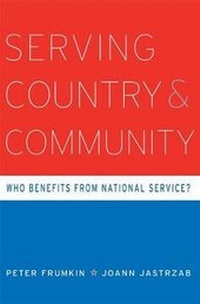
Serving Country and Community
Who Benefits from National Service?
Published on 1. June 2010
Book
Hardback
320 pages
978-0-674-04678-8 (ISBN)
Description
The United States has a long history of citizens rendering service to their communities. Examples of government-sponsored voluntary service organizations include the Civilian Conservation Corps, the Peace Corps, and Volunteers in Service to America (VISTA). During the Clinton administration, the national service movement was advanced by the establishment of AmeriCorps, a large-scale national service program designed to place young people in community service positions across the country. More recently, the Obama administration has set in motion a major program expansion of AmeriCorps over the coming decade.
Many decades, billions of dollars, and hundreds of thousands of volunteers after the creation of the first national service programs, it remains unclear who benefits from service, under what conditions these programs work best, and how exactly these service efforts contribute to the strengthening of communities. Serving Country and Community answers each of these questions through an in-depth study of how service shapes the lives of young people and a careful analysis of the strengths and weaknesses of these programs. Based on years of field work and data collection, Serving Country and Community provides an in-depth examination of the aims and effects of national service and, in the process, opens up a conversation about what works and what needs reform in national service today.
Many decades, billions of dollars, and hundreds of thousands of volunteers after the creation of the first national service programs, it remains unclear who benefits from service, under what conditions these programs work best, and how exactly these service efforts contribute to the strengthening of communities. Serving Country and Community answers each of these questions through an in-depth study of how service shapes the lives of young people and a careful analysis of the strengths and weaknesses of these programs. Based on years of field work and data collection, Serving Country and Community provides an in-depth examination of the aims and effects of national service and, in the process, opens up a conversation about what works and what needs reform in national service today.
Reviews / Votes
Who benefits from AmeriCorps, Vista, and National Civilian Community Corps? Frumkin and Jastrzab make important recommendations on how to improve the programs and resolve some of the political and administrative issues which have plagued those initiatives in the past two decades. -- James Youniss, Catholic University of America Serving Country and Community is the most definitive effort to date to understand and evaluate the impact of national and community service on individual participants and local communities. Through rigorous research and a very accessible style, the authors have produced a highly informative, timely, and important book with broad implications for future policy, practice, and research. -- Steven R. Smith, Georgetown Public Policy InstituteMore details
Language
English
Place of publication
Cambridge, Mass
United States
Target group
College/higher education
Illustrations
1 chart, 17 graphs, 12 tables
Dimensions
Height: 235 mm
Width: 156 mm
Thickness: 25 mm
Weight
635 gr
ISBN-13
978-0-674-04678-8 (9780674046788)
Copyright in bibliographic data and cover images is held by Nielsen Book Services Limited or by the publishers or by their respective licensors: all rights reserved.
Schweitzer Classification
Other editions
Additional editions
E-Book
06/2010
1st Edition
Harvard University Press
€135.99
Available for download
Persons
Peter Frumkin is Professor of Public Affairs at the Lyndon B. Johnson School of Public Affairs, and Director of the RGK Center for Philanthropy and Community Service, both at the University of Texas at Austin. JoAnn Jastrzab is Principal Associate, Abt Associates, Inc.
Content
* Acknowledgments * Visions of National Service * The Evolution of National Service * The Shape of National Service Today * Civic Engagement * Personal Growth * Social Capital * Public Work * The Institutional Politics of National Service * New Directions for National Service * Appendices * Notes * Bibliography * Index