

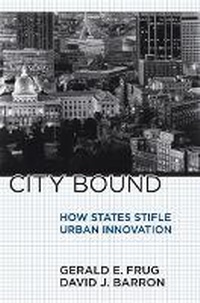
City Bound
How States Stifle Urban Innovation
Published on 15. November 2008
Book
Hardback
280 pages
978-0-8014-4514-9 (ISBN)
Description
Many major American cities are defying the conventional wisdom that suburbs are the communities of the future. But as these urban centers prosper, they increasingly confront significant constraints. In City Bound, Gerald E. Frug and David J. Barron address these limits in a new way.
Based on a study of the differing legal structures of Boston, New York, Atlanta, Chicago, Denver, San Francisco, and Seattle, City Bound explores how state law determines what cities can and cannot do to raise revenue, control land use, and improve city schools. Frug and Barron show that state law can make it much easier for cities to pursue a global-city or a tourist-city agenda than to respond to the needs of middle-class residents or to pursue regional alliances. But they also explain that state law is often so outdated, and so rooted in an unjustified distrust of local decision making, that the legal process makes it hard for successful cities to develop and implement any coherent vision of their future. Their book calls not for local autonomy but for a new structure of state-local relations that would enable cities to take the lead in charting the future course of urban development. It should be of interest to everyone who cares about the future of American cities, whether political scientists, planners, architects, lawyers, or simply citizens.
Based on a study of the differing legal structures of Boston, New York, Atlanta, Chicago, Denver, San Francisco, and Seattle, City Bound explores how state law determines what cities can and cannot do to raise revenue, control land use, and improve city schools. Frug and Barron show that state law can make it much easier for cities to pursue a global-city or a tourist-city agenda than to respond to the needs of middle-class residents or to pursue regional alliances. But they also explain that state law is often so outdated, and so rooted in an unjustified distrust of local decision making, that the legal process makes it hard for successful cities to develop and implement any coherent vision of their future. Their book calls not for local autonomy but for a new structure of state-local relations that would enable cities to take the lead in charting the future course of urban development. It should be of interest to everyone who cares about the future of American cities, whether political scientists, planners, architects, lawyers, or simply citizens.
Reviews / Votes
Frug and Barron examine the balance between state and local control in seven cities, asserting that state control distorts and fragments policy making across a number of issues, including education, land use, and taxation. Their claim is persuasive.... This work is very well grounded in the most interesting recent literature about cities and offers many important insights into how the law shapes urban public policy. Highly recommended.(Choice)
More details
Language
English
Place of publication
Ithaca
United States
Product notice
Paper over boards
Dimensions
Height: 229 mm
Width: 152 mm
Thickness: 25 mm
Weight
907 gr
ISBN-13
978-0-8014-4514-9 (9780801445149)
Copyright in bibliographic data and cover images is held by Nielsen Book Services Limited or by the publishers or by their respective licensors: all rights reserved.
Schweitzer Classification
Other editions
Additional editions

E-Book
03/2011
Cornell University Press
€21.49
Available for download
Persons
Gerald E. Frug is Louis D. Brandeis Professor of Law at Harvard Law School. He is the author of City Making: Building Communities without Building Walls. David J. Barron is Professor of Law at Harvard Law School. He is the coauthor (with Gerald E. Frug) of Dispelling the Myth of Home Rule: Local Power in Greater Boston and coeditor (with Gerald E. Frug and Richard Ford) of Local Government Law, 4th edition.
Content
Preface
AcknowledgmentsPart I: CITY STRUCTURES
1. City Structures and Urban Theory
2. City Structures and Local AutonomyPart II: SEVEN CITIES
3. Home Rule
4. Revenue and Expenditures
5. Land Use and Development
6. EducationPart III: CITY FUTURES
7. The Global City
8. The Tourist City
9. The Middle Class City
10. The Regional CityConclusion
Notes
About the Authors
Index
AcknowledgmentsPart I: CITY STRUCTURES
1. City Structures and Urban Theory
2. City Structures and Local AutonomyPart II: SEVEN CITIES
3. Home Rule
4. Revenue and Expenditures
5. Land Use and Development
6. EducationPart III: CITY FUTURES
7. The Global City
8. The Tourist City
9. The Middle Class City
10. The Regional CityConclusion
Notes
About the Authors
Index