

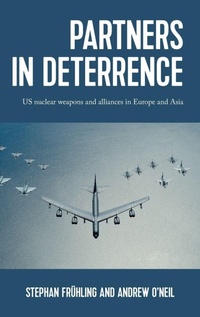
Partners in Deterrence
Us Nuclear Weapons and Alliances in Europe and Asia
Published on 13. July 2021
Book
Hardback
256 pages
978-1-5261-5072-1 (ISBN)
Description
From the dawn of the atomic age to today, nuclear weapons have been central to the internal dynamics of US alliances in Europe and Asia. But nuclear weapons cooperation in US alliances has varied significantly between allies and over time. This book explores the history of America's nuclear posture worldwide, delving into alliance structures and interaction during and since the end of the Cold War to uncover the underlying dynamics of nuclear weapons cooperation between the US and its allies.
Combining in-depth empirical analysis with an accessible theoretical lens, the book reveals that US allies have wielded significant influence in shaping nuclear weapons cooperation with the US in ways that reflect their own, often idiosyncratic, objectives. Alliances are ecosystems of exchange rather than mere tools of external balancing, the book argues, and institutional perspectives can offer an unprecedented insight into how structured cooperation can promote policy convergence. -- .
Combining in-depth empirical analysis with an accessible theoretical lens, the book reveals that US allies have wielded significant influence in shaping nuclear weapons cooperation with the US in ways that reflect their own, often idiosyncratic, objectives. Alliances are ecosystems of exchange rather than mere tools of external balancing, the book argues, and institutional perspectives can offer an unprecedented insight into how structured cooperation can promote policy convergence. -- .
Reviews / Votes
'Long a footnote to US nuclear strategy, extended deterrence is rising in salience and urgency as the United States and its allies contend with a deteriorating security environment. This important new study combines historical research, political science, and policy analysis to generate valuable new insights into past and present practices in both Europe and Asia and thereby lays the foundation for future policy development.'Brad Roberts, Director of the Center for Global Security Research at Lawrence Livermore National Laboratory, California
'Partners in deterrence offers a fresh perspective on an enduring question: what motivates states to form nuclear alliances? As US alliances in Europe and Asia face growing nuclear threats, strategists would be well-served to understand what brings in security partners - and what helps them stay. This book makes a valuable contribution, blending classic theory with meticulous examination of well-selected case studies to explain contemporary nuclear alliances. By going beyond the traditional fixation on proximate security threats as the main driver of nuclear alliances, the book widens the aperture of contemporary debates, providing a valuable perspective for academics and policymakers alike.'
Matthew Kroenig, Professor of Government and Foreign Service at Georgetown University and the author of The Logic of American Nuclear Strategy -- .
More details
Language
English
Place of publication
Manchester
United Kingdom
Target group
College/higher education
Professional and scholarly
Dimensions
Height: 240 mm
Width: 161 mm
Thickness: 18 mm
Weight
552 gr
ISBN-13
978-1-5261-5072-1 (9781526150721)
Copyright in bibliographic data and cover images is held by Nielsen Book Services Limited or by the publishers or by their respective licensors: all rights reserved.
Schweitzer Classification
Other editions
Additional editions
Stephan Fruehling | Andrew O'Neil
Partners in Deterrence
Us Nuclear Weapons and Alliances in Europe and Asia
E-Book
08/2021
1st Edition
Manchester University Press
€189.99
Available for download
Stephan Fruehling | Andrew O'Neil
Partners in Deterrence
Us Nuclear Weapons and Alliances in Europe and Asia
E-Book
08/2021
1st Edition
Manchester University Press
from
€189.99
Available for download
Persons
Stephan Fruehling is Professor in the Strategic and Defence Studies Centre and Deputy Dean of the College of Asia & the Pacific at Australian National University
Andrew O'Neil is Dean and Professor of Political Science in the Griffith Business School, Griffith University -- .
Andrew O'Neil is Dean and Professor of Political Science in the Griffith Business School, Griffith University -- .
Content
Introduction
1 Realism, institutionalism, and nuclear weapons cooperation
2 Nuclear sharing and mutual dependence: Germany and NATO nuclear weapons cooperation
3 Local accommodation: Norway and nuclear weapons cooperation in NATO
4 Security at arm's length: US-Japan nuclear weapons cooperation
5 Assurance and abandonment: Nuclear weapons in the US-South Korea alliance
6 Informal bargaining: Nuclear weapons cooperation and the US-Australia alliance
7 Understanding the drivers of nuclear weapons cooperation
Index -- .
1 Realism, institutionalism, and nuclear weapons cooperation
2 Nuclear sharing and mutual dependence: Germany and NATO nuclear weapons cooperation
3 Local accommodation: Norway and nuclear weapons cooperation in NATO
4 Security at arm's length: US-Japan nuclear weapons cooperation
5 Assurance and abandonment: Nuclear weapons in the US-South Korea alliance
6 Informal bargaining: Nuclear weapons cooperation and the US-Australia alliance
7 Understanding the drivers of nuclear weapons cooperation
Index -- .