

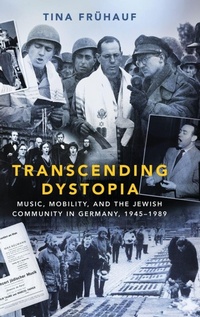
Transcending Dystopia
Music, Mobility, and the Jewish Community in Germany, 1945-1989
Published on 31. March 2021
Book
Hardback
644 pages
978-0-19-753297-3 (ISBN)
Description
By the end of the Second World War, Germany was in ruins and its Jewish population so gravely diminished that a rich cultural life seemed unthinkable. And yet, as surviving Jews returned from hiding, the camps, and their exiles abroad, so did their music. Transcending Dystopia tells the story of the remarkable revival of Jewish musical activity that developed in postwar Germany against all odds. Author Tina Fruehauf provides a kaleidoscopic panorama of musical practices in worship and social life across the country to illuminate how music contributed to transitions and transformations within and beyond Jewish communities in the aftermath of the Holocaust.
Drawing on newly unearthed sources from archives and private collections, this book covers a wide spectrum of musical activity-from its role in commemorations and community events to synagogue concerts and its presence on the radio-across the divided Germany until the Fall of the Wall in 1989. Fruehauf's use of mobility as a conceptual framework reveals the myriad ways in which the reemergence of Jewish music in Germany was shaped by cultural transfer and exchange that often relied on the circulation of musicians, their ideas, and practices within and between communities. By illuminating the centrality of mobility to Jewish experiences and highlighting how postwar Jewish musical practices in Germany were defined by politics that reached across national borders to the United States and Israel, this pioneering study makes a major contribution to our understanding of Jewish life and culture in a transnational context.
Drawing on newly unearthed sources from archives and private collections, this book covers a wide spectrum of musical activity-from its role in commemorations and community events to synagogue concerts and its presence on the radio-across the divided Germany until the Fall of the Wall in 1989. Fruehauf's use of mobility as a conceptual framework reveals the myriad ways in which the reemergence of Jewish music in Germany was shaped by cultural transfer and exchange that often relied on the circulation of musicians, their ideas, and practices within and between communities. By illuminating the centrality of mobility to Jewish experiences and highlighting how postwar Jewish musical practices in Germany were defined by politics that reached across national borders to the United States and Israel, this pioneering study makes a major contribution to our understanding of Jewish life and culture in a transnational context.
Reviews / Votes
Transcending Dystopia is a detailed historiography of Jewish music history based on extensive research into sources and, more recently, on interviews, particularly with regard to the aspects of mobility (in the spatial and cultural sense and that of cultural self-image) and identity. The book also touches on what could be called a musical histoire des mentalites. * Joachim Luedtke, Forum Musikbibliothek * Transcending Dystopia is a meticulously researched and articulately written work that analyzes music as a modality of transition for Jewish communities in postwar Germany. * Religious Studies Review * Fruehauf gives a picture of a community grappling with how to transition in a post-Holocaust world, and the role music plays in this transition. It is a masterful interdisciplinary work on a little-studied time period in Jewish musical history, and provides an important framework for looking at the musical life of other postwar Jewish communities in the future. * Karen Uslin, The Defiant Requiem Foundation * Though the book's title uses community in the singular, Fruehauf draws attention to the heterogeneity of Germany's postwar Jewish communities by consistently attending to vectors of difference such as class, generation, regional identity, and religious tradition. Transcending Dystopia paints a complex portrait of Jewish musical life in the postwar period, and demonstrates the importance of attending to local dynamics when crafting historical narratives. * Martha Sprigge, University of California, Santa Barbara * Tina Fruehauf is a leading scholar of German-Jewish music culture, its composers and performers, its institutions, instruments, and practices. Her latest monograph, Transcending Dystopia: Music Mobility, and the Jewish Community in Germany, 1945-1989, is a tour-de-force of research and reconstruction. Her archival virtuosity has yielded mountains of detail about the people who reconstituted Jewish musical practices in Germany after the Holocaust. * Celia Applegate, Vanderbilt University, H-Soz-Kult * Encyclopedic in scope and rich with facsimiles of photographs and performance posters, the apparatus includes extensive scholarly notes, a bibliography of the most relevant sources, and a helpful index. The first ever scholarly compendium of Jewish musical events in Germany from 1945 to 1989, this volume will be valuable for students of music, postwar European history, and Judaic studies worldwide. * D. Hutchins, CHOICE * By examining the musical world of Holocaust survivors in Germany, Tina Fruehauf has found an original way to look at Jewish life in Europe after the war...Fruehauf's research is comprehensive, down to the level of describing individual concerts with their performers, the pieces that were heard, the location, and the date. She includes details about radio broadcasts and newspaper reviews, career moves of individual cantors and other musicians, and the musical fate of local congregations. There is no other book on this subject, with or without this level of detail. It's an astonishing achievement and an essential addition to the history of Jewish music. * Beth Dwoskin, Jewish Book Council * Fruehauf builds a detailed picture of the issues facing this confusing era and music's vital role in it. For those concerend with this area of history, this factfilled book is essential reading * Jessica Duchen, BBC Music Magazine * By analyzing the development of Jewish life in Germany through its music, Fruehauf gives us a fresh perspective on the cultures of East and West Germany after the Holocaust. * Mikhail Krutikov, Forward * An astonishing achievement and an essential addition to the history of Jewish music. * Beth Dwoskin, Jewish Book Council * Comprehensive, authoritative, highly readable, insightful, and ground-breaking, Tina Fruehauf's book enriches our understanding of the varied fate of postwar German Jews - east and west - through music, a powerful expression of Jewish resilience, identity, and belief. * Mark Slobin, Winslow-Kaplan Professor of Music Emeritus, Wesleyan University * As deftly traced by Tina Fruehauf, the post-World War Two renewal of German Jewry's uniquely creative liturgical musical tradition is a testimony to the spiritual resilience of the surviving remnant of the Shoah. * Paul Mendes-Flohr, Professor Emeritus of Jewish Thought at the Hebrew University of Jerusalem and Professor Emeritus of the University of Chicago * Transcending Dystopia is a meticulously researched and articulately written work that analyzes music as a modality of transition for Jewish communities in postwar Germany. * Jade Weimer, Religious Studies Review Vol 48.4 * It is a masterful interdisciplinary work on a little-studied time period in Jewish musical history, and provides an important framework for looking at the musical life of other postwar Jewish communities in the future. * Karen Uslin, German History *More details
Language
English
Place of publication
New York
United States
Target group
Professional and scholarly
Product notice
sewn/stitched
Cloth over boards
Illustrations
29
Dimensions
Height: 244 mm
Width: 170 mm
Thickness: 50 mm
Weight
1035 gr
ISBN-13
978-0-19-753297-3 (9780197532973)
Copyright in bibliographic data and cover images is held by Nielsen Book Services Limited or by the publishers or by their respective licensors: all rights reserved.
Schweitzer Classification
Other editions
Additional editions
E-Book
01/2021
1st Edition
OUP eBook
€38.49
Available for download
E-Book
01/2021
1st Edition
OUP eBook
€38.49
Available for download
Person
Tina Fruehauf is Adjunct Associate Professor at Columbia University and serves on the doctoral faculty of The Graduate Center of the City University of New York. She is the editor of the award-winning Dislocated Memories: Jews, Music, and Postwar German Culture (OUP, 2014) and has published widely on German Jewish music culture and twentieth-century music.
Content
On Transliteration and Translation, Spelling, and Names
Acknowledgements
Prologue: Moving Toward Silence
Introduction: Against All Odds--The Jewish Gemeinde as Sonic Community in an Age of Mobility
Part I: After the Rupture--The Interregnum and the Culture of Rebirth
Chapter 1: In the Midst of Rubble: Rebuilding a Musical Life in Berlin
Chapter 2: Out of the Depths: The Case of Munich and the South
Chapter 3: Communal Encounters--Frankfurt am Main and the North
Chapter 4: Remnants in the Soviet and French Zones and Beyond
Chapter 5: Remembering the Holocaust: Mourning and Celebration
Chapter 6: Disseminating Survival: Jews, Music, and the Media
Chapter 7: The End of Dystopia?
Part II: Music in Motion: The Jewish Communities in West Germany
Chapter 8: Returning and Leaving: Frankfurt in Flux
Chapter 9: Rebuilding with or without Organ
Chapter 10: Cantors on the Move
Chapter 11: Regenerating a Choral Music Culture
Chapter 12: Music in Social Life
Part III: The Presence of Absence: Jewish (Heritage) Music in East Germany
Chapter 13: Dystopia under Communism: The Communities in the Crossfire of Politics
Chapter 14: Werner Sander and the Formation of the Leipziger Synagogalchor
Chapter 15: Facing Cultural Stagnation: Musical Life after Sander
Chapter 16: "Making Antifascist Politics Visible"--Jewish Heritage Music and Cold War Politics
Chapter 17: The Leipziger Synagogalchor in the Service of State Propaganda
Chapter 18: Jewish Culture in Public Diplomacy, Memory Politics, and the Curious Case of Halle
Chapter 19: Projecting Utopia: Jewish Heritage Music Abroad
Chapter 20: The Politics of Commemoration and Reorientation
Part IV: Music as Vortex in Jewish Berlin
Chapter 21: The Establishment of the Juedische Gemeinde von Gross-Berlin
Chapter 22: The Anniversary Year of 1971 and the Dawn of Detente
Chapter 23: The Rise of the Juedische Gemeinde zu Berlin
Chapter 24: Deterioration and Recovery: The Juedische Gemeinde Berlin, Hauptstadt der DDR
Chapter 25: Toward a New Communal Future: Parallel Sound Worlds and Rapprochement
Acknowledgements
Prologue: Moving Toward Silence
Introduction: Against All Odds--The Jewish Gemeinde as Sonic Community in an Age of Mobility
Part I: After the Rupture--The Interregnum and the Culture of Rebirth
Chapter 1: In the Midst of Rubble: Rebuilding a Musical Life in Berlin
Chapter 2: Out of the Depths: The Case of Munich and the South
Chapter 3: Communal Encounters--Frankfurt am Main and the North
Chapter 4: Remnants in the Soviet and French Zones and Beyond
Chapter 5: Remembering the Holocaust: Mourning and Celebration
Chapter 6: Disseminating Survival: Jews, Music, and the Media
Chapter 7: The End of Dystopia?
Part II: Music in Motion: The Jewish Communities in West Germany
Chapter 8: Returning and Leaving: Frankfurt in Flux
Chapter 9: Rebuilding with or without Organ
Chapter 10: Cantors on the Move
Chapter 11: Regenerating a Choral Music Culture
Chapter 12: Music in Social Life
Part III: The Presence of Absence: Jewish (Heritage) Music in East Germany
Chapter 13: Dystopia under Communism: The Communities in the Crossfire of Politics
Chapter 14: Werner Sander and the Formation of the Leipziger Synagogalchor
Chapter 15: Facing Cultural Stagnation: Musical Life after Sander
Chapter 16: "Making Antifascist Politics Visible"--Jewish Heritage Music and Cold War Politics
Chapter 17: The Leipziger Synagogalchor in the Service of State Propaganda
Chapter 18: Jewish Culture in Public Diplomacy, Memory Politics, and the Curious Case of Halle
Chapter 19: Projecting Utopia: Jewish Heritage Music Abroad
Chapter 20: The Politics of Commemoration and Reorientation
Part IV: Music as Vortex in Jewish Berlin
Chapter 21: The Establishment of the Juedische Gemeinde von Gross-Berlin
Chapter 22: The Anniversary Year of 1971 and the Dawn of Detente
Chapter 23: The Rise of the Juedische Gemeinde zu Berlin
Chapter 24: Deterioration and Recovery: The Juedische Gemeinde Berlin, Hauptstadt der DDR
Chapter 25: Toward a New Communal Future: Parallel Sound Worlds and Rapprochement