

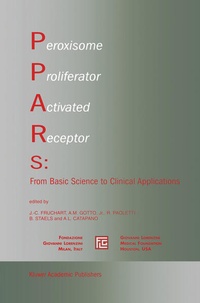
Peroxisome Proliferator Activated Receptors: From Basic Science to Clinical Applications
Published on 30. November 2002
Book
Hardback
XVI, 172 pages
978-1-4020-7199-7 (ISBN)
Description
Peroxisome Proliferator Activated Receptors (PPARs) attract great attention in light of the wide spectrum of genes of biological and medical relevance identified as under their control. As a consequence, our knowledge of the role of these receptors in physiology and pathology continues to grow at a fast pace and PPARs have become an interesting target for the treatment of many pathological conditions, including diabetes and atherosclerosis. This volume provides an authoritative view of the current clinical and scientific developments within this evolving area of study.
More details
Series
Edition
2002 ed.
Language
English
Place of publication
New York
United States
Target group
Professional and scholarly
Research
Product notice
sewn/stitched
Cloth over boards
Illustrations
XVI, 172 p.
Dimensions
Height: 241 mm
Width: 160 mm
Thickness: 17 mm
Weight
463 gr
ISBN-13
978-1-4020-7199-7 (9781402071997)
DOI
10.1007/978-1-4615-1171-7
Schweitzer Classification
Other editions
Additional editions
J.-C. Fruchart | Antonio M. Gotto Jr. | Rodolfo Paoletti
Peroxisome Proliferator Activated Receptors: From Basic Science to Clinical Applications
Book
10/2012
Springer
€106.50
Shipment within 7-9 days
Persons
Content
1. Peroxisome Proliferator Activated Receptor Alpha Coordinates Intermediary Metabolism During Fasting.- 2. Design, Structure, and Function of Novel PPAR Ligands.- 3. Functions of PPAR Gamma in Macrophages and Atherosclerosis.- 4. PPARs and Atherogenesis: Mediators or Modulators of the Inflammatory Response in the Vessel Wall?.- 5. Role of PPARs in Inflammation, Atherosclerosis, and Thrombosis.- 6. Effects of Thiazolidinediones on Vascular Reactivity and Endothelial Dysfunction.- 7. Activation of Human PPAR Subtypes by Pioglitazone.- 8. PPAR? Mechanism of Action Studies.- 9. The Role of PPAR? in Fatty Acid Metabolism and Hepatocarcinogenesis: Studies with PPAR?-Null Mice.- 10. PPAR?, Lipoprotein Metabolism, Metabolic Disease, and Atherosclerosis.- 11. PPAR? and Atherosclerosis.- 12. Regulation of CD36 by PPAR?: Pro- or Anti-atherogenic?.- 13. Anti-inflammatory Properties of High Density Lipoproteins.- 14. The Low-HDL Syndrome: Epidemiology and Pathophysiology.- 15. Diabetes: A Growing CHD Epidemic.- 16. Influence of PPARs on Muscle Lipid Metabolism and Insulin Resistance.- 17. PPAR? in Adipogenesis and Insulin Resistance.- 18. Pharmacology of a Selective Peroxisome Proliferator-Activated Receptor ? Agonist, GW501516, in Obese Dyslipidemic Primates.- 19. PPAR?: A Regulator of Growth and Differentiation.- 20. Peroxisome Proliferator Activator Receptor Gamma Agonists Inhibit the Development of Atherosclerosis in Low Density Lipoprotein Receptor-Deficient Male Mice.- 21. Are Thiazolidinediones Superior to Standard Therapy in the Treatment of Type 2 Diabetes?.- 22. PPAR? Ligands and Intestinal Inflammation.- 23. Inflammatory Mechanisms in Alzheimer's Disease: ?-Amyloid-Stimulated Proinflammatory Responses Are Blocked by PPAR? Agonists.