

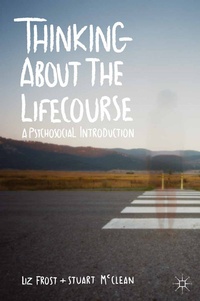
Thinking about the Lifecourse
Description
Taking a psychosocial approach to exploring human growth and development, this book:
Provides an insightful exploration of the human life course by looking at significant life stages and key themes (such as parenting, ill-health and violence).
Draws on both contemporary and classic research in the fields of psychology and sociology, to deliver an in-depth analysis of issues about self and society.
Moves beyond traditional, limiting approaches to understanding people's lives toward an interdisciplinary, psychosocial approach.
Whether you are studying on a Social Work, Nursing or related Health or Social Care degree, or taking a course in the newly emerging field of Psychosocial Studies, this book is a clear and ground-breaking contribution to the understanding of human growth and development.
Reviews / Votes
"Thinking About the Lifecourse: A Psychosocial Introduction is a primer of a 'psychosocial way of thinking' about issues of human growth and development and their social context. . The combination of this breadth with the engaging style of writing maintained in the text and accessible format it is presented . render it well-matched to the needs of a diverse health and social welfare practitioner readership." (Philip John Archard, Journal of Social Work Practice, 2015)More details
Other editions
Additional editions
Persons
Stuart McClean is Senior Lecturer in Health Science at the School of Health and Social Care, University of the West of England, Bristol, UK.
Content
PART I.- 1. Psychosocial Theory: Being and Becoming.- 2. How People Begin: 'the child as father to the man'.- 3. How People Become: Agency and Identification.- 4. How People Connect: Love, Marriage and the Family.- 5. How People are Occupied: School, Work and After in Consumer Societies.- 6. How People Thrive: Resilience and Well-being.- 7. How People Struggle: Social Suffering and Ill-being.- 8. How People Hurt and Hate: Violence and Bullying.- 9. How People Age and Die: Disengagement, Disruption and Loss.- PART II.- 1. Background to the Psychosocial Approach.- 2. Psychosocial Theory in Process.- 3. Psychosocial Theory from Psychoanalysis and Child Psychiatry.- 4. Psychosocial Theory from Psychology.- 5. Psychosocial Theory from Sociology and Social Theory.- 6. Psychosocial Theory in Applied Contexts.- 7. Psychosocial Theory and the Theorist.