

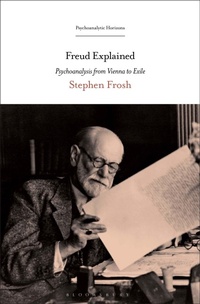
Freud Explained
Psychoanalysis from Vienna to Exile
Published on 14. May 2026
Book
Paperback/Softback
160 pages
979-8-216-37199-1 (ISBN)
Description
An engaging biographical introduction to Sigmund Freud, contextualizing the evolution of his theories within the vibrant and tumultuous climate of early-20th-century Vienna.
Freud Explained presents Freud's core ideas as they developed over the course of his life, in context with his historical moment. It explains key moments in the progression of Freud's theories - such as sexual repression, the Oedipus complex, and the interpretation of dreams - weaving these together with discussions of his family history and upbringing. It also highlights important shifts, contradictions, and controversies, particularly relating to seduction theory, hysteria, female sexuality, and homosexual desire.
Stephen Frosh describes Freud's life in Vienna and the patients with whom he worked; looks at the relationships he formed with his teachers and followers; and focuses on how his theories developed in the context of the enormous social and political upheavals of the time - disruptions that eventually prompted Freud to move to England, in order "to die in freedom." Frosh's expertise on antisemitism is especially vital to his discussion of the challenges Freud faced, as a Jewish intellectual in Vienna, to the dissemination of his radical ideas.
As more people feel comfortable seeking psychotherapy, and as the socio-political world in which we live becomes more emotionally challenging, we all - knowingly or not - draw on Freud's ideas about unresolved conflicts and traumatic memories as we try to make sense of things. Freud Explained provides a highly researched and very accessible introduction to Freud that speaks to this growing curiosity about what makes us feel and act the way we do.
Freud Explained presents Freud's core ideas as they developed over the course of his life, in context with his historical moment. It explains key moments in the progression of Freud's theories - such as sexual repression, the Oedipus complex, and the interpretation of dreams - weaving these together with discussions of his family history and upbringing. It also highlights important shifts, contradictions, and controversies, particularly relating to seduction theory, hysteria, female sexuality, and homosexual desire.
Stephen Frosh describes Freud's life in Vienna and the patients with whom he worked; looks at the relationships he formed with his teachers and followers; and focuses on how his theories developed in the context of the enormous social and political upheavals of the time - disruptions that eventually prompted Freud to move to England, in order "to die in freedom." Frosh's expertise on antisemitism is especially vital to his discussion of the challenges Freud faced, as a Jewish intellectual in Vienna, to the dissemination of his radical ideas.
As more people feel comfortable seeking psychotherapy, and as the socio-political world in which we live becomes more emotionally challenging, we all - knowingly or not - draw on Freud's ideas about unresolved conflicts and traumatic memories as we try to make sense of things. Freud Explained provides a highly researched and very accessible introduction to Freud that speaks to this growing curiosity about what makes us feel and act the way we do.
Reviews / Votes
Engaging, illuminating and wondrously erudite, this compact book packs more into its study of Freud than many a library shelf. Frosh juggles biography, history, and Freud's evolving ideas with the mastery of a theoretician who is also a clinician and a consummate teacher. * Lisa Appignanesi OBE FRSL, former Chair, Freud Museum London, UK * Stephen Frosh's Freud Baedeker provides the best concise tour of Sigmund Freud's life and thought available. Clear, shorn of jargon, Frosh shows here his mastery of the complexity of psychoanalysis by making the evolution of Freud's thinking transparent. * Sander Gilman, Distinguished Professor of Arts and Sciences and Professor of Psychiatry, Emeritus, Emory University, USA *More details
Series
Language
English
Place of publication
New York
United States
Publishing group
Bloomsbury Publishing Plc
Target group
College/higher education
Professional and scholarly
Dimensions
Height: 212 mm
Width: 139 mm
Thickness: 12 mm
Weight
220 gr
ISBN-13
979-8-216-37199-1 (9798216371991)
Copyright in bibliographic data and cover images is held by Nielsen Book Services Limited or by the publishers or by their respective licensors: all rights reserved.
Schweitzer Classification
Other editions
Additional editions
E-Book
04/2026
Bloomsbury Academic
€20.49
Available for download
E-Book
04/2026
Bloomsbury Academic
€20.49
Available for download
Person
Stephen Frosh is a Fellow of the Academy of Social Sciences, an Academic Associate of the British Psychoanalytical Society, a Founding Member of the Association of Psychosocial Studies, and an Honorary Member of the Institute of Group Analysis. He is Emeritus Professor in the Department of Psychosocial Studies at Birkbeck, University of London, UK, and was a Visiting Professor at the University of Witwatersrand, South Africa, and at the University of Sao Paulo, Brazil. He is the author of over 20 books, including most recently, Antisemitism and Racism: Ethical Challenges for Psychoanalysis, published by Bloomsbury in 2023.
Content
Preface
1. Childhood: "My Golden Sigi"
2. Freud before psychoanalysis
3. Dreaming of Psychoanalysis
4. Sexuality
5. Founding a Movement
6. War and Its Aftermath
7. Late Freud
Notes
Suggested Reading
Reference Notes
1. Childhood: "My Golden Sigi"
2. Freud before psychoanalysis
3. Dreaming of Psychoanalysis
4. Sexuality
5. Founding a Movement
6. War and Its Aftermath
7. Late Freud
Notes
Suggested Reading
Reference Notes