

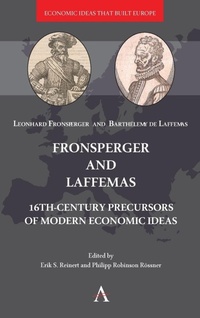
Fronsperger and Laffemas
16th-century Precursors of Modern Economic Ideas
Published on 2. May 2023
Book
Hardback
252 pages
978-1-83998-708-3 (ISBN)
Description
This volume introduces two unique and hitherto largely unknown contributions to the making of modern economic knowledge and makes them available internationally for the first time in full English translation. The messages of the books are seemingly contradictory, one focuses on the role of individual interests and the other on the role of government., but together they form two important pillars for the economics profession: self-interest and industrial policy.
- Written in 1597 Barthelemy de Laffemas' General regulation for the establishment of manufactures (originally in French: Reiglement general pour dresser les manufactures) is one of the earliest voices in the history of political economy emphasizing the necessity of manufacturing and large-scale industry as the source of the wealth of nations.
Located somewhat at the cross-roads between medieval Scholasticism and early mercantilism the book presents a basic version of the infant industry argument and European standard model of economic development which evolved into the works of Enlightenment thinkers such as Colbert and Friedrich List and of the nineteenth- and twentieth-century industrial policy in all the countries that followed England's path to industrialization, including the post-WW II Marshall Plan. - Leonhard Fronsperger's On the praise of self-interest (German original: Von dem Lob dess Eigen Nutzen, 1564) is the first documented instance of the 'Mandeville paradox', a theorem in modern economics usually associated with much later writings including Bernard de Mandeville's Fable of the Bees (1705/14), and Adam Smith's Wealth of Nations (1776).
- Written in 1597 Barthelemy de Laffemas' General regulation for the establishment of manufactures (originally in French: Reiglement general pour dresser les manufactures) is one of the earliest voices in the history of political economy emphasizing the necessity of manufacturing and large-scale industry as the source of the wealth of nations.
Located somewhat at the cross-roads between medieval Scholasticism and early mercantilism the book presents a basic version of the infant industry argument and European standard model of economic development which evolved into the works of Enlightenment thinkers such as Colbert and Friedrich List and of the nineteenth- and twentieth-century industrial policy in all the countries that followed England's path to industrialization, including the post-WW II Marshall Plan. - Leonhard Fronsperger's On the praise of self-interest (German original: Von dem Lob dess Eigen Nutzen, 1564) is the first documented instance of the 'Mandeville paradox', a theorem in modern economics usually associated with much later writings including Bernard de Mandeville's Fable of the Bees (1705/14), and Adam Smith's Wealth of Nations (1776).
Reviews / Votes
"The history of economics has famously been dubbed 'the wrong opinions of dead men'. This handsome little book with translations of texts by Leonhard Fronsperger (1564) and Barthelemy de Laffemas (1597) plus valuable classifications by editors and commentators shows how wrong this view is - an expression of provincialism of time." - Professor em. Dr. Dr. h.c. Heinz D. Kurz, Department of Economics and Graz Schumpeter Centre, University of Graz, Austria. "Reinert and Roessner provide us once again with important perspectives on 'pre-classic' European economic thought with relevance to modern-day issues. Their book offers translated works by 16th-century economists Laffemas and Fronsperger, enhancing our understanding of economic theory and policy. No chatbot can yet replace such a valuable and unique contribution." -Wolfgang Drechsler, Professor of Governance at TalTech's Ragnar Nurkse, Department of Innovation and Governance, Honorary Professor of University College London in the Institute for Innovation and Public Purpose, and Associate and Member of the Advisory Board at Harvard University's Davis Center for Russian and Eurasian Studies. "This collection makes available, for the first time in English translation, texts by the German Leonhard Fronsperger and the Frenchman Barthelemy Laffemas. Already in Fronsperger's Praise of Self-Interest (1564), we see arguments that would emerge later in works by Pierre Nicole and Bernard Mandeville, who are frequently credited with laying the basis of political economy in arguments of moral philosophy. In Laffemas's General Regulation for the Establishment of Manufactures (1597), we see how, at its origin, political economy was conceived of as a new system of governance intended to pacify early modern societies and states in almost perpetual conflict. Taken together, these make a persuasive argument that the late Renaissance deserves more attention, and this valuable edition will help to catalyse more work on this period in the history of political economy." - Paul Cheney, Professor of European History, University of Chicago. "Lately there has been an increased interest in past economic thought that goes beyond the standard interpretation of doctrinal developments from the 16th century up to emergence of the Smithian revolution in the 18th century. This book concentrating on the 16th century tries to present and put into historical context two early economists, the French Barthelemy de Laffemas and the German Leonhard Fronsperger. Presented with a newly written foreword by Erik S Reinert included original texts for the first time translated to English this volume present a fresh and challenging starting-point for understanding early continental economics in its own terms before the emergence of modern economics." -Lars Magnusson, Dept of Economic History, Uppsala University, Sweden.More details
Series
Language
English
Place of publication
London
United Kingdom
Target group
Professional and scholarly
US School Grade: College Graduate Student
Dimensions
Height: 235 mm
Width: 157 mm
Thickness: 19 mm
Weight
565 gr
ISBN-13
978-1-83998-708-3 (9781839987083)
Copyright in bibliographic data and cover images is held by Nielsen Book Services Limited or by the publishers or by their respective licensors: all rights reserved.
Schweitzer Classification
Other editions
Additional editions
Leonhard Fronsperger | Barthelemy de Laffemas | Erik S. Reinert
Fronsperger and Laffemas
16th-century Precursors of Modern Economic Ideas
E-Book
05/2023
Anthem Press
€33.99
Available for download
Persons
Erik S. Reinert is a Professor of Technology Governance and Development Strategies, at Tallinn University of Technology. He is also Honorary Professor at theInstitute for Innovation and Public Purpose, University College London.
Philipp Robinson Roessner is a Professor (chair) of Early Modern History, The University of Manchester.
Philipp Robinson Roessner is a Professor (chair) of Early Modern History, The University of Manchester.
Content
Introduction; 1 Barthelemy de Laffemas (1545-ca. 1611) as an Early Economist: Context and Scholarly Voices in the English-language Literature, Erik S. Reinert and Philipp Robinson Roessner; 2 General Regulation for the Establishment of Manufactures (1597), Barthelemy de Laffemas Translated from the original French by Philip Stewart; 3 Leonhard Fronsperger (1520-ca. 1575) as an Early Apology of the Market Economy, Rainer Klump and Lars Pilz; 4 Leonhard Fronsperger 'On the Praise of Self-Interest' (1564), Translated from the original Early New High German by Philipp Robinson Roessner with Julia McLachlan