

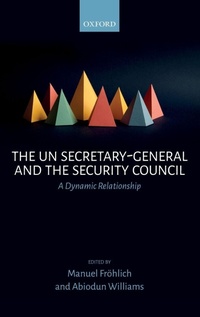
The UN Secretary-General and the Security Council
A Dynamic Relationship
Published on 22. March 2018
Book
Hardback
276 pages
978-0-19-874891-5 (ISBN)
Description
The United Nations Secretary-General and the United Nations Security Council spend significant amounts of time on their relationship with each other. They rely on each other for such important activities as peacekeeping, international mediation, and the formulation and application of normative standards in defense of international peace and security - in other words the executive aspects of the UN's work.
The UN Secretary-General and the Security Council fills an important lacuna in the scholarship on the UN system. Although there exists today an impressive body of literature on the development and significance of the Secretariat and the Security Council as separate organs, an important gap remains in our understanding of the interactions between them. Bringing together some of the most prominent authorities on the subject, this volume is the first book-length treatment of this topic. It studies the UN from an innovative angle, creating new insights on the (autonomous) policy-making of international organizations, and adds to our understanding of the dynamics of intra-organizational relationships.
Within the book, the contributors examine how each Secretary-General interacted with the Security Council, touching upon such issues as the role of personality, the formal and informal infrastructure of the relationship, the selection and appointment processes, as well as the Secretary-General's threefold role as a crisis manager, administrative manager, and manager of ideas.
The UN Secretary-General and the Security Council fills an important lacuna in the scholarship on the UN system. Although there exists today an impressive body of literature on the development and significance of the Secretariat and the Security Council as separate organs, an important gap remains in our understanding of the interactions between them. Bringing together some of the most prominent authorities on the subject, this volume is the first book-length treatment of this topic. It studies the UN from an innovative angle, creating new insights on the (autonomous) policy-making of international organizations, and adds to our understanding of the dynamics of intra-organizational relationships.
Within the book, the contributors examine how each Secretary-General interacted with the Security Council, touching upon such issues as the role of personality, the formal and informal infrastructure of the relationship, the selection and appointment processes, as well as the Secretary-General's threefold role as a crisis manager, administrative manager, and manager of ideas.
Reviews / Votes
[The UN Secretary-General and the Security Council] highlight[s] both the importance of-and the difficultyin maintaining-good relations between states and executive heads of IOs. * Herman T. Salton, ICU University, Tokyo, Japan, International Affairs *More details
Language
English
Place of publication
Oxford
United Kingdom
Target group
Professional and scholarly
Dimensions
Height: 240 mm
Width: 161 mm
Thickness: 19 mm
Weight
581 gr
ISBN-13
978-0-19-874891-5 (9780198748915)
Copyright in bibliographic data and cover images is held by Nielsen Book Services Limited or by the publishers or by their respective licensors: all rights reserved.
Schweitzer Classification
Other editions
Additional editions
Manuel Fröhlich | Abiodun Williams
The UN Secretary-General and the Security Council
A Dynamic Relationship
E-Book
03/2018
1st Edition
OUP eBook
€54.49
Available for download
Manuel Fröhlich | Abiodun Williams
The UN Secretary-General and the Security Council
A Dynamic Relationship
E-Book
03/2018
1st Edition
OUP eBook
€54.49
Available for download
Persons
Manuel Froehlich holds the Chair of International Relations and Foreign Policy at Trier University. He has published several books and articles on a range of issues from the United Nations and global governance to the political philosophy of international relations and the role of individuals in world politics as well as the transformation of sovereignty, the responsibility to protect, and peacekeeping. Froehlich is an elected board member of the German Society for Political Science and co-editor of the German Journal of Political Science ( Zeitschrift fuer Politikwissenschaft). Prof. Froehlich is a fellow of the NRW School of Governance, John W. Holmes Memorial Lecturer of the Academic Council on the United Nations System, recipient of the presidential teaching award of Friedrich-Schiller-University Jena and member of the program committee of the Edelstam Institute.
Abiodun Williams served as the Founding President of The Hague Institute for Global Justice from 2013 to 2016. From 2008 to 2012 he served at the United States Institute of Peace first as Vice President of the Center for Conflict Analysis and Prevention, and later as Senior Vice President of the Center for Conflict Management. From 2001 to 2007 Dr. Williams was Director of Strategic Planning for United Nations Secretaries-General Ban Ki-Moon and Kofi Annan in New York. He held faculty appointments at Georgetown, Rochester, and Tufts universities. Dr. Williams is the past Chair of the Academic Council on the UN System (ACUNS). He has published widely on conflict prevention and management.
Abiodun Williams served as the Founding President of The Hague Institute for Global Justice from 2013 to 2016. From 2008 to 2012 he served at the United States Institute of Peace first as Vice President of the Center for Conflict Analysis and Prevention, and later as Senior Vice President of the Center for Conflict Management. From 2001 to 2007 Dr. Williams was Director of Strategic Planning for United Nations Secretaries-General Ban Ki-Moon and Kofi Annan in New York. He held faculty appointments at Georgetown, Rochester, and Tufts universities. Dr. Williams is the past Chair of the Academic Council on the UN System (ACUNS). He has published widely on conflict prevention and management.
Content
Manuel Froehlich and Abiodun Williams: Introduction
1: Ellen Jenny Ravndal: Trygve Lie, 1946-1953
2: Manuel Froehlich: Dag Hammarskjoeld, 1953-1961
3: Bernard J. Firestone: U Thant, 1961-1971
4: Kent J. Kille: Kurt Waldheim, 1972-1981
5: Alvaro de Soto: Javier Perez de Cuellar, 1982-1991
6: Adekeye Adebajo: Boutros Boutros-Ghali, 1992-1996
7: Abiodun Williams: Kofi Annan, 1997-2006
8: Richard Gowan: Ban Ki-moon, 2007-2016
9: Manuel Froehlich and Abiodun Williams: Conclusion
Tom Buitelaar and Sam Daws: Annex 1: Note on the election and distribution of the non-permanent members of the Security Council
Annex 2: List of Security Council membership and representatives 1946-2016
1: Ellen Jenny Ravndal: Trygve Lie, 1946-1953
2: Manuel Froehlich: Dag Hammarskjoeld, 1953-1961
3: Bernard J. Firestone: U Thant, 1961-1971
4: Kent J. Kille: Kurt Waldheim, 1972-1981
5: Alvaro de Soto: Javier Perez de Cuellar, 1982-1991
6: Adekeye Adebajo: Boutros Boutros-Ghali, 1992-1996
7: Abiodun Williams: Kofi Annan, 1997-2006
8: Richard Gowan: Ban Ki-moon, 2007-2016
9: Manuel Froehlich and Abiodun Williams: Conclusion
Tom Buitelaar and Sam Daws: Annex 1: Note on the election and distribution of the non-permanent members of the Security Council
Annex 2: List of Security Council membership and representatives 1946-2016