

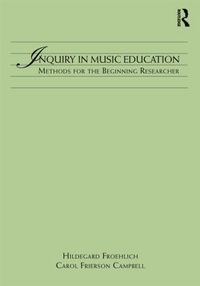
Inquiry in Music Education
Concepts and Methods for the Beginning Researcher
1st Edition
Published on 25. August 2012
Book
Paperback/Softback
352 pages
978-0-415-89640-5 (ISBN)
Description
Inquiry in Music Education: Concepts and Methods for the Beginning Researcher provides an introduction to research and scholarship in music education. This textbook covers topic formulation, information literacy, reading and evaluating research studies, and planning and conducting original studies within accepted guidelines, based on research conventions in music, the other arts, education, and the humanities. Electronic search tools, hands-on assignments, supplementary teaching materials and other resources are included on the companion web site (available January 2013).
Skills in research and scholarship introduce students to the language and protocols by which to succeed in today's competitive market of grant writing, arts advocacy, and public outreach as a contributing member of the community of music educators.
Following the legacy begun by Rainbow and Froehlich in Research in Music Education, published in 1987, the objectives of this book are:
To expand what is meant by music education and research,
To help students find their niche in those definitions, and
To teach tangible skills that are useful for music educators with diverse instructional goals and career aspirations.
Skills in research and scholarship introduce students to the language and protocols by which to succeed in today's competitive market of grant writing, arts advocacy, and public outreach as a contributing member of the community of music educators.
Following the legacy begun by Rainbow and Froehlich in Research in Music Education, published in 1987, the objectives of this book are:
To expand what is meant by music education and research,
To help students find their niche in those definitions, and
To teach tangible skills that are useful for music educators with diverse instructional goals and career aspirations.
More details
Language
English
Place of publication
London
United Kingdom
Publishing group
Taylor & Francis Ltd
Target group
College/higher education
Illustrations
45 tables, 5 halftones and 15 line drawings
Dimensions
Height: 254 mm
Width: 178 mm
Weight
680 gr
ISBN-13
978-0-415-89640-5 (9780415896405)
Copyright in bibliographic data and cover images is held by Nielsen Book Services Limited or by the publishers or by their respective licensors: all rights reserved.
Schweitzer Classification
Other editions
New editions
Carol Frierson-Campbell | Hildegard C. Froehlich
Inquiry in Music Education
Concepts and Methods for the Beginning Researcher
Book
03/2022
2nd Edition
Routledge
€77.80
Shipment within 15-20 days
Additional editions
Hildegard Froehlich | Carol Frierson-Campbell | Hildegard C. Froehlich
Inquiry in Music Education
Concepts and Methods for the Beginning Researcher
Book
08/2012
1st Edition
Routledge
€223.21
Article exhausted; check for reprint
Persons
Hildegard Froehlich is Professor Emeritus at the University of North Texas.
Carol Frierson-Campbell is Associate Professor at William Paterson University.
Carol Frierson-Campbell is Associate Professor at William Paterson University.
Content
Part 1. Chapters One through Four: Entering the World of Questioning 1. The Spiral and Modes of Inquiry: Options, Choices, and Initial Decisions 2. Finding and Mapping Sources of Information 3. Reading and Thinking in Conceptual Frames 4. Toward a Rationale and Research Plan: Writing a Contract with Yourself Part 2. Chapters Five through Thirteen: Methods in Modes of Inquiry 5. Approaches in the Philosophical Mode of Inquiry 6. Historical Inquiry: Getting Inside the Process 7. Purposes and Questions in Qualitative Research 8. Selected Procedures for Gathering, Analyzing, and Reflecting on Qualitative Data 9. Quantitative Research in Music Education: Letting Numbers Speak 10. Understanding Descriptive Statistics 11. Interpreting Correlations 12. Designing Ex Post Facto and Experimental Studies 13. Tools for Data Gathering: Basics of Content and Construction 14. "So What?" Interpreting and Sharing your Findings