

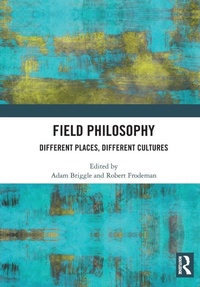
Field Philosophy
Different Places, Different Cultures
1st Edition
Published on 21. May 2026
Book
Paperback/Softback
148 pages
978-1-032-73796-6 (ISBN)
Description
Philosophical issues often lie at the heart of societal problems, yet it is rare for philosophers to be actively engaged in the search for solutions. Conventionally, philosophy prioritizes the written word and the seminar room while living at a remove from everyday life. In contrast, field philosophy, the approach invoked by the chapters in this book, emphasizes the immediacy of the spoken word and engages people in their daily activities to help them understand the philosophical elements of their everyday tasks.
This book offers field philosophy as a model for social engagement, advancing a new way for doing philosophy relevant to the needs of 21st century society. The chapters in the book describe the historical significance of field philosophy, its ethical commitments, and the theoretical warrant underlying its practice. Together, they advance the societal relevance of philosophy and the many ways it can interface with a diverse range of communities from engineers and scientists to policymakers and activists.
This book will be of interest to the academic philosophy community, policy makers and policy researchers, university administrators, and those interested in the theory and practice of interdisciplinarity. Versions of some of its chapters were originally published as a special issue of Social Epistemology.
This book offers field philosophy as a model for social engagement, advancing a new way for doing philosophy relevant to the needs of 21st century society. The chapters in the book describe the historical significance of field philosophy, its ethical commitments, and the theoretical warrant underlying its practice. Together, they advance the societal relevance of philosophy and the many ways it can interface with a diverse range of communities from engineers and scientists to policymakers and activists.
This book will be of interest to the academic philosophy community, policy makers and policy researchers, university administrators, and those interested in the theory and practice of interdisciplinarity. Versions of some of its chapters were originally published as a special issue of Social Epistemology.
More details
Language
English
Place of publication
London
United Kingdom
Publishing group
Taylor & Francis Ltd
Target group
College/higher education
Professional and scholarly
Postgraduate, Undergraduate Advanced, and Undergraduate Core
Dimensions
Height: 246 mm
Width: 174 mm
Weight
300 gr
ISBN-13
978-1-032-73796-6 (9781032737966)
Copyright in bibliographic data and cover images is held by Nielsen Book Services Limited or by the publishers or by their respective licensors: all rights reserved.
Schweitzer Classification
Other editions
Additional editions

E-Book
10/2024
1st Edition
Routledge
€211.99
Available for download

E-Book
10/2024
1st Edition
Routledge
€211.99
Available for download
Book
10/2024
1st Edition
Routledge
€230.90
Shipment within 10-20 days
Persons
Adam Briggle is Professor and Director of Graduate Studies in the Department of Philosophy and Religion at the University of North Texas. He is the author of six books, including Thinking through Climate Change: A Philosophy of Energy in the Anthropocene (2021) and A Field Guide to Climate Change: Understanding the Problems (2024).
Robert Frodeman writes on environmental philosophy and public policy, the philosophy of technology, and the future of the university. He is the author and/or editor of 16 books, including Sustainable Knowledge (2013) and Transhumanism, Nature, and the Ends of Science (2019), and has lectured at universities worldwide.
Robert Frodeman writes on environmental philosophy and public policy, the philosophy of technology, and the future of the university. He is the author and/or editor of 16 books, including Sustainable Knowledge (2013) and Transhumanism, Nature, and the Ends of Science (2019), and has lectured at universities worldwide.
Content
Introduction: A Philosophy for the 21st Century 1. What Trans Philosophy Can Teach Field Philosophy 2. Field Philosophy in the Light of its Ancestors 3. Field Philosophy: Practice and Theory 4. Philosophy of Gongcheng (Engineering): A Chinese Field Philosophy Case Study 5. Field Philosophy and the Chinese National Park System 6. The Gene Edited Babies Controversy in China: Field Philosophical Questioning 7. Field Philosophy and Social Justice 8. Field Philosophy and its Institutions in the East and West 9. Chinese Philosophy as a Kind of Field Philosophy 10. Limits to Collaboration: Field Philosophy and Working Lands in the West