

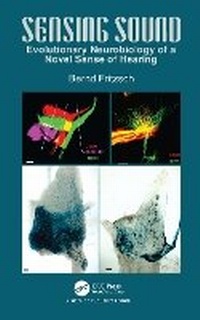
Sensing Sound
Evolutionary Neurobiology of a Novel Sense of Hearing
1st Edition
Published on 1. December 2023
Book
Hardback
214 pages
978-1-138-49717-7 (ISBN)
Description
Hearing is a prerequisite for the evolution of language and thus the development of human societies. It is the only major sense whose evolution can be traced back to vertebrates, starting with sarcopterygians.
The book explores the evolution of auditory development that has remained largely unexplored in contemporary theories of neurosensory brain evolution, including the telencephalon. It describes how sensory epithelia from the basilar papilla evolved in the ear and connected dedicated cochlear neurons to neuronal centers in the brain, and deals with how sound is converted through sound modulations into reliably decoded messages.
The loss of hearing with age is expected to reach 2.6 billion people by 2050. As such, the book explains and reviews hearing loss at the molecular level to the behavioral level, and provides suggestions to manage the loss.
The book explores the evolution of auditory development that has remained largely unexplored in contemporary theories of neurosensory brain evolution, including the telencephalon. It describes how sensory epithelia from the basilar papilla evolved in the ear and connected dedicated cochlear neurons to neuronal centers in the brain, and deals with how sound is converted through sound modulations into reliably decoded messages.
The loss of hearing with age is expected to reach 2.6 billion people by 2050. As such, the book explains and reviews hearing loss at the molecular level to the behavioral level, and provides suggestions to manage the loss.
More details
Language
English
Place of publication
London
United Kingdom
Publishing group
Taylor & Francis Ltd
Target group
Professional and scholarly
Academic
Illustrations
20 farbige Abbildungen, 1 s/w Tabelle, 33 s/w Abbildungen
1 Tables, black and white; 20 Illustrations, color; 33 Illustrations, black and white
Dimensions
Height: 234 mm
Width: 156 mm
Weight
512 gr
ISBN-13
978-1-138-49717-7 (9781138497177)
Copyright in bibliographic data and cover images is held by Nielsen Book Services Limited or by the publishers or by their respective licensors: all rights reserved.
Schweitzer Classification
Other editions
Additional editions
Book
05/2025
1st Edition
CRC Press
€91.30
Shipment within 10-20 days
E-Book
12/2023
1st Edition
CRC Press
€68.49
Available for download
E-Book
12/2023
1st Edition
CRC Press
€68.49
Available for download
Person
Bernd Fritzsch is a leading expert in the field of inner ear neuroembryology and evolution, with almost 40 years' experience. He has organized multiple conferences, published books, journal articles, has 300 PubMed indexed papers and over 25,000 citations. His contributions to the field are conceptual and provide testable hypothesis using novel techniques. Bernd's research aims at the development and maintenance of the aging neurosensory system of the ear and its connection to the brain. He was the DEO (Chair) of the Department of Biology at the University of Iowa from 2008 - 2016. He developed a viable conditional deletion of mouse model that expands on earlier embryonic work on neurotrophin function for the inner ear on neuron viability into the postnatal phase. His work on the molecular basis of neurosensory development and maintenance helps others by fine tuning their approach toward restoration of lost hair cells and neurons. He has been the Director of the University of Iowa Aging Mind and Brain Initiative as well as the Center on Aging from 2013-2019. His research could provide a better molecular understanding of the underlying aging brain molecular changes. His recently applied R01 will allow us to use fluorescent genes to study age dependent mice defects in the vestibular and cochlear connection and function.
Content
Preface. Introduction. Defining novelty in the neurosensory system. Evolving mechanosensation for gravity and angular orientation, lateral line, and electroreception. Connecting a novel sensory input from the ear to the brain: how to make new neuronal networks and new connections of an auditory system. Defining the auditory system of tetrapods. Sound processing: boundaries for auditory signal processing revealed. The evolution of the auditory system as a blueprint for sensory expansions using established principles - evolving new or adding artificial senses to expand the perception of the world. Summary and conclusions