

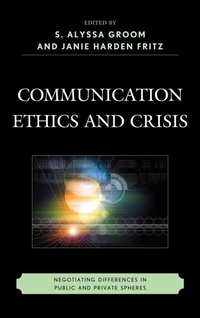
Communication Ethics and Crisis
Negotiating Differences in Public and Private Spheres
Published on 19. December 2011
Book
Hardback
196 pages
978-1-61147-449-7 (ISBN)
Description
This collection of essays extends the conversation on communication ethics and crisis communication to offer practical wisdom for meeting the challenges of a complex and ever-changing world. In multiple contexts ranging from the intrapersonal, interpersonal, and family to the political and public, moments of crisis call us to respond from within particular standpoints that shape our understanding and our response to crisis as we grapple with contested notions of "the good" in our shared life together. With no agreed-upon set of absolutes to guide us, this moment calls us to learn from difference as we seek resources to continue the human conversation as we engage the unexpected. This collection of essays invites multiple epistemological and methodological standpoints to consider alternative ways of thinking about communication ethics and crisis.
Reviews / Votes
In this unified collection, Groom and Fritz (both, Duquesne Univ.) feature prominent and rising American ethics scholars. In three distinct sections, these essays establish that crisis reactions can be understood through the presentation of a narrative; investigate the idea of a productive distance between a crisis and the responder, despite the impossibility of mastering the crisis; and distinguish the differences between public and private contexts. The editors assert that a banal view of crisis has developed due to its increased permeation of public and private spheres. Celeste Grayson Seymour confirms this position in her essay, 'Understanding Anxiety: The Crisis of Ethical Choice'; she explains that this universal human crisis is due to the restless state of existence. In 'The Crisis Fallacy: Egoism, Epistemology, and Ethics in Crisis Communication and Preparation,' Pat Gehrke (Univ. of South Carolina) invites the reader to turn unreflective engagement into reflective engagement. This unique collection extends the conversation on communication ethics and crisis communication through its multiplicity of perspectives. Summing Up: Recommended. Upper-division undergraduates through researchers/faculty. * Choice Reviews * Over the course of nine essays broadly centered on the titular theme, the collection largely follows through on that promise, offering a variety of pragmatic, phenomenological approaches to ethical decision-making in crisis situations. ... Communication Ethics and Crisis offers a variety of methodological approaches for viewing ethical communication and/or crisis; for that, the collection has value for scholars of either or both. Scholars looking for practical approaches to crisis communication will find material of interest here, as will those whose interests lie in the foundational theories governing out understanding of crises both material and philosophical. Groom and Fritz's compilation contributes material both reflective and forward-looking to larger conversations about ethics and crisis response in a postmodern world; those engaged in such conversations would do well to take a look. * Rhetoric Review * [T]his collection offers readers a chance to negotiate different postmodernist approaches to understanding communication ethics and crisis. * Journal of Media Ethics *More details
Series
Language
English
Place of publication
Cranbury
United States
Publishing group
Associated University Presses
Target group
College/higher education
Dimensions
Height: 235 mm
Width: 157 mm
Thickness: 15 mm
Weight
445 gr
ISBN-13
978-1-61147-449-7 (9781611474497)
Copyright in bibliographic data and cover images is held by Nielsen Book Services Limited or by the publishers or by their respective licensors: all rights reserved.
Schweitzer Classification
Other editions
Additional editions
E-Book
11/2011
1st Edition
Fairleigh Dickinson University Press,U.S.
€48.49
Available for download
Persons
S. Alyssa Groom is assistant professor of communication & rhetorical Studies at Duquesne University.
Janie M. Harden Fritz is associate professor of communication & rhetorical studies at Duquesne University.
Janie M. Harden Fritz is associate professor of communication & rhetorical studies at Duquesne University.
Content
Acknowledgments
Contributors
Introduction
Part One:Narrativity and Situatedness
Moviegoing Epideictic: Walker Percy and the Rhetorical Tradition
Dialogic Meeting of Crisis: Illuminating Illusions Of The Death Of God and Nietzsche's Revaluation of Values
Understanding Anxiety: The Crisis of Ethical Choice
Part Two:Response-ability as Inner Transparency
Interpersonal Crisis Communication in the Workplace: Professional Civility as Ethical Response to Problematic Interactions
Questioning Back: Engaging an Organization's Narrative for Ethical Communicative Responsiveness in Crisis Situations
The Ethical Imperative Of Significant Choice: Addressing Learning Styles in Crisis Messages
Part Three:Discerning Public and Private Spheres
A More Perfect Union: Recovering Ethics in Public Dialogue
The Crisis Fallacy: Egoism, Epistemology, and Ethics in Crisis Communication and Preparation
Communication Ethics as Janus at the Gates: Responding to Postmodernity and the Normativity of Crisis
Contributors
Introduction
Part One:Narrativity and Situatedness
Moviegoing Epideictic: Walker Percy and the Rhetorical Tradition
Dialogic Meeting of Crisis: Illuminating Illusions Of The Death Of God and Nietzsche's Revaluation of Values
Understanding Anxiety: The Crisis of Ethical Choice
Part Two:Response-ability as Inner Transparency
Interpersonal Crisis Communication in the Workplace: Professional Civility as Ethical Response to Problematic Interactions
Questioning Back: Engaging an Organization's Narrative for Ethical Communicative Responsiveness in Crisis Situations
The Ethical Imperative Of Significant Choice: Addressing Learning Styles in Crisis Messages
Part Three:Discerning Public and Private Spheres
A More Perfect Union: Recovering Ethics in Public Dialogue
The Crisis Fallacy: Egoism, Epistemology, and Ethics in Crisis Communication and Preparation
Communication Ethics as Janus at the Gates: Responding to Postmodernity and the Normativity of Crisis