

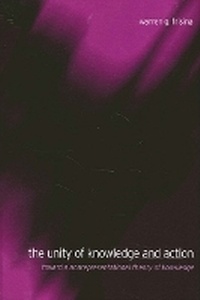
The Unity of Knowledge and Action
Toward a Nonrepresentational Theory of Knowledge
Published on 1. August 2002
Book
Hardback
280 pages
978-0-7914-5361-2 (ISBN)
Description
Building upon insights from the sixteenth century Neo-Confucian Wang Yang-ming, the American pragmatist John Dewey, and the process philosopher Alfred North Whitehead, this book argues that knowledge is best understood as a form of action. Many of the most puzzling philosophic problems in the modern era can be traced to our tendency to assume that knowledge is separate from action. Letting go of the sharp knowledge-action distinction, however, makes possible a more coherent theory of knowledge that is more adaptive to the way we experience one another, the world, and ourselves. By responding directly to problems raised by contemporary thinkers like Charles Taylor, Donald Davidson, Richard Rorty, Daniel Dennett, Mark Johnson, George Lakoff, and Robert Neville, this book maps out a strategy for making progress in the contemporary quest for a "nonrepresentational theory of knowledge."
Reviews / Votes
"The author's discussion of works of Davidson, Rorty, Taylor, and Dennett not only lays out the central problems of representational theories within epistemology itself but also elucidates the significant implications of such epistemology for our understanding of the self, of the human mind, and of the way we experience, one another and the world." - Journal of the American Academy of Religion"Frisina has moved comparative Asian/Western philosophical activity beyond its usual level of mere comparison to that of the active engagement of alternative sensibilities in which each participant to the debate is able to benefit from the others. This is a significant contribution to the current engagement between American pragmatism and Asian Neo-Confucianism that promises to bear fruit for generations to come." - David L. Hall, coauthor of Thinking from the Han: Self, Truth, and Transcendence in Chinese and Western Culture
"Frisina has put together an unlikely group of philosophers to make a compelling argument. It is a 'page turner' and a most enjoyable read." - Roger T. Ames, coeditor of Self and Deception: A Cross-Cultural Philosophical Enquiry
More details
Series
Language
English
Place of publication
Albany, NY
United States
Target group
College/higher education
US School Grade: College Graduate Student and over
Illustrations
Total Illustrations: 0
Dimensions
Height: 229 mm
Width: 152 mm
Thickness: 25 mm
Weight
481 gr
ISBN-13
978-0-7914-5361-2 (9780791453612)
Copyright in bibliographic data and cover images is held by Nielsen Book Services Limited or by the publishers or by their respective licensors: all rights reserved.
Schweitzer Classification
Other editions
Additional editions
E-Book
02/2012
1st Edition
De Gruyter
€35.99
Available for download
Person
Warren G. Frisina is Associate Professor of Philosophy and Religious Studies at Hofstra University.
Content
Acknowledgments
Introduction
PART I. Preliminary Remarks
1. Knowledge and the Self: Charles Taylor's Sources of the Self
2. Antirepresentationalism in Late- and Postanalytic Philosophy: Donald Davidson and Richard Rorty
3. Minds, Bodies, and Consciousness: Daniel Dennett's Consciousness Explained
PART II. Preliminary Remarks
4. Are Knowledge and Action Really One Thing? Wang Yang-ming's Doctrine of Mind
5. Knowledge as Active, Aesthetic, and Hypothetical: The Relationship between Dewey's Metaphysics and Epistemology
6. A Pragmatic Interpretation of Whitehead's Cosmology
PART III. Preliminary Remarks
7. Minds, Bodies, Experience, Nature: Is Panpsychism Really Dead?
8. Heaven's Partners or Nietzschean Free Spirits?
9. Knowledge, Action, and the Organicist Turn
Notes
Works Cited
Index
Introduction
PART I. Preliminary Remarks
1. Knowledge and the Self: Charles Taylor's Sources of the Self
2. Antirepresentationalism in Late- and Postanalytic Philosophy: Donald Davidson and Richard Rorty
3. Minds, Bodies, and Consciousness: Daniel Dennett's Consciousness Explained
PART II. Preliminary Remarks
4. Are Knowledge and Action Really One Thing? Wang Yang-ming's Doctrine of Mind
5. Knowledge as Active, Aesthetic, and Hypothetical: The Relationship between Dewey's Metaphysics and Epistemology
6. A Pragmatic Interpretation of Whitehead's Cosmology
PART III. Preliminary Remarks
7. Minds, Bodies, Experience, Nature: Is Panpsychism Really Dead?
8. Heaven's Partners or Nietzschean Free Spirits?
9. Knowledge, Action, and the Organicist Turn
Notes
Works Cited
Index