

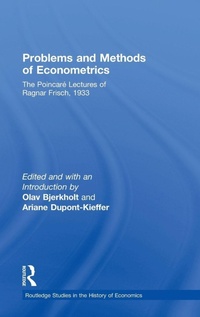
Problems and Methods of Econometrics
The Poincare Lectures of Ragnar Frisch 1933
1st Edition
Published on 1. June 2009
Book
Hardback
208 pages
978-0-415-45144-4 (ISBN)
Description
The development of economics changed dramatically during the twentieth century with the emergence of econometrics, macroeconomics and a more scientific approach in general. One of the key individuals in the transformation of economics was Ragnar Frisch, professor at the University of Oslo and the first Nobel Laureate in economics in 1969. He was a co-founder of the Econometric Society in 1930 (after having coined the word econometrics in 1926) and edited the journal Econometrics for twenty-two years. The discovery of the manuscripts of a series of eight lectures given by Frisch at the Henri Poincare Institute in March-April 1933 on The Problems and Methods of Econometrics will enable economists to more fully understand his overall vision of econometrics.
This book is a rare exhibition of Frisch's overview on econometrics and is published here in English for the first time. Edited and with an introduction by Olav Bjerkholt and Ariane Dupont-Kieffer, Frisch's eight lectures provide an accessible and astute discussion of econometric issues from philosophical foundations to practical procedures.
Concerning the development of economics in the twentieth century and the broader visions about economic science in general and econometrics in particular held by Ragnar Frisch, this book will appeal to anyone with an interest in the history of economics and econometrics.
This book is a rare exhibition of Frisch's overview on econometrics and is published here in English for the first time. Edited and with an introduction by Olav Bjerkholt and Ariane Dupont-Kieffer, Frisch's eight lectures provide an accessible and astute discussion of econometric issues from philosophical foundations to practical procedures.
Concerning the development of economics in the twentieth century and the broader visions about economic science in general and econometrics in particular held by Ragnar Frisch, this book will appeal to anyone with an interest in the history of economics and econometrics.
Reviews / Votes
'The set of lecture notes is a rare exhibition of Frisch's overview on econometrics. Its accessible and astute description of economic and econometric modelling versus economic reality shines a timeless warning light especially for those who are deeply lost in the thick mist of formal technique twiddling.' Duo Qin (Queen Mary's University of London, UK)More details
Series
Language
English
Place of publication
London
United Kingdom
Publishing group
Taylor & Francis Ltd
Target group
Professional and scholarly
Product notice
Paper over boards
Illustrations
3 s/w Tabellen, 48 s/w Zeichnungen, 48 s/w Abbildungen
3 Tables, black and white; 48 Line drawings, black and white; 48 Illustrations, black and white
Dimensions
Height: 240 mm
Width: 161 mm
Thickness: 16 mm
Weight
482 gr
ISBN-13
978-0-415-45144-4 (9780415451444)
Copyright in bibliographic data and cover images is held by Nielsen Book Services Limited or by the publishers or by their respective licensors: all rights reserved.
Schweitzer Classification
Other editions
Additional editions
Ragnar Frisch | Olav Bjerkholt | Ariane Dupont-Kieffer
Problems and Methods of Econometrics
The Poincare Lectures of Ragnar Frisch 1933
Book
11/2013
1st Edition
Routledge
€78.20
Shipment within 15-20 days
Ragnar Frisch | Olav Bjerkholt | Ariane Dupont-Kieffer
Problems and Methods of Econometrics
The Poincare Lectures of Ragnar Frisch 1933
E-Book
06/2009
Routledge
€72.49
Available for download
Ragnar Frisch | Olav Bjerkholt | Ariane Dupont-Kieffer
Problems and Methods of Econometrics
The Poincare Lectures of Ragnar Frisch 1933
E-Book
06/2009
1st Edition
Routledge
€72.49
Available for download
Ragnar Frisch | Olav Bjerkholt | Ariane Dupont-Kieffer
Problems and Methods of Econometrics
The Poincaré Lectures of Ragnar Frisch 1933
E-Book
06/2009
1st Edition
Routledge
€126.49
Available for download
Persons
Ragnar Frisch (1895-1973) was the first nobel laureate in economics in 1969 and was largely responsible for introducing econometrics to government economic planning and accounting.
Olav Bjerkholt was head of the Research Department in Statistics Norway between 1984 and 1996. Since then he has been professor of economics at the University of Oslo, Norway.
Ariane Dupont-Kieffer was previously researcher in the Department of History of Economic Thought and Sociology at Pantheon-Sorbonne University, defended a PhD on Ragnar Frisch in 2003. She is now researcher in the Department of Economics and Sociology at the French National Institute for Transportation and Safety, working on transport economics and environmental policy issues.
Olav Bjerkholt was head of the Research Department in Statistics Norway between 1984 and 1996. Since then he has been professor of economics at the University of Oslo, Norway.
Ariane Dupont-Kieffer was previously researcher in the Department of History of Economic Thought and Sociology at Pantheon-Sorbonne University, defended a PhD on Ragnar Frisch in 2003. She is now researcher in the Department of Economics and Sociology at the French National Institute for Transportation and Safety, working on transport economics and environmental policy issues.
Content
Preface Edmond Malinvaud Editor's Introduction Olav Bjerkholt and Ariane Dupont-Kieffer Foreword Paul Samuelson Introduction 1. The philosophical foundations of econometrics. The axiomatic method. Utility as quantity 2. Examples of static and semi-static econometric theories. Monopoly, polypoly. The concept of force 3. What is a "dynamic" theory? Properties of determined and undetermined systems 4. Examples of dynamic econometric theories. Oscillations in closed systems. The theory of crises 5. The creation of cycles by random shocks. Synthesis between a probabilistic point of view and the point of view of deterministic dynamic laws 6. The statistical construction of econometric functions. Autonomous and confluent equations. The danger of analysis of many variables 7. Time series techniques. Decomposition of series. Linear operations and their inversion problem 8. Conclusion: The significance of social and mechanical laws. Invariance and rigidity. Remarks on a philosophy of chaos