

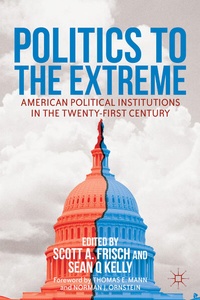
Politics to the Extreme
American Political Institutions in the Twenty-First Century
Published on 11. December 2013
Book
Paperback/Softback
XXVI, 246 pages
978-1-137-36142-4 (ISBN)
Description
To overcome the political deadlock that overshadows the pressing problems facing the United States, the academies top scholars address the causes and consequences of polarization in American politics, and suggest solutions for bridging the partisan divide.
Reviews / Votes
"The dysfunctional gridlock of the modern Congress is on display for even the most casual observers. The bad behavior in Congress reflects deep divisions across the political environment including the media and other institutions- even the Supreme Court. In Politics to the Extreme some of the nation's most savvy observers explain and explore how extreme partisan polarization is undermining effective government. Thoughtful and illuminating books like this one are necessary if we are to find our way to the difficult solutions." Richard A. Arenber, Adjunct Professor at Brown University, USA and co-author of Defending the Filibuster
More details
Edition
2013 edition
Language
English
Place of publication
New York
United States
Target group
Professional and scholarly
Product notice
Paperback (trade)
Unsewn / adhesive bound
Illustrations
15 s/w Abbildungen
XXVI, 246 p. 15 illus.
Dimensions
Height: 231 mm
Width: 150 mm
Thickness: 18 mm
Weight
386 gr
ISBN-13
978-1-137-36142-4 (9781137361424)
DOI
10.1057/9781137312761
Schweitzer Classification
Other editions
Additional editions
S. Frisch | S. Kelly
Politics to the Extreme
American Political Institutions in the Twenty-First Century
Book
12/2013
Palgrave MacMillan
€53.49
Shipment within 10-20 days
Persons
Lara M. Brown, Villanova University, USA
Geoffrey Buhl, California State University Channel Islands, USA
Lawrence C. Dodd, University of Florida, USA
Matthew Dull, Virginia Tech University, USA
Mickey Edwards, Aspen Institute, USA
Douglas B. Harris, Loyola University, USA
Seth E. Masket, University of Denver, USA
Frank H. Mackaman, The Dirksen Congressional Center, USA
Thomas E. Mann, The Brookings Institution, USA
Jose Marichal, California Lutheran University, USA
Kevin J. McMahon, Trinity College, USA
Norman Ornstein, American Enterprise Institute (AEI), USA
David C.W. Parker, Montana State University Bozeman, USA
Scot Schraufnagel, Northern Illinois University, USA
Sean M. Theriault, University of Texas at Austin, USA
Content
Foreword; Thomas Mann and Norman Ornstein Introduction; Scott A. Frisch and Sean Q Kelly PART I: CAUSES AND CONSEQUENCES OF PARTISAN POLARIZATION 1. Appropriations to the Extreme: Partisanship and the Power of the Purse; Geoffrey W. Buhl, Scott A. Frisch and Sean Q Kelly 2. The Gingrich Senators, the Tea Party Senators, and Their Effect on the U.S. Senate; Sean Theriault 3. The Weaponization of Congressional Oversight: The Politics of the Watchful Eye, 1947-2010; David C.W. Parker and Matthew Dull 4. Party Polarization, Member Incivility, and Legislative Productivity: A Two-Dimensional Perspective on Conflict and Moderation in Congress; Lawrence C. Dodd and Scot Schraufnagel 5. Let's Play Hardball: Congressional Partisanship in the Television Era; Douglas Harris 6. Profile Politics: Examining Polarization through Congressional Member Facebook Pages; José Marichal 7. Necessary and Damaging: Presidential Base Electoral Strategies and Partisan Polarization; Lara Brown 8. A Polarizing Supreme Court? Judicial Decisions in a Red/Blue America; Kevin J. McMahon PART II: BRIDGING THE PARTISAN DIVIDE 9. Growing Apart: 'Civilista' Attempts to Bridge the Partisan Rift; Frank Mackaman 10. Can Polarization be Mitigated? California's Experiment with the Top-Two Primary; Seth Masket 11. How to Turn Democrats and Republicans into Americans; Mickey Edwards