

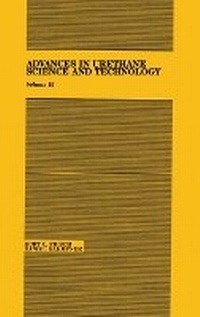
Advances in Urethane
Science & Technology, Volume XIV
1st Edition
Published on 6. August 1998
Book
Hardback
334 pages
978-1-56676-675-3 (ISBN)
Description
Flexible polyurenthane foams of all types are a unique group of plastics materials, characterized by the fact that different sets of properties can be obtained by varying the levels of a small number of base components in the formulations. This book discusses the methodology for obtaining meaningful equations for correlating properties.
More details
Language
English
Place of publication
Bosa Roca
United States
Publishing group
Taylor & Francis Inc
Target group
College/higher education
Professional and scholarly
Dimensions
Height: 229 mm
Width: 152 mm
Weight
780 gr
ISBN-13
978-1-56676-675-3 (9781566766753)
Copyright in bibliographic data and cover images is held by Nielsen Book Services Limited or by the publishers or by their respective licensors: all rights reserved.
Schweitzer Classification
Other editions
Additional editions
E-Book
01/2020
1st Edition
CRC Press
€403.99
Available for download
E-Book
01/2020
1st Edition
CRC Press
€403.99
Available for download
Persons
Frisch\, Kurt C.; Klempner\, Daniel
Content
Mathematical Property Prediction Models for Flexible Polyurethane Foams.
Reinhart Schiffauer, ARCO Chemical Company, South Charleston, South Carolina
o Methods for Obtaining Mathematical Property Prediction Models o Mathematical Analysis o Transformed Variables o Individual Models for Each Property o Density o Hardness o Mechanical Properties o Resilience o Fatique o Maximum Block Temperature, Conventional Slabstock Foam o Individual Influencing Variables o Correlation of Ancillary Chemicals with the Base Formulation o Recommendations for Future Studies o References
The Effective Diffusivity of Cyclopentane and n-Pentane in PU and PUIR Foams by Thin-Slice Gravimetric Analysis.
J. Richard Booth and Deb Bhattarcharjee, Dept. of Chemical Engineering, Tennessee Technological University
o Purpose o Background o Research Approach o Discussion of Results o Conclusions o Nomenclature o References
Scorch Inhibitors for Polyurethane Slabstock Foams.
James H. Botkin, Ciba Specialty Chemicals Corp, Additives Division, Tarrytown, NY
o Introduction o Chemistry of Scorching in Polyurethane Foams o Test Methods for Polyol Stabilization and Scorch Inhibition o Antioxidant Systems for Polyol Stabilization and Scorch Inhibition o Industry Trends and Antiscorch Systems o Conclusions and Outlook o Acknowledgements o Appendix: List of Antioxidants o References
A Novel Architecture for Electro-Optic Polyurethane: Alternating Charge Transporting and Nonlinear Optical Chromophores.
Kevin D. Belfield and Suresh R. Sriram, Dept. of Chemistry, University of Detroit Mercy
o Introduction o Experimental o Results and Discussion o Conclusions o Acknowledgements o References
Advances in Moisture-Curable Siloxane-Urethane Polymers.
Janusg Kozakiewicz, Industrial Chemistry Research Institute, Warsaw, Poland
o Introductory Remarks o Experimental o Results and Discussion o Further Development of Siloxane-Urethane Polymers o References <
Reinhart Schiffauer, ARCO Chemical Company, South Charleston, South Carolina
o Methods for Obtaining Mathematical Property Prediction Models o Mathematical Analysis o Transformed Variables o Individual Models for Each Property o Density o Hardness o Mechanical Properties o Resilience o Fatique o Maximum Block Temperature, Conventional Slabstock Foam o Individual Influencing Variables o Correlation of Ancillary Chemicals with the Base Formulation o Recommendations for Future Studies o References
The Effective Diffusivity of Cyclopentane and n-Pentane in PU and PUIR Foams by Thin-Slice Gravimetric Analysis.
J. Richard Booth and Deb Bhattarcharjee, Dept. of Chemical Engineering, Tennessee Technological University
o Purpose o Background o Research Approach o Discussion of Results o Conclusions o Nomenclature o References
Scorch Inhibitors for Polyurethane Slabstock Foams.
James H. Botkin, Ciba Specialty Chemicals Corp, Additives Division, Tarrytown, NY
o Introduction o Chemistry of Scorching in Polyurethane Foams o Test Methods for Polyol Stabilization and Scorch Inhibition o Antioxidant Systems for Polyol Stabilization and Scorch Inhibition o Industry Trends and Antiscorch Systems o Conclusions and Outlook o Acknowledgements o Appendix: List of Antioxidants o References
A Novel Architecture for Electro-Optic Polyurethane: Alternating Charge Transporting and Nonlinear Optical Chromophores.
Kevin D. Belfield and Suresh R. Sriram, Dept. of Chemistry, University of Detroit Mercy
o Introduction o Experimental o Results and Discussion o Conclusions o Acknowledgements o References
Advances in Moisture-Curable Siloxane-Urethane Polymers.
Janusg Kozakiewicz, Industrial Chemistry Research Institute, Warsaw, Poland
o Introductory Remarks o Experimental o Results and Discussion o Further Development of Siloxane-Urethane Polymers o References <