

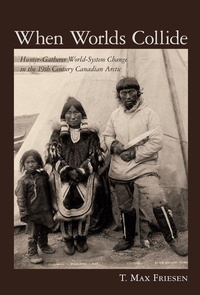
When Worlds Collide
Hunter-Gatherer World-System Change in the 19th Century Canadian Arctic
3rd Edition
Will be published approx. on 30. April 2013
Book
Hardback
256 pages
978-0-8165-0244-8 (ISBN)
Description
Interactions between societies are among the most powerful forces in human history. However, because they are difficult to reconstruct from archaeological data, they have often been overlooked and understudied by understudied by archaeologists. This is particularly true for hunter-gatherer societies, which are frequently seen as adapting to local conditions rather than developing in the context of large-scale networks. When Worlds Collide presents a new model for discerning interaction networks based on the archaeological record, and then applies the model to long-term change in an Arctic society.
Max Friesen has adapted and expanded world-system theory in order to develop a model that explains how hunter-gatherer interaction networks, or world-systems, are structured-and why they change. He has utilized this model to better understand the development of Inuvialuit society in the western Canadian Arctic over a 500-year span, from the pre-contact period to the early twentieth century.
As Friesen combines local archaeological data with more extensive ethnographic and archaeological evidence from the surrounding region, a picture emerges of a dynamic Inuvialuit world-system characterized by bounded territories, trade, warfare, and other forms of interaction. This world-system gradually intensified as the impacts of Euroamerican colonial activities increased. This intensification, Friesen suggests, was based on pre-existing Inuvialuit social and economic structures rather than on patterns imposed from outside. Ultimately, this intense interacting network collapsed near the end of the nineteenth century. When Worlds Collide offers a new way to comprehend small-scale world-systems from the point of view of indigenous people. Its approach will prove valuable for understanding hunter-gatherer societies around the globe.
Max Friesen has adapted and expanded world-system theory in order to develop a model that explains how hunter-gatherer interaction networks, or world-systems, are structured-and why they change. He has utilized this model to better understand the development of Inuvialuit society in the western Canadian Arctic over a 500-year span, from the pre-contact period to the early twentieth century.
As Friesen combines local archaeological data with more extensive ethnographic and archaeological evidence from the surrounding region, a picture emerges of a dynamic Inuvialuit world-system characterized by bounded territories, trade, warfare, and other forms of interaction. This world-system gradually intensified as the impacts of Euroamerican colonial activities increased. This intensification, Friesen suggests, was based on pre-existing Inuvialuit social and economic structures rather than on patterns imposed from outside. Ultimately, this intense interacting network collapsed near the end of the nineteenth century. When Worlds Collide offers a new way to comprehend small-scale world-systems from the point of view of indigenous people. Its approach will prove valuable for understanding hunter-gatherer societies around the globe.
Reviews / Votes
Friesen presents an important and powerful demonstration of an archaeological scientific hypothesis-testing methodology, and he provides an excellent example of a problem-oriented approach to archaeological practice. It should receive attention beyond the confines of its regional content precisely for its rigorous theoretical approach. - Stephen Loring, co-editor of Honoring Our Elders: A History of Eastern Arctic ArchaeologyMore details
Edition
3rd edition
Language
English
Place of publication
Tucson
United States
Product notice
sewn/stitched
Cloth over boards
With dust jacket
Dimensions
Height: 231 mm
Width: 155 mm
Thickness: 25 mm
Weight
522 gr
ISBN-13
978-0-8165-0244-8 (9780816502448)
Copyright in bibliographic data and cover images is held by Nielsen Book Services Limited or by the publishers or by their respective licensors: all rights reserved.
Schweitzer Classification
Person
T. Max Friesen is a professor of archaeology in the Department of Anthropology at the University of Toronto, Canada. He has performed fieldwork in the Arctic for more than twenty years. He is the co-editor of the Oxford Handbook of Arctic Archaeology and has contributed widely to books and journals.