

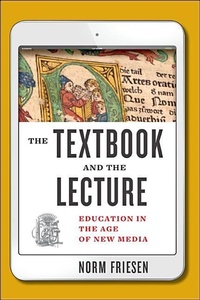
The Textbook and the Lecture
Education in the Age of New Media
Will be published approx. on 9. February 2018
Book
Hardback
192 pages
978-1-4214-2433-0 (ISBN)
Description
Why are the fundamentals of education apparently so little changed in our era of digital technology? Is their obstinate persistence evidence of resilience or obsolescence? Such questions can best be answered not by imagining an uncertain high-tech future, but by examining a well-documented past-a history of instruction and media that extends from Gilgamesh to Google. Norm Friesen looks to the combination and reconfiguration of oral, textual, and more recent media forms to understand the longevity of so many educational arrangements and practices. Friesen examines the interrelationship of reading, writing, and pedagogy in the case of the lecture and the textbook-from their premodern to their postmodern incarnations. Over hundreds of years, these two forms have integrated textual, oral, and (more recently) digital media and connected them with changing pedagogical and cultural priorities. The Textbook and the Lecture opens new possibilities for understanding not only mediated pedagogical practices and their reform but also gradual changes in our conceptions of the knowing subject and of knowledge itself.
Drawing on wide-ranging scholarship in fields as diverse as media ecology and German-language media studies, Foucauldian historiography, and even archaeological research, The Textbook and the Lecture is a fascinating investigation of educational media.
Drawing on wide-ranging scholarship in fields as diverse as media ecology and German-language media studies, Foucauldian historiography, and even archaeological research, The Textbook and the Lecture is a fascinating investigation of educational media.
Reviews / Votes
Through its multiple examples and case studies, The Textbook and the Lecture shows the philosophical assumptions underpinning longstanding debates and serves to inform and perhaps even empower educational workers by helping them understand why they do what they do.-LSE Friesen's book should be attractive to students and instructors of curriculum and instruction as well as instructional designers and educational technology professionals. Educational start-ups and entrepreneurs might fnd it particularly helpful in placing new products in the context of the longue duree of education history.
-Donald Lankiewicz, Emerson College, Publishing Research Quarterly
More details
Series
Language
English
Place of publication
Baltimore, MD
United States
Target group
Professional and scholarly
Product notice
sewn/stitched
Cloth over boards
Illustrations
25 s/w Photographien bzw. Rasterbilder, 5 s/w Zeichnungen
5 Line drawings, black and white; 25 Halftones, black and white
Dimensions
Height: 236 mm
Width: 158 mm
Thickness: 22 mm
Weight
406 gr
ISBN-13
978-1-4214-2433-0 (9781421424330)
DOI
10.1353/book.56899
Copyright in bibliographic data and cover images is held by Nielsen Book Services Limited or by the publishers or by their respective licensors: all rights reserved.
Schweitzer Classification
Other editions
Additional editions
E-Book
02/2018
Johns Hopkins University Press
€24.99
Available for download
Person
Norm Friesen is a professor in the Department of Educational Technology at Boise State University. He is the editor and translator of Forgotten Connections: On Culture and Upbringing and the editor of Media Transatlantic: Media Theory in North America and German-Speaking Europe.
Content
Preface
Part I
1. No More Pencils, No More Books?
2. Writing Instruction in the Twenty-First Century
Part II
3. Psychology and the Rationalist
4. The Romantic Tradition
5. Romantic versus Rationalist Reform
6. Theorizing Media-by the Book
Part III
7. A Textbook Case
8. From Translatio Studiorum to "Intelligences Thinking in Unison"
9. The Lecture as Postmodern Performance
Conclusion
Notes
Bibliography
Index
Part I
1. No More Pencils, No More Books?
2. Writing Instruction in the Twenty-First Century
Part II
3. Psychology and the Rationalist
4. The Romantic Tradition
5. Romantic versus Rationalist Reform
6. Theorizing Media-by the Book
Part III
7. A Textbook Case
8. From Translatio Studiorum to "Intelligences Thinking in Unison"
9. The Lecture as Postmodern Performance
Conclusion
Notes
Bibliography
Index