

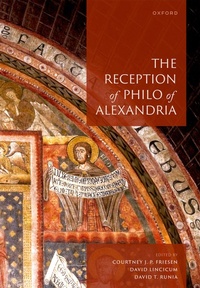
The Reception of Philo of Alexandria
Published on 4. February 2025
Book
Hardback
688 pages
978-0-19-883622-3 (ISBN)
Description
Philo of Alexandria was a Jewish statesman, philosopher, and religious thinker. A significant amount of his literary corpus was preserved by Christian hands and thereby came to resource numerous theologians in the Christian tradition. After passing into obscurity in Jewish circles in antiquity, Philo was rediscovered in the Italian Renaissance and came to feature in Jewish tradition once again. Philo's works straddle an interest in exegesis and philosophy, and the multi-faceted contents of his thought ensured a long history of reception among readers with their own agendas. This authoritative and systematic collection of essays by an international team of experts surveys Philo's reception from the time of his immediate contemporaries to the present day. The book unfolds over six sections: the first centuries, late antiquity, the middle ages, the renaissance and early modern period, from the eighteenth to the twentieth centuries, and contemporary perspectives.
More details
Language
English
Place of publication
Oxford
United Kingdom
Target group
Professional and scholarly
Product notice
sewn/stitched
Cloth over boards
Illustrations
11 black-and-white figures
Dimensions
Height: 249 mm
Width: 180 mm
Thickness: 46 mm
Weight
1372 gr
ISBN-13
978-0-19-883622-3 (9780198836223)
Copyright in bibliographic data and cover images is held by Nielsen Book Services Limited or by the publishers or by their respective licensors: all rights reserved.
Schweitzer Classification
Other editions
Additional editions
Courtney J. P. Friesen | David Lincicum | David T. Runia
The Reception of Philo of Alexandria
E-Book
01/2025
OUP eBook
€132.99
Available for download
Courtney J. P. Friesen | David Lincicum | David T. Runia
The Reception of Philo of Alexandria
E-Book
12/2024
OUP eBook
€132.99
Available for download
Persons
Courtney J. P. Friesen received his Ph.D. in Classical and Near Eastern Studies from the University of Minnesota in 2013 and was Instructor of Greek in the Faculty of Theology and Religion at the University of Oxford from 2013 to 2015. Since 2015 he has been at the University of Arizona and is Associate Professor of Religious Studies and Classics. His first book, Reading Dionysus (2015), explored ancient receptions of Euripides' Bacchae and he has a forthcoming volume entitled Playing Gods, Acting Heroes, and the Interaction between Judaism, Christianity, and Greek Drama in the Early Common Era.
David Lincicum received his D.Phil. in New Testament from the University of Oxford, then served as Departmental Lecturer (2009-2011), Leverhulme Early Career Fellow (2011-2012), and Associate Professor of New Testament Studies (2012-2015) at the University of Oxford, and as G. B. Caird Fellow in Theology at Mansfield College, Oxford (2012-2015) before coming to the University of Notre Dame in 2015, where he is now Associate Professor of Judaism and Christianity in Antiquity.
David T. Runia studied Classics at the University of Melbourne and was awarded the degree of Litt.D. at the Free University, Amsterdam in 1983. He was De Vogel Professor of Ancient and Patristic Philosophy at Utrecht University in 1991-1999, Professor of Ancient and Medieval Philosophy at Leiden University in 1992-2002, Master of Queen's College at the University of Melbourne in 2002-2016, and Director of the Institute for Religion and Critical Inquiry at the Australian Catholic University in 2017-2018. He now lives in retirement in Melbourne, Australia.
David Lincicum received his D.Phil. in New Testament from the University of Oxford, then served as Departmental Lecturer (2009-2011), Leverhulme Early Career Fellow (2011-2012), and Associate Professor of New Testament Studies (2012-2015) at the University of Oxford, and as G. B. Caird Fellow in Theology at Mansfield College, Oxford (2012-2015) before coming to the University of Notre Dame in 2015, where he is now Associate Professor of Judaism and Christianity in Antiquity.
David T. Runia studied Classics at the University of Melbourne and was awarded the degree of Litt.D. at the Free University, Amsterdam in 1983. He was De Vogel Professor of Ancient and Patristic Philosophy at Utrecht University in 1991-1999, Professor of Ancient and Medieval Philosophy at Leiden University in 1992-2002, Master of Queen's College at the University of Melbourne in 2002-2016, and Director of the Institute for Religion and Critical Inquiry at the Australian Catholic University in 2017-2018. He now lives in retirement in Melbourne, Australia.
Editor
Professor, Religious Studies and ClassicsProfessor, Religious Studies and Classics, University of Arizona
Associate Professor of Christianity and Judaism in AntiquityAssociate Professor of Christianity and Judaism in Antiquity, University of Notre Dame
Professorial FellowProfessorial Fellow, The University of Melbourne
Content
Courtney J. P. Friesen, David Lincicum, and David T. Runia: Introduction Part One: The First Centuries 1: Katell Berthelot: Flavius Josephus 2: Torrey Seland: The New Testament 3: James Carleton Paget: Apostolic Fathers and Early Christian Apologists 4: Annewies van den Hoek: Clement of Alexandria 5: Michael B. Cover: Origen of Alexandria 6: M. David Litwa: Gnosticism 7: Gregory E. Sterling: Ancient Platonic Philosophy 8: Steven D. Fraade: Rabbinic Judaism Part Two: Late Antiquity 9: Sabrina Inowlocki: Eusebius 10: Justin Rogers: Didymus the Blind 11: Albert C. Geljon: The Cappadocians 12: Madalina Toca and Johan Leemans: Isidore of Pelusium 13: Maria E. Doerfler: Ambrose 14: Matthew A. Kraus: Jerome 15: Ilaria L. E. Ramelli: Augustine Part Three: The Middle Ages 16: James R. Royse: The Greek and Latin Manuscript Traditions 17: Elke Morlok and Ze'ev Strauss: Medieval Jewish Philosophy and Mysticism 18: Olga Vardazaryan: Armenian Christianity 19: Alexander Treiger: Christian Arabic Literature 20: David T. Runia: Byzantium 21: David T. Runia and Frans van Liere: The Latin West from 500 to 1500 CE Part Four: The Renaissance and Early Modern Period 22: David T. Runia, Gregory E. Sterling and Michael B. Cover: Early Printed Editions of Philo's Works 23: Joanna Weinberg: The Jewish Rediscovery of Philo in Early Modern Europe 24: Eric J. DeMeuse: Post-Tridentine Catholic Thought 25: Giovanni Benedetto: Thomas Mangey and Philonic Scholarship from the Sixteenth to Eighteenth Centuries 26: Dirk Westerkamp: German Philosophy, 1650-1850 Part Five: From the Eighteenth to the Twentieth Centuries 27: David Lincicum: The Rise of New Testament Criticism 28: Ze'ev Strauss: The Jewish Enlightenment (Haskalah) 29: Goerge K. Hasselhoff: The Wissenschaft des Judentums 30: David T. Runia: Modern Literature from the 19th to the 21st Century Part Six: Contemporary Perspectives 31: Courtney J. P. Friesen: Contemporary Receptions and Future Prospects Among Classicists 32: Gretchen Reydams-Schils: Contemporary Receptions and Future Prospects Among Historians of Philosophy 33: Ellen Birnbaum: Contemporary Receptions and Future Prospects Among Scholars of Judaism 34: Mark Edwards: Contemporary Receptions and Future Prospects Among Scholars of Christianity 35: David T. Runia: Bibliographies on Philo Bibliography Index