

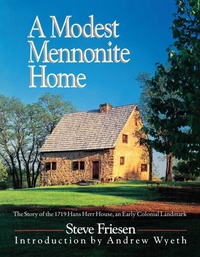
A Modest Mennonite Home
The Story of the 1719 Hans Herr House, an Early Colonial Landmark
Will be published approx. on 1. September 2026
Book
Paperback/Softback
128 pages
978-1-964219-28-8 (ISBN)
Description
A vivid exploration of the 1719 Hans Herr House, a cornerstone of Mennonite heritage in Pennsylvania.
A Modest Mennonite Home by Steve Friesen offers a vivid exploration of the 1719 Hans Herr House, a cornerstone of Mennonite heritage in Pennsylvania. Through detailed chapters, Friesen traces the journey of the Herr family from their Anabaptist roots in Europe, through the trials of migration, to their settlement in the New World. The book delves into the construction and architecture of Christian Herr’s stone house, revealing how its sturdy walls and simple design reflect both the faith and practicality of its builders.
Readers are guided through the daily rhythms of early Mennonite life—market trips, farming, and the use of household spaces like the stube, kammer, and cellar. Friesen’s narrative brings to life the modest furnishings and the spiritual devotion that shaped the home, including its role as a place of worship and print culture. The surrounding landscape, described as “the most charming,” is depicted in its agricultural richness and connection to the community.
The book also chronicles the transformation of the Herr House into a museum, preserving its legacy for future generations. With personal reflections from Andrew Wyeth, whose family ties to the house add emotional depth, A Modest Mennonite Home is both a historical account and a celebration of enduring values—simplicity, faith, and resilience. This richly illustrated volume invites readers to step inside a world where home and heritage are inseparable.
A Modest Mennonite Home by Steve Friesen offers a vivid exploration of the 1719 Hans Herr House, a cornerstone of Mennonite heritage in Pennsylvania. Through detailed chapters, Friesen traces the journey of the Herr family from their Anabaptist roots in Europe, through the trials of migration, to their settlement in the New World. The book delves into the construction and architecture of Christian Herr’s stone house, revealing how its sturdy walls and simple design reflect both the faith and practicality of its builders.
Readers are guided through the daily rhythms of early Mennonite life—market trips, farming, and the use of household spaces like the stube, kammer, and cellar. Friesen’s narrative brings to life the modest furnishings and the spiritual devotion that shaped the home, including its role as a place of worship and print culture. The surrounding landscape, described as “the most charming,” is depicted in its agricultural richness and connection to the community.
The book also chronicles the transformation of the Herr House into a museum, preserving its legacy for future generations. With personal reflections from Andrew Wyeth, whose family ties to the house add emotional depth, A Modest Mennonite Home is both a historical account and a celebration of enduring values—simplicity, faith, and resilience. This richly illustrated volume invites readers to step inside a world where home and heritage are inseparable.
More details
Persons
Steve Friesen was born in Lawrence, Kansas and grew up in the small Kansas town of Buhler. He attended Bethel College, a Mennonite school in North Newton, Kansas, where he received a BA in History and Social Sciences with a minor in Peace Studies. In 1975–76 he attended the Cooperstown Graduate Program of SUNY Oneonta, receiving an MA in American Folk Culture. He has worked at various museums in Colorado, Kansas, and Pennsylvania since 1976. His first book A Modest Mennonite Home was written while he was Director of the 1719 Hans Herr House. It explores 18th century Mennonite/Pennsylvania German history and culture. Following two years as Director of the Molly Brown House Museum in Denver, Friesen moved to the top of Lookout Mountain overlooking Denver. There he became Director of the Buffalo Bill Museum and Grave, a position he has held since 1995.