

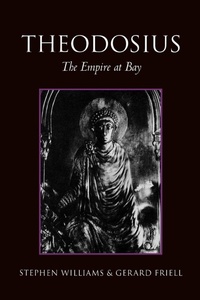
Theodosius
The Empire at Bay
1st Edition
Published on 28. May 1998
Book
Paperback/Softback
246 pages
978-0-415-17040-6 (ISBN)
Description
Emperor Theodosius (379-95) was the last Roman emperor to rule a unified empire of East and West and his reign represents a turning point in the policies and fortunes of the Late Roman Empire. In this imperial biography, Stephen Williams and Gerry Friell bring together literary, archaeological and numismatic evidence concerning this Roman emperor, studying his military and political struggles, which he fought heroically but ultimately in vain.
Summoned from retirement to the throne after the disastrous Roman defeat by the Goths at Adrianople, Theodosius was called on to rebuild the armies and put the shattered state back together. He instituted a new policy towards the barbarians, in which diplomacy played a larger role than military might, at a time of increasing frontier dangers and acute manpower shortage. He was also the founder of the established Apostolic Catholic Church. Unlike other Christian emperors, he suppressed both heresy and paganism and enforced orthodoxy by law.
The path was a diffucult one, but Theodosius (and his successor, Stilicho) had little choice. This new study convincingly demonstrates how a series of political misfortunes led to the separation of the Eastern and Western empires which meant that the overlordship of Rome in Europe dwindled into mere ceremonial. The authors examine the emperor and his character and the state of the Roman empire, putting his reign in the context of the troubled times.
Summoned from retirement to the throne after the disastrous Roman defeat by the Goths at Adrianople, Theodosius was called on to rebuild the armies and put the shattered state back together. He instituted a new policy towards the barbarians, in which diplomacy played a larger role than military might, at a time of increasing frontier dangers and acute manpower shortage. He was also the founder of the established Apostolic Catholic Church. Unlike other Christian emperors, he suppressed both heresy and paganism and enforced orthodoxy by law.
The path was a diffucult one, but Theodosius (and his successor, Stilicho) had little choice. This new study convincingly demonstrates how a series of political misfortunes led to the separation of the Eastern and Western empires which meant that the overlordship of Rome in Europe dwindled into mere ceremonial. The authors examine the emperor and his character and the state of the Roman empire, putting his reign in the context of the troubled times.
More details
Series
Language
English
Place of publication
London
United Kingdom
Publishing group
Taylor & Francis Ltd
Target group
College/higher education
Undergraduate
Dimensions
Height: 234 mm
Width: 156 mm
Thickness: 14 mm
Weight
383 gr
ISBN-13
978-0-415-17040-6 (9780415170406)
Copyright in bibliographic data and cover images is held by Nielsen Book Services Limited or by the publishers or by their respective licensors: all rights reserved.
Schweitzer Classification
Other editions
Additional editions
E-Book
08/2005
Routledge
€55.49
Available for download
E-Book
08/2005
Routledge
€55.49
Available for download

Book
07/1994
1st Edition
Batsford
€88.19
Article exhausted; check different version
Persons
Gerard Friell, Stephen Williams
Content
List of plates List of maps Acknowledgements Part 1: 1. Adrianople and After 2. The Burdens of Empire 3. Imperial Divisions 4. Catholic Ascendancy 5. Victory in the West Part 2: 6. The War Machine 7. The Barbarian Settlements: from Laeti to Foederati 8. The Topheavy Empire Part 3: 9. Contra Paganos 10. Triumph and Death Part 4: 11. Stilicho: Last Guardian of a United Empire 12. The Inevitable? Maps Appendices I The Battle of Adrianople II The Roman Army in the Later Fourth Century III Dynastic Stemmata: Valentinian and Theodosius IV Barbarian Settlements V Fourth-Century Barbarians in the Roman Army References and Notes Bibliography Index