

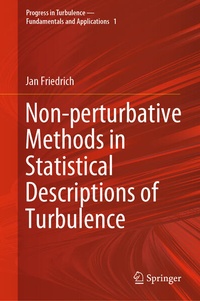
Non-perturbative Methods in Statistical Descriptions of Turbulence
Published on 26. September 2020
Book
Hardback
XI, 164 pages
978-3-030-51976-6 (ISBN)
Description
This book provides a comprehensive overview of statistical descriptions of turbulent flows. Its main objectives are to point out why ordinary perturbative treatments of the Navier-Stokes equation have been rather futile, and to present recent advances in non-perturbative treatments, e.g., the instanton method and a stochastic interpretation of turbulent energy transfer. After a brief introduction to the basic equations of turbulent fluid motion, the book outlines a probabilistic treatment of the Navier-Stokes equation and chiefly focuses on the emergence of a multi-point hierarchy and the notion of the closure problem of turbulence. Furthermore, empirically observed multiscaling features and their impact on possible closure methods are discussed, and each is put into the context of its original field of use, e.g., the renormalization group method is addressed in relation to the theory of critical phenomena. The intended readership consists of physicists and engineers who wantto get acquainted with the prevalent concepts and methods in this research area.
More details
Series
Edition
2021 ed.
Language
English
Place of publication
Cham
Switzerland
Publishing group
Springer International Publishing
Target group
Professional and scholarly
Illustrations
42 s/w Abbildungen, 11 farbige Abbildungen
XI, 164 p. 53 illus., 11 illus. in color.
Dimensions
Height: 241 mm
Width: 160 mm
Thickness: 16 mm
Weight
436 gr
ISBN-13
978-3-030-51976-6 (9783030519766)
DOI
10.1007/978-3-030-51977-3
Schweitzer Classification
Other editions
Additional editions
Book
09/2021
Springer
€160.49
Shipment within 7-9 days
E-Book
09/2020
1st Edition
Springer
€149.79
Available for download
Content
Introduction.- Basic Properties of Hydrodynamic Turbulence.- Statistical Formulation of the Problem of Turbulence.- Overview of Closure Methods for the Closure Problem of Turbulence.- Non-Perturbative Methods.- Outlook.