

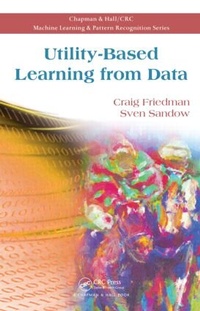
Utility-Based Learning from Data
1st Edition
Will be published approx. on 12. August 2010
Book
Hardback
418 pages
978-1-58488-622-8 (ISBN)
Description
Utility-Based Learning from Data provides a pedagogical, self-contained discussion of probability estimation methods via a coherent approach from the viewpoint of a decision maker who acts in an uncertain environment. This approach is motivated by the idea that probabilistic models are usually not learned for their own sake; rather, they are used to make decisions. Specifically, the authors adopt the point of view of a decision maker who
(i) operates in an uncertain environment where the consequences of every possible outcome are explicitly monetized,
(ii) bases his decisions on a probabilistic model, and
(iii) builds and assesses his models accordingly.
These assumptions are naturally expressed in the language of utility theory, which is well known from finance and decision theory. By taking this point of view, the book sheds light on and generalizes some popular statistical learning approaches, connecting ideas from information theory, statistics, and finance. It strikes a balance between rigor and intuition, conveying the main ideas to as wide an audience as possible.
(i) operates in an uncertain environment where the consequences of every possible outcome are explicitly monetized,
(ii) bases his decisions on a probabilistic model, and
(iii) builds and assesses his models accordingly.
These assumptions are naturally expressed in the language of utility theory, which is well known from finance and decision theory. By taking this point of view, the book sheds light on and generalizes some popular statistical learning approaches, connecting ideas from information theory, statistics, and finance. It strikes a balance between rigor and intuition, conveying the main ideas to as wide an audience as possible.
Reviews / Votes
Utility-Based Learning from Data is an excellent treatment of data-driven statistics for decision-making. Friedman and Sandow lucidly describe the connections between different branches of statistics and econometrics, such as utility theory, maximum entropy, and Bayesian analysis. A must-read for serious statisticians! -Marco Avellaneda, Professor of Mathematics, New York University, and Risk Magazine Quant of the Year 2010 Combining insights from both theory and practice, this is a model trade book about modeling trading books. -Peter Carr, Global Head of Market Modeling, Morgan Stanley, and Executive Director, Masters in Math Finance, New York University Utility-Based Learning from Data connects key ideas from utility theory with methods from statistics, machine learning, and information theory. It presents, using decision-theoretic principles, a framework for building models that can be used by decision makers. By adopting the utility-based approach, Friedman and Sandow are able to adapt models to the risk preferences of the model user, while maintaining tractability. It is a much-needed and comprehensive book, which should help put model-building for use by decision makers on more solid ground. -Gregory Piatetsky-Shapiro, editor of KDnuggets.com, co-founder and past Chair of SIGKDD, and founder of the Knowledge Discovery and Data Mining (KDD) conferencesMore details
Series
Language
English
Place of publication
Oxford
United States
Publishing group
Taylor & Francis Inc
Target group
College/higher education
Computer scientists, statisticians, and applied mathematicians in statistical and machine learning; graduate students and researchers in machine learning, financial mathematics, mathematical economics, econometrics, and financial engineering; electrical engineers in communications.
Illustrations
34 b/w images and 12 tables
Dimensions
Height: 234 mm
Width: 156 mm
Weight
725 gr
ISBN-13
978-1-58488-622-8 (9781584886228)
Copyright in bibliographic data and cover images is held by Nielsen Book Services Limited or by the publishers or by their respective licensors: all rights reserved.
Schweitzer Classification
Other editions
Additional editions
Craig Friedman | Sven Sandow
Utility-Based Learning from Data
Book
11/2019
1st Edition
Chapman & Hall/CRC
€51.98
Shipment within 15-20 days
Craig Friedman | Sven Sandow
Utility-Based Learning from Data
E-Book
04/2016
Chapman & Hall/CRC
€55.49
Available for download
Craig Friedman | Sven Sandow
Utility-Based Learning from Data
E-Book
04/2016
1st Edition
Chapman & Hall/CRC
€55.49
Available for download
Persons
Craig Friedman is a managing director and head of research in the Quantitative Analytics group at Standard & Poor's in New York. Dr. Friedman is also a fellow of New York University's Courant Institute of Mathematical Sciences. He is an associate editor of both the International Journal of Theoretical and Applied Finance and the Journal of Credit Risk.
Sven Sandow is an executive director in risk management at Morgan Stanley in New York. Dr. Sandow is also a fellow of New York University's Courant Institute of Mathematical Sciences. He holds a Ph.D. in physics and has published articles in scientific journals on various topics in physics, finance, statistics, and machine learning.
The contents of this book are Dr. Sandow's opinions and do not represent Morgan Stanley.
Sven Sandow is an executive director in risk management at Morgan Stanley in New York. Dr. Sandow is also a fellow of New York University's Courant Institute of Mathematical Sciences. He holds a Ph.D. in physics and has published articles in scientific journals on various topics in physics, finance, statistics, and machine learning.
The contents of this book are Dr. Sandow's opinions and do not represent Morgan Stanley.
Content
Introduction. Mathematical Preliminaries. The Horse Race. Elements of Utility Theory. The Horse Race and Utility. Select Methods for Measuring Model Performance. A Utility-Based Approach to Information Theory. Utility-Based Model Performance Measurement. Select Methods for Estimating Probabilistic Models. A Utility-Based Approach to Probability Estimation. Extensions. Select Applications. References. Index.